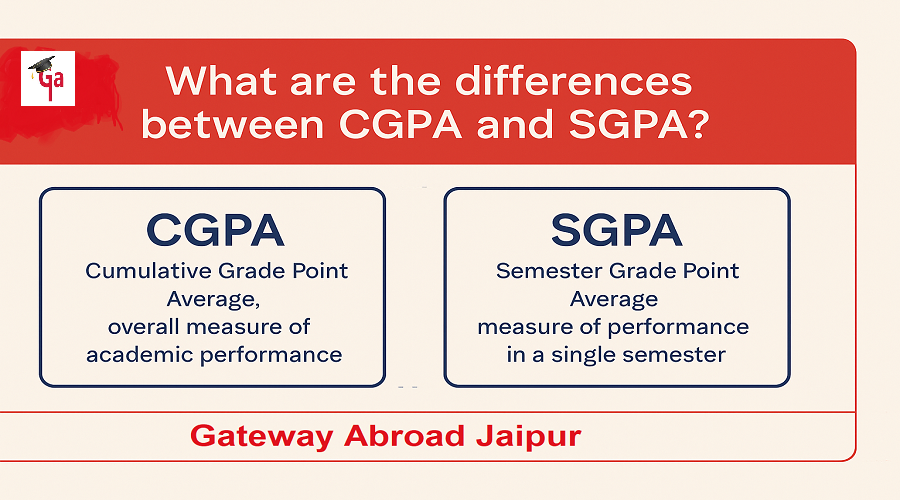
The two most widely used grading schemes worldwide for assessing academic performance in schools, colleges, and universities are CGPA and SGPA. Although a student's academic success is measured using both terms, their definitions and calculation methods differ.
This guide will clarify the meaning, calculation process, and main distinctions between CGPA and SGPA.
The weighted average of a student's subject grades for a semester determines the semester grade point average (SGPA). SGPA shows how well a student performed on average throughout that term.
The formula to calculate SGPA is:
|
SGPA= |
∑(CreditPoints×GradePoints) |
|
∑(CreditPoints) |
Were,
Before calculating the total, grade points are multiplied by credits. For every subject, the credit total is computed independently. The SGPA for a particular semester is then calculated after taking into consideration both of these factors.
|
Subject |
Grade Points |
Credits |
Total (Grade Points × Credits) |
|
Math |
9 |
4 |
36 |
|
Science |
8 |
3 |
24 |
|
English |
7 |
2 |
14 |
Total Credits = 4 + 3 + 2 = 9
Total Points = 36 + 24 + 14 = 74
SGPA=74/9=8.22
SGPA = \frac {74}{9} = 8.22
SGPA=97/4=8.22
The cumulative grade point average, or CGPA, is the average of the SGPAs obtained for a semester. It symbolizes a student's overall academic achievement during the program.
|
CGPA = |
∑(SGPA× Semester Credits) |
|
∑(Total Semester Credits) |
|
Semester |
SGPA |
Total Credits |
|
Semester 1 |
8.22 |
25 |
|
Semester 2 |
7.85 |
24 |
|
Semester 3 |
8.10 |
26 |
Total Credits = 25 + 24 + 26 = 75
CGPA= (8.22×25) +(7.85×24) +(8.10×26)/ 75
CGPA=205.5+188.4+210.6/75=604.5/75=8.06
To assess an applicant's academic achievement, universities and other educational organizations utilize the CGPA (Cumulative Grade Point Average) and SGPA (Semester Grade Point Average) marking schemes. However, they gauge efficiency, breadth, time frame, and methodology.
Full form-
Definition-
Scope-
Duration-
Significance-
Method of calculation-
|
Aspect |
SGPA |
CGPA |
|
Time Frame |
Single Semester |
Entire Course Duration |
|
Calculation |
Average of one semester's grades |
Average of all semesters' grades |
|
Frequency |
Calculated after each semester |
Calculated at the end of the course |
|
Purpose |
Short-term academic performance |
Overall academic performance |
|
Importance |
Helps monitor semester progress |
Used for final academic evaluation and admissions |
Using the appropriate SGPA and CGPA calculator is crucial to guarantee an accurate assessment of academic performance. Many students utilize online calculators to avoid doing calculations by hand; nevertheless, using the incorrect calculator or misusing it can produce unreliable results. When selecting an SGPA and CGPA calculator, you should steer clear of the following typical mistakes-
Choose a calculator that offers the option to select your grading system.
Despite their significant differences, SGPA and CGPA serve the same function at the year's or semester's end. Realizing that these two indicators are still calculated independently, they are employed for a few similar objectives.
Although SGPA and CGPA are significant indicators for assessing academic achievement, they have different uses. While CGPA thoroughly evaluates the educational journey, SGPA only considers short-term performance.
Universities frequently request your CGPA as a standard indicator of your academic performance when you apply for higher education overseas. Comprehending the distinction between these two will enable you to showcase your educational record appropriately.
Ans- Semester Grade Point Average (SGPA) and Cumulative Grade Point Average (CGPA) are two different acronyms.
Ans- SGPA represents the average grade points earned in a single semester, while CGPA represents the overall grade points earned across all semesters.
Ans- CGPA is more critical as it reflects the student's overall academic performance throughout the entire course.
Ans- SGPA is calculated by dividing the total grade points earned in a semester by the total credit points of that semester.
Ans- CGPA is calculated by averaging the SGPAs of all semesters, weighted by the total credit points of each semester.
Ans- CGPA is the average of all SGPAs earned during the course.
Ans- No, CGPA is typically calculated only at the end of the entire course.
Ans- The grading systems vary across universities and countries, so CGPA and SGPA calculation methods may differ.
Ans- Most universities prefer CGPA to evaluate students' academic performance during international admissions.
Ans- Most universities follow a standard conversion formula to calculate percentages from CGPA or SGPA.
Author
Content Writer & International Education Specialist
Sakshi Taneja is a content writer specializing in international education, study abroad opportunities, university admissions, student visas, scholarships, and career guidance. She creates accurate, research-driven, and student-focused content to help aspiring international students make informed decisions about their global education journey.
No comments yet
Be the first to share your thoughts!
Please provide your contact information
Free Counselling

9/21/2026

2/26/2026

11/3/2025

11/3/2025

10/27/2025
Want some help figuring out what kind of prep service is right for you?
Help and Support

Leave a Comment
Your email address will not be published.