
British vs. American vs. Australian English: Accents, Slang & Spelling Compared
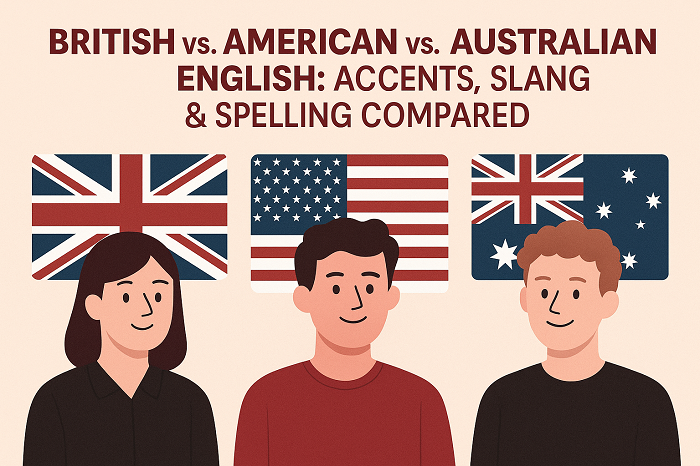
English is a global language with impressive diversity. Beyond spelling, grammar, and vocabulary, the phonetics and accents vary significantly in British, American, and Australian English. Understanding these differences is not just academic; it is essential for confident communication when living, studying, or working abroad. This guide explores how these accents differ, why they evolved, and how learners can adapt through practical strategies.
A quick summary of origins and historical context to understand regional English variations-
British English
Rooted in Old and Middle English, the Norman Conquest further shaped it, which was later reinforced by print and Received Pronunciation (RP) in the 19th century. Students interested in the British education system can also explore opportunities to study in UK.
RP, also known as “the Queen’s English,” is non‑rhotic (no pronounced “r” at the word end), with precise enunciation and long vowels.
American English
Developed distinct features after colonization, embracing rhotic pronunciation (“r” pronounced in all positions). Students planning to pursue their education in the country can also explore opportunities to study in USA.
Regional dialects, such as General American, Southern, New York, etc., exhibit marked variations in vowel sounds, intonation, and tempo.
Australian English
Originates from 18th-century settlers but soon diverged, developing unique vowel shifts and non-rhotic patterns. Students interested in Australian education can also explore opportunities to study in Australia.
Sub‑dialects include Broad (e.g., Steve Irwin), General (Hugh Jackman), and Cultivated (Cate Blanchett), each with subtle differences.
How do you explain the pronunciation and accent features of regional English variations?
Here’s a clearer and more structured explanation of pronunciation and accent features in regional English variations focusing on British (RP and regional), American (General American), and Australian English to help your students grasp and adapt effectively-
Rhoticity: To “r” or not to “r”
American English is strongly rhotic: words like “car” [kɑːr] and “water” [ˈwɑtər] pronounce the final “r.”
British RP and most Australian English are non-rhotic: “car” becomes [kɑː], and “water” [ˈwɔːtə], with only linking “r” if the next word begins with a vowel.
Vowel Quality and Diphthongs
Australian English often features flattened vowels and extended diphthongs; e.g., “day” may sound like “die," while “night” has a nasal edge.
The trap–bath split: Words like “bath,” “laugh,” and “grass” shift from short [æ] to broader [ɑː] in British RP and Australian accents.
American English has clear, short vowels and often employs the “flap t” (e.g., “butter” becomes [ˈbʌɾər]).
Diphthongs and Vowel Shifts
Australian English has flatter, more nasal diphthongs-
Understanding a Diphthong can also help learners recognize how vowel sounds change within a single syllable across different English accents.
§ Day might sound closer to /daɪ/ (“die”)
§ No can be triphthongized: /nəʊ/ → /nəʊʊ/
American English features clear diphthongs-
Go (/goʊ/) and vowel raising before nasals: man, /meən/ vs British /mæn/Consonants and Intonation
British RP maintains precise, elongated vowels contrasted against flattened American diphthongs
Consonants and Intonation
Understanding Consonants and Vowels can also help explain why pronunciation varies across British, American, and Australian English.
T-glottalization (British non-rhotic dialects) sees “t” in “better” become a glottal stop [ʔ]: “beh-uh”
American employs a “hard T” or flap: “water” sounds like “wadder”
Australian English also shares some non‑rhotic and glottal characteristics, though typically clearer than Cockney.
Intonation Patterns
British RP: Generally flat or falling intonation—formal and measured.
American: Varied; clear downbeats, sometimes uptalk at phrase ends.
Australian: Characterized by “upspeak”—rising intonation at sentence ends, perceived as casual or friendly.
Resonance and Mouth Positioning
American: Resonance tends to sit in the middle of the mouth—clear, balanced.
Australian: More back-of-mouth resonance, sometimes nasal quality due to jaw posture; vowels are “slippery”.
British RP: Often taught with forward mouth focus tip and teeth for precision.
Summary Table
Feature | American (GenAm) | British (RP) | Australian English |
Rhoticity | Rhotic | Non-rhotic | Non-rhotic, intrusive r |
Trap–Bath | /æ/ | /ɑː/ | /ɑː/ |
T Pronunciation | Flap [ɾ] | Glottal stop [ʔ] | Flap + mild glottal = |
Vowel Shifts | Clear diphthongs | Precise monophthongs | Flat, nasal diphthongs |
Intonation | Varied, stress-rich | Falling melodic | Rising “upspeak” |
Resonance/Mouth | Middle, open | Tip-focused | Back, tight, flat |
Explain vocabulary and slang of Regional English Variations-
Core Differences
British vs. American: lift/elevator, lorry/truck, flat/apartment, biscuit/cookie.
Australian English shares overlap, yet has unique terms: footpath (US sidewalk, UK pavement), capsicum (bell pepper), doonah (comforter), servo (gas station), arvo (afternoon).
British English vocabulary and slang-
Cuppa – “cup of tea” (e.g., “Fancy a cuppa?”)
Bloke / Lad – roughly guy, dude (bloke used more broadly than lad)
Quid – pound sterling (“That cost me 20 quid.”)
Dodgy – suspicious or shoddy (“That deal sounds dodgy.”)
Bevvy – alcoholic drink (“Fancy a bevvy later?”)
Fiver / Tenner – £5 / £10 note
Innit – colloquial for “isn’t it?”, common in informal speech
Key things to note- Many traditional British terms are declining among Gen Z, who often prefer Americanisms.
American English vocabulary and slang
Awesome, cool – common informal affirmations (“That’s awesome!”)
Hang out – spend time casually (“Let’s hang out later.”)
Bail – leave abruptly (“He bailed on us.”)
Crash – fall asleep or stay over somewhere (“I crashed early.”)
Cookie – sweet baked snack (UK calls this “biscuit”)
Apartment – housing unit (UK: flat)
Truck – large vehicle (UK: lorry)
These expressions typically carry informal, casual tones across everyday conversations.
Australian English: A Fresh Slang World
Australia’s regional slang is colorful and deeply embedded in daily life. Two main patterns emerge:
Diminutives (Nicknames)-
Australians love abbreviations, often adding -o, -ie/-y, -s endings:
Barbie = barbecue
Arvo = afternoon
Brekky = breakfast
Sunnies = sunglasses
Bikkie = biscuit
Servo = service station (gas station)
Aussie = Australian; Ute = utility vehicle
Here is a quick comparison table of accent variations in regional English-
Item | British | American | Australian |
Elevator | Lift | Elevator | Lift |
Biscuit (snack) | Biscuit | Cookie | Biscuit/Bikkie |
Gas Station | Petrol Station | Gas Station | Servo |
Football | Football (soccer) | Soccer | Footy (AFL/Rugby) |
Shorts/Thong (flip-flops) | N/A | Thong (underwear) | Thongs (flip-flops) |
How do you understand slang and idioms in regional English variations?
What are slang and idioms?
Slang: Informal words or phrases specific to communities (e.g., bogan, awesome).
Idioms: Expressions whose meanings can’t be guessed literally (e.g., take a rain check).
Both reflect culture, humor, and regional identity.
Why do they vary regionally?
Slang and idioms evolve with regional culture, daily life, and values. Learning Slang and Idioms can make it easier to understand informal conversations and everyday expressions used by native speakers.
E.g., southern US’s pop vs northeaster n’s soda, Australian fair dinkum vs UK irony.
Examples by region-
British English-
- Irony and understatement are key: e.g., “Oh, brilliant” can mean the opposite.
Common slang-
- bungalow = detached house,
- bobby = police officer,
- regional pride shows in terms of Manchester or Scouse dialect
American English-
- Regional diversity-
- North: faucet; South: spigot.
- US-wide: awesome, hang out, cookie
- African-American Vernacular English (AAVE) adds terms like “dig,” “main squeeze,” and “chill out.”
Australian English-
- Diminutives: barbie (barbecue), arvo (afternoon), sunnies.
- True Aussie terms-
- fair dinkum (genuine), g’day, mosmie (mosquito), bogan
- Regional slang: WA’s verge (nature strip), home open (open house)
What about spelling variations in regional English variations?
1.“‑or” vs “‑our”-
American English drops the u, e.g., color, honor, labor.
British & Australian English retain it: colour, honour, labour
2. “‑re” vs “‑er” (French‑derived words)-
British/Australian: centre, theatre, metre
American: center, theater, meter
3. “‑ise” vs “‑ize” and “‑yse” vs “‑yze”-
American: organize, analyze
British/Australian: typically organise, analyse—though Oxford spelling allows “‑ize” based on etymology
Australian uses “‑yse” in words like analyse, not “‑yze”
4. Doubling final consonants: “‑l” vs “‑ll”-
Americans often use a single “l”: traveled, canceled, fueling.
British/Australian double the “l”: travelled, cancelled, fuelling.
5. “‑ce” vs “‑se” (noun vs verb distinction)-
British-
Noun: practice, licence, defence
Verb: practise, license, defend
American: same forms for noun and verb (practice, license, defense).
6. Vowel patterns: “‑ae/oe” vs “‑e”-
British: paediatrics, oestrogen, analogue
American: pediatrics, estrogen, analog
Australian: retains “‑ae/oe” but varies; for example, analogue is accepted, but analog is also listed.
Table of other frequent differences-
Pattern | British/Australian | American |
Jewellery | jewellery | jewelry |
Litre / Centre | litre, centre | liter, center |
Pyjamas | pyjamas | pajamas |
Grey | grey | gray |
Aluminium | aluminium | aluminum |
Dialogue vs. Dialog | dialogue | dialog |
What about grammar nuances regional English variations?
While core grammar remains consistent across dialects, a few subtle differences are noteworthy:
Past Tense Forms-
The use of Past Tense forms differs slightly across regions. US tends to use “gotten” (get–got–gotten), while UK/Australia prefer “got”.
UK/Australia often use “learnt,” whereas the US prefers “learned”.
Present Perfect vs Simple Past-
UK/Australia: “I have just eaten.”
US: “I just ate.”
Collective Nouns-
UK: "The team are playing well."
US/Australia: "The team is playing well."
Auxiliary Preferences-
UK: "Shall we have a cuppa?"
US: "Should we get a cup of coffee?"
These distinctions, though small, shape tone perception and grammatical correctness in different regions.
Explain mutual intelligibility in Regional English Variations-
Mutual intelligibility describes how well speakers of different English dialects, like British, American, and Australian English, can understand one another without special study. Key factors include pronunciation, familiarity, exposure, and context.
- Understanding mutual intelligibility- Mutual intelligibility is not an all-or-nothing concept but a spectrum of understanding. Variations in accent, vocabulary, and idiom can slow comprehension, but speakers generally understand one another with some effort.
- High mutual intelligibility among major varieties-
- British, American, and Australian English are highly mutually intelligible, remaining the same language despite regional differences.
- Comprehension scores between British and American speakers on familiar sentences are around 80–90%.
- Differences are mainly pronunciation, slang, and regional idioms rather than grammatical structure.
Why are some varieties harder to understand?
Pronunciation differences-
Accents—such as non-rhotic (UK/Aus) vs. rhotic (US), glottal stops, flapped T, and diphthongs—can make speech less transparent.
The Cockney or Northern Irish accent may be harder for unfamiliar listeners.
Vocabulary and idiom differences-
Words like boot (UK car trunk) vs boot (footwear) and idioms like fair dinkum (Aus) or raining cats and dogs (UK) may cause momentary confusion.
Cultural experience and exposure-
Regular exposure through media, travel, or interaction—enhances comprehension.
Americans, for instance, often understand British English better than vice versa due to global exposure to US media.
Real-Life Examples: Actors as Case Studies
Actors often need precise accents to portray characters authentically:
Australian accent training often requires coaches because it's challenging: flat mouth, non‑rhotic vowels, intrusive “r” (e.g., “law and order” → “law rand ord-ah”).
Productions featuring American actors adopting Australian accents—including Kaitlyn Dever and Cosmo Jarvis—show the difficulty and craft behind accent acquisition.
Dialect training focuses on mouth placement, vowel adjustments, and exposure to accent variation.
These high-level practices offer insight into how learners can train their ears and tongue.
Which should be used to adapt regional English variations?
Adapting to regional English requires deliberate effort. Here are proven strategies-
Active listening and shadowing-
Engage with radio, podcasts, movies, or YouTube from target regions (e.g., BBC for the UK, NPR or TV for the US, and Aussie dramas).
Use shadowing repeat segments aloud to internalize rhythm and pronunciation.
Phonetics and IPA-
Learn IPA symbols to distinguish sounds like /æ/ (cat), /ɑː/ (bath), and /ɔː/ (thought).
The study features the trap–bath split.
Intensive accent work-
- Focus on region-specific traits-
- Australian: Practice non-rhotic speech, intrusive r (“I saw it”), and lengthened diphthongs.
- British RP: Use glottal stops, maintain ‘schwa’ endings, and drop “r.”
- American: Ensure strong rhotic r’s, use flap t’s, and apply General American intonation.
Media immersion and subtitles-
Start with subtitles to align sound with text, then transition to unsub-titled audio as familiarity grows.
Choose region-specific content: British dramas, American sitcoms, Australian wildlife shows.
Vocabulary Journals-
Keep a regional vocabulary list—e.g., “lorry/truck,” “servo,” and “arvo.”
Track idiomatic and slang differences across contexts.
Speak with native speakers-
Use language exchange apps or local tutors.
Imitate natural speech: “cup of tea” (UK), “a cup of joe” (US), “a cuppa” (Australia).
Accent coaching (Optional)-
For advanced learners or actors, dialect coaches can fine-tune prosody and mouth shape—mirroring professional accent acquisition.
Why do regional English variations matter?
Understanding and adapting to regional English benefits learners in crucial contexts:
Professional Edge-
Job interviews benefit from local accents, colloquialisms, and appropriate registers.
Avoid confusion: e.g., “pants” means trousers in the US/Aus, but underwear in the UK.
Academic Success-
Spelling consistency matters: American papers should use "color," British papers "colour."
Grammar choices (e.g., present perfect vs simple past) align with academic norms.
Travel Ease-
Understanding locals enhances experiences: asking for a “lorry” or “truck,” or “Maccas” or “McDonald’s.”
Being aware of non‑rhotic pronunciation and vocabulary helps comprehension.
Cultural Connection-
Using idioms and slang fosters rapport: “mate” (Aus/UK), “awesome” (US), and “bloody” (UK).
It makes learners sound more natural and approachable.
What are the common challenges to understanding regional English variations?
Pronunciation and phonetic variations-
Vowel and consonant shifts: Word sounds change—e.g., the "a" in cat or the "r" usage in car differs across accents.
Connected speech: Native accents often link, blend, or drop sounds—"going to" becomes “gonna,” “don't know” turns into “dunno,” for example—which can hinder comprehension.
Rapid or casual pace: Regional accents, such as Australian or Scottish, may be spoken quickly or casually, making them hard to follow.
Accent-specific features-
Glottal stops, h-dropping, th-fronting: In accents like Cockney or regional British, t may be glottal, or h may be dropped (e.g., “‘arm” for “harm”), and th becomes f/v—leading to confusion.
Intonation and rhythm: Some accents have distinctive patterns, like Australian "upspeak" or Southern US drawl, which further complicate comprehension.
Regional vocabulary and idioms-
Unique terms: Words like servo (Aus), bobby (UK), pop vs soda (US), double-double (Canada), robot for traffic light (SA).
Idiomatic expressions: Phrases such as "no worries," "fair dinkum," and "pain in the neck" rely on context and familiarity.
Academic and social contexts-
Speed and complexity: In lectures or group conversations (like Liverpool accents), non-native learners may struggle. Seventy percent of students took 1–6 months to adapt.
Accent bias and discrimination: Speakers with strong regional accents may face negative judgments or misunderstandings, especially in academic or professional settings.
Cognitive and psychological barriers-
Self-doubt and anxiety: Learners often feel embarrassment or frustration, hindering comprehension and willingness to engage.
Accent perception biases: People unconsciously attach social status or intelligence to accents, affecting interactions, a phenomenon known as linguistic prejudice.
Common challenges and solutions
Challenge | Why It Matters | Suggested Fix |
Dropping the “r” in non-rhotic accents | Miscommunications: “water” as “wata” may confuse non-locals | Drill non-rhotic speech and linking-r usage |
Mispronouncing trap–bath words | “bath” as “bæθ” sounds odd in British/Australian contexts | Practice elongated “bɑːθ” using minimal pairs |
Over-Rhotic American accent in UK/Aus | Words like “water” stand out as non-native | Train mouth relaxation, avoid final “r” |
Spelling inconsistencies | Academic or formal writing penalties | Use US: "favorite," "organize"; UK/Aus: "favourite," "organise" |
Incorrect tense usage | Affects tone and correctness in writing/speaking | Learn regional verb forms (learnt/learned, got/gotten) |
Intonation misfires | Can unintentionally express uncertainty or sarcasm | Record and compare phrase intonation across regions |
What should be practice routines to overcome regional English variations?
Daily
10 minutes of shadowing (choose region).
5–10 new words/slang per region in your vocabulary notebook.
Listen to a short podcast or radio clip.
Weekly
Speak for 10 minutes in the role of an interviewer (US), travel vlogger (UK), or café barista (Aus).
Watch a regional show: Rick Stein (UK), Friends (US), Bluey, or Wellmania (Aus).
Monthly
Get feedback via native speaker exchange.
Record yourself reading and compare it to native audio.
Immersion Trip
Visit the country or region.
Focus on public interaction, such as buying groceries and chatting with baristas.
Use role-play before travel.
Final tips for students-
Set realistic goals: Aim for clarity, not perfection.
Focus on high-impact features: Pronunciation, vocabulary, and grammar.
Prioritize listening: Passive exposure builds familiarity.
Be open to correction: Feedback is key.
Blend accents if needed: A neutral General American or soft RP often works best in global settings.
Have fun! Learning slang and accent quirks enriches the experience.
Conclusion-
Mastering regional English accents is a rewarding journey that enhances fluency, comprehension, and connection. By immersing yourself in regional media, finetuning pronunciation, learning slang, and seeking feedback, you can speak and understand English in any cultural context, whether sipping tea in London, ordering coffee in New York, or greeting mates in Sydney.
FAQs-
Q.1 What’s the biggest accent difference I should prepare for?
Ans- Focus on rhoticity—American English pronounces all “r” sounds (e.g., car = /kɑr/), whereas British RP and Australian drop the final “r” unless followed by a vowel (e.g., car = /kɑː/).
Q.2 How important are vowel sounds and diphthongs?
Ans- Very. Australian English elongates vowels—"day" can sound like “die”—and British English emphasizes clear, precise vowels. Students should practice these subtle shifts for better listening and speaking.
Q.3 What about regional consonant features?
Ans- You will encounter features like-
Glottal stops in British accents (e.g., bottle → boʔle),
Flapped “t” in American and Australian accents (e.g., butter → budder)
Q.4 How do you handle slang and idioms?
Ans- Each region has unique terms:
UK: knackered = tired,
US: awesome,
Aus: buggered = exhausted
Watch local shows, keep a slang journal, and ask native speakers for meaning and tone.
Q.5 Will you understand all dialects easily?
Ans- Major accents, such as General American, British RP, and General Australian, are highly mutually intelligible. However, strong regional variants like Liverpool’s Scouse, rural Southern US, or thick Aussie Isles may take more exposure.
Q.6 How can you improve understanding across accents?
Ans- Effective strategies-
Shadow recordings (repeat what you hear),
Use subtitles initially,
Practice minimal pairs (e.g., water across accents),
Listen to media from different English regions.
Q.7 Will you sound native if you mimic these accents?
Ans- Sounding native-level takes practice. However, adopting key features like vowel length, “r” use, and intonation can greatly improve clarity and authenticity. Accent reduction coaching can help refine your performance.
Author
Sakshi Taneja
Content Writer & International Education Specialist
Sakshi Taneja is a content writer specializing in international education, study abroad opportunities, university admissions, student visas, scholarships, and career guidance. She creates accurate, research-driven, and student-focused content to help aspiring international students make informed decisions about their global education journey.
Comments (0)
No comments yet
Be the first to share your thoughts!
Contact Details
Please provide your contact information
Free Counselling
Similar Blogs

Top 10 Universities in Germany
9/21/2026

How to become a great Communicator?
2/26/2026

Preparing for TOEFL Speaking Scoring section: Key Skills and Practice Techniques
11/3/2025

Educational loan for study abroad: Everyone Should Know in 2026
11/3/2025

Form I-20 Explained: Start Your U.S. Study Journey with Confidence
10/27/2025
Have a question about GMAT?
Want some help figuring out what kind of prep service is right for you?
Help and Support
Leave a Comment
Your email address will not be published.