
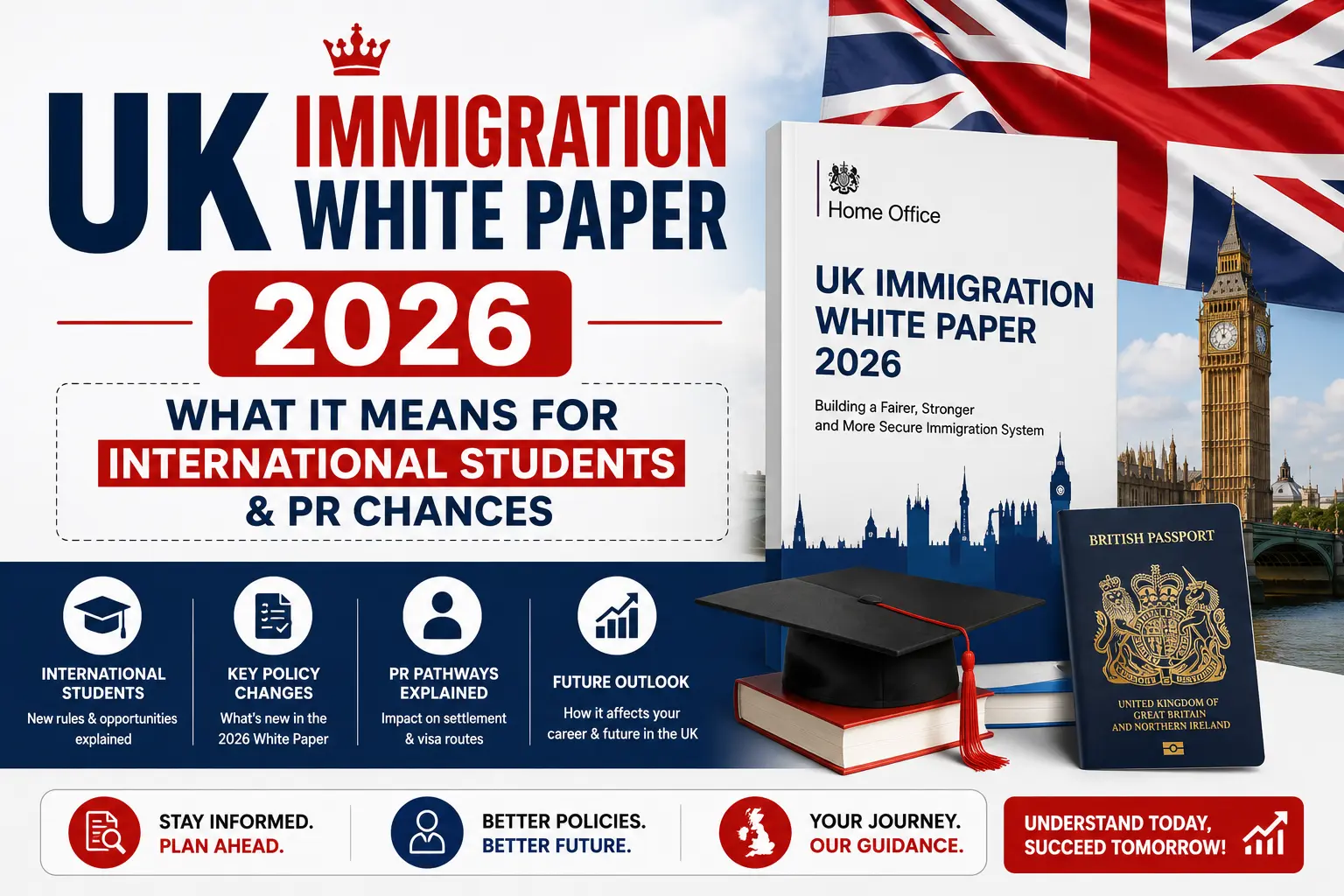
The UK Immigration White Paper 2026 sends a clear signal: the government wants to control migration while still welcoming skilled global talent. This shift directly impacts international students, who make up a large share of migrants in the UK. Whether you plan to study there or are already enrolled, these changes will affect your study choices, work opportunities, and long-term settlement plans. The new policies aim to make the system more selective and focused on quality. As a result, students must now plan more carefully than before. In this article, we explain the key changes in simple language and show how they influence your chances of building a career and securing permanent residency (PR) in the UK.
What is the Immigration White Paper?
The Immigration White Paper is an official policy document released by the UK government. It explains the country’s plans for managing immigration. It is not a law, but it shows what changes the government wants to make in the coming years. After publishing a White Paper, the government may later introduce new rules or laws based on these ideas.
The Immigration White Paper 2026 focuses on creating a more controlled and skill-based immigration system. The government wants to reduce overall migration numbers while still attracting talented people who can contribute to the economy. It also aims to prevent misuse of visas, especially in the student and work categories. For international students, this document is important because it shapes visa rules, post-study work options, and long-term settlement opportunities like permanent residency (PR). The main goals are-
- Reduce overall migration numbers
- Focus on skilled workers
- Prevent misuse of student and work visas
- Support the UK economy with talent
What are the major changes introduced in the UK Immigration White Paper 2026?
Let’s look at the most important updates.
1. Stricter Student Visa Rules- The UK government plans to tighten student visa rules. This does not mean international students are not welcome. Instead, it wants to ensure that only genuine students come. If your university is well-ranked and your course has good value, you will likely not face major issues. Key points-
- Stronger checks on universities
- Higher scrutiny of student applications
- Focus on course quality
2. Changes to Dependent Visas- This is one of the biggest changes. Earlier, many students could bring family members. This change aims to reduce migration numbers. Now-
- Only postgraduate research students (like PhD students) can bring dependents easily
- Taught master’s students face restrictions
Impact- If you plan to study in the UK and bring your family, you must choose your course carefully.
3. Graduate Route Under Review- The Graduate Route allows students to stay and work in the UK after completing their degree. Current rule-
- 2 years stay for bachelor’s and master’s students
- 3 years for PhD students
The White Paper suggests-
- Reviewing the route
- Possibly shortening the duration
- Linking it more closely to skilled jobs
What this means- The route may still exist, but it may become stricter.
4. Skilled Worker Visa Changes- The UK wants more skilled workers, but with stricter rules. Changes include-
- Higher salary thresholds
- Focus on high-demand jobs
- Fewer low-skilled roles
Impact for students- After graduation, you must secure a well-paying, skilled job to stay.
5. Crackdown on “Low-Quality” Institutions- The government plans to-
- Remove sponsorship rights from weak institutions
- Monitor universities more closely
This ensures that-
- Students receive quality education
- Fake admissions reduce
6. English Language Requirements- This ensures better integration into UK society. The White Paper may raise English language standards for-
- Students
- Workers
How do the new UK immigration rules affect students’ choices and opportunities?
1. The UK is still open but more selective- The UK still wants international students. They bring:
- Money to the economy
- Cultural diversity
- Skilled talent
However, the system now focuses on:
- Quality over quantity
- Serious students over casual applicants
If you are serious about your education, your chances remain strong.
2. Choosing the right university matters more- Earlier, many students chose any university to enter the UK. Now, that approach may not work. You should-
- Choose recognized universities
- Avoid unknown or low-ranked colleges
- Check graduate employment rates
A good university increases:
- Visa approval chances
- Job opportunities
- PR chances
3. Course selection becomes important- The UK prefers courses linked to-
- Technology
- Healthcare
- Engineering
- Finance
If you choose such fields-
- You improve your job chances
- You align with UK skill shortages
4. Financial planning is more important- With stricter visa checks, you must:
- Show clear financial proof
- Explain your study plans well
Also, without dependent visas, some students may face emotional and financial challenges.
5. Work opportunities may get competitive- Students can still work part-time during studies. However:
- Post-study jobs may become harder to secure
- Employers may prefer highly skilled candidates
So, you must-
- Build skills early
- Gain internships
- Improve communication skills
What changes have been introduced in PR (Permanent Residency) pathways in the UK under the new immigration rules?
- Shift to an “Earned Settlement” system- The UK is moving towards an earned settlement system, which means PR is no longer based only on how long you stay in the country. Earlier, many people could qualify for PR after completing a fixed number of years. Now, the government wants individuals to prove their contribution, skills, and integration into society. This change makes the process more performance-based and selective.
- Longer waiting period for PR- The waiting time for PR is expected to increase. Earlier, most people could apply after five years of living and working in the UK. Under the new system, this period may extend to ten years for many applicants. In some cases, people in lower-skilled roles may have to wait even longer, which makes long-term planning more important.
- PR based on merit, not just time- The new rules focus more on merit rather than just time spent in the UK. The government will assess factors such as your job level, income, contribution to the economy, and how well you are integrated into society. It means staying in the UK for several years alone will not guarantee PR anymore.
- Stricter salary and employment requirements- Applicants will now need to meet stricter salary and job requirements. Having a stable and skilled job with a good income will play an important role in PR approval. People working in low-paying or unstable jobs may find it more difficult to qualify under the new system.
- Higher English language and integration standards- The UK government is also raising the standards for English language and social integration. Applicants will need to show better communication skills and may have to pass tests that prove their understanding of life in the UK. This ensures that migrants can actively participate in society.
- Flexible timeline (Faster or Slower PR)- The new system may introduce a flexible timeline for PR. Highly skilled workers or high earners may get PR faster, while others may take longer, depending on their profile. This approach rewards individuals who contribute more to the economy.
- Stricter compliance and background checks- The government will apply stricter checks on applicants’ records and behavior. Individuals must follow all visa rules, maintain a clean legal record, and show consistent residency in the UK. Any violations or gaps in compliance can delay or even prevent PR approval.
What does the White Paper change?
The PR pathway still exists, but it becomes harder.
1. Higher salary requirement- To qualify for a Skilled Worker visa, you must meet salary thresholds. However, the White Paper suggests-
- Increasing minimum salary levels
Impact:
Low-paying jobs may no longer help you stay.
2. Focus on high-skilled jobs- If your job falls outside these areas, PR may become difficult. The UK wants workers in sectors like-
- IT
- Healthcare
- Engineering
3. Reduced dependence on temporary routes- The government wants fewer people to stay long-term through temporary visas. This means-
- The Graduate Route may not guarantee PR anymore
- You must move quickly into skilled work
4. Longer or stricter PR requirements- The White Paper hints at-
- Stricter background checks
- Possible longer waiting periods
Although details are not final, PR will likely require-
- Stable job
- Good salary
- Clean record
What opportunities are still available for international students under the new UK immigration rules?
- High demand for skilled workers- The UK still needs skilled professionals in many sectors, especially in areas like technology, healthcare, and engineering. Even with stricter immigration rules, students who build strong skills in these fields can find good job opportunities. If you choose a course that matches these high-demand sectors, your chances of employment and long-term stay remain strong.
- Strong education system- The UK continues to offer one of the best education systems in the world. Its universities are globally recognized and provide high-quality learning and research opportunities. Students benefit from shorter course durations and practical learning, which helps them enter the job market quickly.
- Post-study work opportunities- The Graduate Route still allows international students to stay and work in the UK after completing their studies. Although the government may review or adjust this route, it currently provides valuable time to gain work experience and explore career options.
- Career growth through networking- It plays an important role in building a career in the UK. Students who actively connect with professionals, attend events, and engage on platforms like LinkedIn can discover better job opportunities. Building strong professional relationships can help students secure jobs and grow in their careers.
What challenges might international students face under the new UK immigration rules?
- Increased competition- The new rules make the system more selective, which means fewer easy opportunities. As a result, students will face stronger competition for university admissions, internships, and full-time jobs. Employers will also prefer candidates with better skills and experience, making it harder for average profiles to stand out.
- Financial pressure- Studying in the UK is already expensive, and stricter visa requirements make financial planning even more important. Students must show clear proof of funds and manage their expenses carefully. Since part-time work may not fully cover living costs, students need to be financially prepared before moving.
- Limited options for dependents- With new restrictions on dependent visas, many students may not be able to bring their family members with them. This can create emotional stress and make it harder to manage personal responsibilities while studying abroad.
- Uncertainty around policy changes- Immigration policies can change over time, and this creates uncertainty for students planning their future. Rules related to post-study work visas and PR pathways may be updated again, so students must stay informed and be ready to adjust their plans.
- Difficulty in securing skilled jobs- After graduation, students need to find skilled jobs that meet salary and visa requirements. However, not all students may find such roles quickly. This makes it challenging to switch from a student visa to a work visa, which is important for long-term settlement.
Tips for Students Planning to Study in the UK
- Choose the right course- You should select a course that matches your interests and also connects with job demand in the UK. Fields like technology, healthcare, engineering, and finance offer better career opportunities. A relevant course increases your chances of getting a good job after graduation.
- Pick a recognized university- Choosing a well-known and trusted university is very important. A good institution improves your visa approval chances and also helps you build a strong career. Employers often prefer graduates from universities with a good reputation.
- Focus on skill development- A degree alone is not enough in today’s competitive environment. You should work on building practical skills along with your studies. Strong technical knowledge, communication ability, and problem-solving skills can help you stand out in the job market.
- Start career preparation early- Do not wait until the final year to think about jobs. You should start preparing early by building your resume, applying for internships, and connecting with professionals. Early preparation gives you an advantage over others.
- Plan your finances carefully- Studying in the UK requires proper financial planning. You must arrange funds for tuition fees and living expenses in advance. It is also important to understand that part-time work may not cover all your costs.
- Understand visa rules clearly- Before applying, you should carefully read and understand the latest visa rules. This helps you avoid mistakes during the application process and ensures that you follow all requirements correctly.
- Improve your English skills- Good English communication is essential for both studies and jobs. You should work on improving your speaking, writing, and understanding skills. Strong English ability increases your confidence and helps you succeed in interviews and workplace communication.
- Build a long-term plan- You should think beyond just studying and create a long-term plan. Decide what kind of job you want and whether it meets visa and PR requirements. Clear planning helps you stay focused and achieve your goals more easily.
Comparison: Before vs After White Paper-
|
Aspect |
Before 2026 |
After White Paper |
|
Student Visa |
Easier |
More checks |
|
Dependents |
Allowed widely |
Restricted |
|
Graduate Route |
Stable |
Under review |
|
Job Requirements |
Moderate |
Higher salary |
|
PR Chances |
Moderate |
More selective |
Conclusion-
The UK Immigration White Paper 2026 clearly shows that the country is not closing its doors to international students, but it is becoming more selective and focused on quality. The new rules encourage students to make smarter decisions about their education, career, and long-term plans. While opportunities to study and work in the UK still exist, the path to staying permanently has become more challenging.
Students now need to focus on choosing the right university, selecting in-demand courses, and building strong skills that match the UK job market. In addition, proper financial planning and early career preparation are more important than ever. The journey to PR is still possible, but it requires consistent effort, a good job, and a clear understanding of the rules. Overall, the UK remains a strong destination for serious and skilled students. Those who plan wisely and stay focused can still achieve their study, work, and settlement goals successfully.
FAQs on UK Immigration White Paper 2026: What It Means for International Students & PR Chances
Q.1 What is the UK Immigration White Paper 2026?
Ans- It is a policy document that outlines the UK government’s plans for managing immigration and visa rules.
Q.2 Does the UK still accept international students?
Ans- Yes, the UK still welcomes international students, but the system is now more selective and focused on quality applicants.
Q.3 Has the Graduate Route been removed?
Ans- No, it still exists, but the government may review or modify it in the future.
Q.4 Is PR in the UK now harder to get?
Ans- Yes, the process has become stricter, with higher requirements related to salary, skills, and job type.
Q.5 What is the new waiting period for PR?
Ans- The waiting period may increase from 5 years to around 10 years in many cases.
Q.6 Can students still work during their studies?
Ans- Yes, students can work part-time, but competition for jobs has increased.
Q.7 Are dependent visas allowed for students?
Ans- They are now restricted mainly to postgraduate research students like PhD candidates.
Q.8 Which courses have better job opportunities in the UK?
Ans- Courses in technology, healthcare, engineering, and finance offer better career prospects.
Q.9 Do students need higher English language skills now?
Ans- Yes, the UK may require higher English proficiency to ensure better communication and integration.
Q.10 Is the UK still a good option for studying abroad?
Ans- Yes, it is still a good option for students who plan carefully, choose the right course, and focus on building strong skills.



Leave a Comment
Your email address will not be published.