
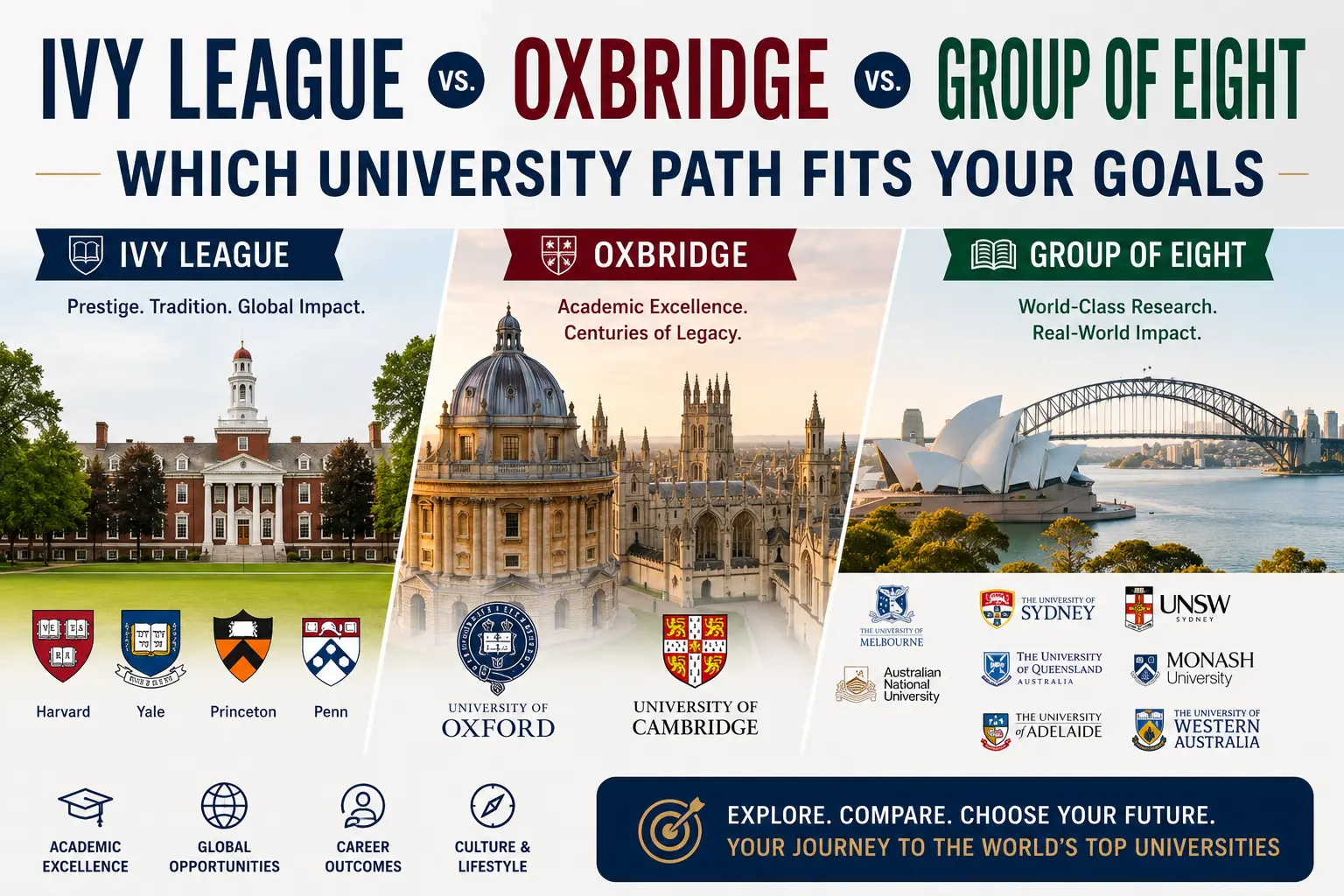
Choosing where to study abroad is one of the most significant decisions of your life. It shapes not only your education but also your career path, personal growth, and global exposure. Many students dream of studying at world‑class universities, and three names often stand out: the Ivy League in the United States, Oxbridge in the United Kingdom, and Australia’s Group of Eight (Go8). Each of these university groups has a strong global reputation. Each offers excellent teaching, research opportunities, and career outcomes. Yet, they differ significantly in teaching style, campus culture, cost, admissions process, and long‑term benefits. What works perfectly for one student may not suit another. This detailed guide compares the Ivy League, Oxbridge, and the Group of Eight clearly and simply. It uses active voice, avoids jargon, and focuses on what truly matters to students. By the end, you will have a clearer idea of which option best fits your academic goals, career plans, and personal preferences.
Understanding the Three University Groups: Ivy League vs. Oxbridge vs. Group of Eight-
When students plan to study abroad, they often hear three prestigious names again and again: the Ivy League, Oxbridge, and the Group of Eight. These university groups represent academic excellence, global recognition, and strong career outcomes. However, they differ in history, structure, teaching style, and overall student experience. Understanding these differences helps students choose a university that truly matches their goals.
- The Ivy League: Excellence in the United States-
The Ivy League refers to a group of eight private universities in the United States. While the term began as an athletic association, it now stands for academic prestige and global influence. The Ivy League universities include Harvard, Yale, Princeton, Columbia, the University of Pennsylvania, Brown, Dartmouth, and Cornell.
These universities focus on well-rounded education. Students often study a mix of subjects before choosing a major. This system allows exploration and flexibility, which suits students who want to discover their interests before committing to one field. Ivy League institutions also place substantial value on leadership, innovation, and independent thinking.
Another key feature of the Ivy League is its global reputation. Employers, universities, and organizations across the world recognize these institutions. Students benefit from strong alumni networks, world-class faculty, and access to advanced research facilities. The Ivy League suits students who aim for leadership roles, competitive careers, or top research opportunities.
- Oxbridge: Tradition and Academic Depth in the UK-
Oxbridge is the collective name for the University of Oxford and the University of Cambridge in the United Kingdom. These universities rank among the oldest in the world and carry centuries of academic tradition. Oxbridge is known for its intense academic focus and personalized teaching style.
Unlike many universities, Oxbridge requires students to choose their subject before admission. From the first day, students study their chosen field in depth. The teaching system centers on tutorials or supervisions, where one or two students meet a professor regularly. Students prepare written work and discuss their ideas in detail during these sessions. This approach encourages deep thinking, strong writing skills, and academic discipline. Oxbridge suits students who already know what they want to study and enjoy focused, challenging learning. It also appeals to those interested in research, academia, public policy, or intellectually driven careers.
- Group of Eight: Research and Practical Learning in Australia-
The Group of Eight represents Australia’s leading research-intensive universities. This group includes the University of Melbourne, Australian National University, University of Sydney, University of Queensland, Monash University, University of Western Australia, University of Adelaide, and the University of New South Wales.
These universities combine strong academics with practical learning. Courses often include industry projects, internships, and real-world case studies—the Group of Eight places high importance on employability and skills that match current job markets. Australian universities also attract many international students because of their transparent admission process, supportive campus environment, and post-study work opportunities. The Group of Eight suits students who want a balance between theory and practice, along with a high quality of life.
What about the academic structure and teaching style, Ivy League vs. Oxbridge vs. Group of Eight?
One of the most important differences among these groups lies in how they teach students.
Ivy League: Flexible and Exploratory Learning- Ivy League universities follow a flexible academic structure. Most programs allow students to explore different subjects during the early years of study. Students usually declare their major after trying a range of courses. This system supports curiosity and encourages interdisciplinary learning. Teaching in the Ivy League focuses on classroom interaction. Professors expect students to ask questions, share opinions, and take part in discussions. Classes often include seminars, group projects, presentations, and case-based learning. This approach helps students develop critical thinking, communication skills, and confidence. Assessment in Ivy League universities remains continuous. Students earn grades through essays, assignments, quizzes, mid-term exams, and final exams. This structure reduces pressure on a single exam and rewards consistent effort. The Ivy League suits students who enjoy active participation, flexibility, and broad academic exposure.
Oxbridge: Focused and Intensive Academic Training- Oxbridge follows a highly structured and subject-focused academic model. Students choose their field of study before admission and concentrate on that subject throughout their degree. This system works best for students who already have a clear academic direction. The hallmark of Oxbridge teaching is the tutorial or supervision system. In this method, one or two students meet a professor regularly for in-depth discussions. Students prepare essays or problem sets in advance and defend their ideas during these sessions. Professors challenge students to think deeply, question assumptions, and refine arguments. Lectures support the learning process, but tutorials drive academic development. Assessment relies heavily on final exams and major written work. This approach demands discipline, strong writing skills, and independent study habits. Oxbridge suits students who thrive in intense academic environments and enjoy deep intellectual engagement.
Group of Eight: Practical and Career-Oriented Education- The Group of Eight universities in Australia follow a structured yet practical academic approach. Programs combine lectures with tutorials, lab sessions, workshops, and industry-linked projects. This blend helps students connect theory with real-world application. Teaching at Go8 universities emphasizes skills development and employability. Many courses include internships, work placements, and industry case studies. Faculty members often design assessments around real-life problems, teamwork, and applied research. Assessment methods balance exams with assignments, presentations, and group projects. This structure prepares students for workplace expectations and professional environments. The Group of Eight suits students who want practical skills, career readiness, and a balanced learning experience.
What about the admission process and entry requirements, Ivy League vs. Oxbridge vs. Group of Eight?
Admission standards remain high across all three groups, but the process differs.
1. Ivy League (USA): Holistic and Highly Competitive
- Admission Process- Ivy League universities follow a holistic admissions approach. This means they don’t judge you only on marks. Instead, they look at the whole student.
- Key steps include:
· Online application (Common App / Coalition App)
· Multiple essays and personal statements
· Letters of recommendation (teachers + counselor)
· Standardized test scores (many are test-optional, but strong scores help)
- Interviews (often alumni-led)-
· Admissions committees assess academic strength, leadership, extracurriculars, community impact, and personal story.
- Entry Requirements
· Academic records: Excellent high school grades or strong undergraduate GPA.
· Standardized tests: SAT/ACT (optional, but competitive scores matter).
· English proficiency: TOEFL / IELTS for international students.
Extracurricular profile: Leadership roles, research, sports, volunteering, startups, etc.
2. Oxbridge (UK): Subject-Focused and Academically Intense- Oxford and Cambridge use a specialized, subject-driven admission process that is very different from the US system.
- Admission Process- The process tests how deeply you understand your chosen subject, not how many activities you’ve done.
· Application through UCAS.
· One personal statement (academically focused).
· Subject-specific entrance tests (e.g., TSA, LNAT, MAT, BMAT).
· Written work (for many humanities subjects).
· Formal interviews conducted by subject tutors.
- Entry Requirements-
· Very high academic scores (A-levels, IB, or equivalent).
· Strong performance in entrance exams.
· Clear academic motivation in the personal statement.
· English proficiency: IELTS / TOEFL.
3. Group of Eight (Australia): Transparent and Accessible- The Go8 universities follow a more straightforward and student-friendly admission system, especially for international applicants.
- Admission Process- Admissions are less subjective and more criterion-based.
· Direct application via the university portal or authorized agents
· Fewer essays and usually no interviews
· Faster offer letters (sometimes within weeks)
· Conditional offers are common
- Entry Requirements- Work experience is considered for professional master’s courses
· Academic scores: Based mainly on previous qualifications
· English proficiency: IELTS / TOEFL / PTE (widely accepted)
· Standardized tests (SAT/GRE/GMAT) are required only for specific programs
Quick Comparison Table
|
Criteria |
Ivy League (USA) |
Oxbridge (UK) |
Group of Eight (Australia) |
|
Application Style |
Holistic |
Subject-specific |
Criteria-based |
|
Entrance Exams |
SAT/ACT (optional) |
Mandatory subject tests |
Rare |
|
Interviews |
Often |
Almost always |
Rare |
|
Focus |
Overall personality + impact |
Academic depth |
Academic eligibility |
|
Offer Speed |
Slow |
Moderate |
Fast |
|
Flexibility |
High |
Low (fixed subject) |
High |
Cost of Education and Financial Support-
Cost plays a significant role in choosing a study destination.
1. Ivy League (USA)-
- Cost of Education- Studying at an Ivy League university involves a high tuition cost, typically ranging from $50,000 to $65,000 or more per year for undergraduate programs. When accommodation, food, books, health insurance, and personal expenses are included, the total annual cost can reach $75,000 to $90,000 or higher. Although the sticker price appears steep, many students do not pay the full amount due to extensive financial aid options.
- Financial Support and Scholarships- Ivy League universities are known for their generous need-based financial aid systems. Institutions such as Harvard, Yale, and Princeton commit to meeting 100% of demonstrated financial need for both domestic and international students. In recent years, Harvard has expanded its financial aid policy, allowing students from families earning up to $200,000 per year to study tuition-free, while those from families earning under approximately $100,000 may receive full coverage for tuition, housing, food, and insurance. Unlike many other institutions, Ivy League universities generally do not offer merit-based scholarships, as financial assistance is awarded primarily based on family income and need. As a result, while financial aid can significantly reduce costs, students must provide detailed financial documentation to qualify.
2. Oxbridge (United Kingdom)-
- Cost of Education- The cost of studying at Oxford or Cambridge differs significantly for domestic and international students. UK “home” students pay tuition fees of around £9,000 to £10,000 per year, supported by government-backed student loans. International students, however, face substantially higher fees, typically ranging from £27,000 to £45,000 or more per year, particularly for laboratory-based or medical courses. In addition to tuition, students should budget approximately £10,000 to £15,000 per year for living expenses, depending on lifestyle and accommodation choices.
- Financial Support and Scholarships- Financial support at Oxbridge is more limited compared to the Ivy League system. While the universities and individual colleges offer some bursaries and scholarships, these awards are highly competitive and rarely cover the full cost of tuition and living expenses for international students. Government student loans are generally available only to UK citizens or long-term residents. Some international students rely on prestigious external scholarships such as Gates Cambridge or the Rhodes Scholarship, which can provide full or substantial funding. However, these scholarships are highly competitive and awarded to a minimal number of exceptional candidates each year.
3. Group of Eight (Go8 — Australia)-
- Cost of Education- For international students, tuition fees at Group of Eight universities generally fall within a moderate to high range. However, they are typically lower than those of Ivy League institutions and broadly comparable to Oxbridge for similar programs. The overall cost of study, including living expenses, varies depending on the city, with locations such as Sydney and Melbourne being more expensive. Even so, total costs are often somewhat lower than those at top private universities in the United States.
- Financial Support & Scholarships- Group of Eight universities offer a wider range of merit-based scholarships for international students, particularly those with strong academic records. These scholarships commonly reduce tuition fees by 15% to 50% or more, making education more financially accessible. For postgraduate research students, funding opportunities such as the Australian Government’s Research Training Program (RTP) can cover full tuition and provide a living stipend. In addition, Australia allows international students to work part-time during their studies, enabling them to offset some living expenses through legal employment.
How do research opportunities and innovation differ across the Ivy League, Oxbridge, and the Group of Eight universities?
All three groups lead in research, but their focus differs.
Research opportunities and innovation differ significantly across the Ivy League, Oxbridge, and the Group of Eight (Go8) universities because each system follows a distinct academic philosophy and research focus.
- Ivy League universities are global leaders in research across science, medicine, law, business, and the humanities. They emphasize innovation, interdisciplinary collaboration, and practical impact. Students benefit from access to cutting-edge laboratories, extensive libraries, and substantial research funding. A key strength of the Ivy League is early research exposure—undergraduate students are often encouraged to participate in funded research projects alongside faculty. This environment suits students aiming for innovation-driven careers, entrepreneurship, advanced studies, or research-intensive professional fields.
- Oxbridge universities place a strong emphasis on theoretical research and deep scholarly inquiry. Research at Oxford and Cambridge values intellectual rigor, originality, and long-term academic contribution. Students typically work closely with leading scholars through tutorials, supervision, and small research groups. This close mentorship model is especially beneficial for those planning doctoral studies or academic careers, as it promotes critical thinking, independent research, and subject mastery.
- The Group of Eight universities in Australia focus heavily on applied and industry-linked research. Their research culture prioritizes solving real-world problems through collaboration with industry partners, government agencies, and global organizations. Go8 institutions are powerful in areas such as technology, healthcare, environmental science, engineering, and business innovation. This practical approach benefits students who want research experience that leads directly to industry roles, commercialization, or policy impact.
How do career outcomes and employability differ for graduates of the Ivy League, Oxbridge, and Group of Eight universities?
Ivy League Graduates
- Strong global recognition, especially in the United States and international job markets.
- Employers associate Ivy League degrees with leadership, excellence, and ambition.
- Common career paths include finance, consulting, technology, law, entrepreneurship, and academia.
- Powerful alumni networks provide access to top employers, mentorship, funding, and leadership roles.
- High earning potential and strong presence in multinational companies.
Oxbridge Graduates
- Exceptional academic reputation, particularly in the UK and Europe.
- Degrees are highly respected in research-driven and traditional professions.
- Popular career fields include research and academia, public policy, government, law, journalism, science, and innovation.
- Strong intellectual training supports careers requiring analytical depth and independent thinking.
- Oxbridge branding opens doors to elite institutions and public sector roles.
Group of Eight Graduates
- Strong focus on employability and job readiness.
- Graduates are well-prepared for industry-oriented roles.
- Key career areas include engineering, IT, business and management, healthcare, life sciences, environmental studies, and data-related fields.
- Close industry and government collaboration enhances real-world skills.
- Post-study work opportunities in Australia help international students gain professional experience.
What about the campus life and student experience?
Your daily life matters as much as academics.
- Life at Ivy League Campuses- Ivy League campuses offer vibrant student life. Students join clubs, sports teams, cultural groups, and volunteer activities. The campus culture encourages independence, diversity, and leadership. Students often balance academics with social engagement.
- Life at Oxbridge Colleges- Oxbridge life centers around colleges. Each college offers housing, dining, and social events. The environment feels traditional and academic. While social activities exist, academic commitment remains intense.
- Life at the Group of Eight Universities- Go8 campuses provides a relaxed and inclusive atmosphere. Australia’s lifestyle encourages balance between studies, work, and leisure. Students enjoy multicultural communities, outdoor activities, and strong student support services.
Which fits your goals best?
Choosing the right option depends on your priorities.
Choose the Ivy League if:
- You want flexible education and exploration.
- You value global prestige and strong alumni networks.
- You aim for leadership roles or competitive industries.
- You can secure financial aid or funding.
Choose Oxbridge if:
- You have a clear academic focus.
- You enjoy intense, one‑on‑one academic discussions.
- You aim for research or scholarly careers.
- You prefer a traditional academic environment.
Choose the Group of Eight if:
- You want practical and career‑focused education.
- You seek affordable study options with scholarships.
- You value post‑study work opportunities.
- You prefer a balanced lifestyle.
Final Thoughts
There is no single “best” choice among the Ivy League, Oxbridge, and the Group of Eight. Each represents excellence in its own way. The right choice depends on your goals, learning style, budget, and long‑term plans. Instead of chasing names alone, focus on fit. When your university aligns with your ambitions and personality, success follows naturally. The Ivy League suits students seeking global prestige, generous need-based financial aid, interdisciplinary research exposure, and access to elite corporate and leadership careers. Oxbridge is ideal for those who prioritize academic depth, theoretical research, and subject-focused learning, with strong outcomes in academia, public policy, and traditional professions, especially in the UK and Europe. The Group of Eight offers a balanced option with relatively lower costs, applied and industry-linked research, strong employability, and post-study work opportunities. Ultimately, the best choice is not about rankings alone, but about finding the system that supports your ambitions, learning style, and long-term success. A well‑chosen path matters more than a famous label.
FAQs on Ivy League vs. Oxbridge vs. Group of Eight-
Q.1 What is the main difference between the Ivy League, Oxbridge, and the Group of Eight?
Ans: The Ivy League focuses on holistic education and global leadership, Oxbridge emphasizes academic depth and subject mastery, while the Group of Eight prioritizes practical learning and employability.
Q.2 Which option is best for research-oriented students?
Ans: The Ivy League excels in innovation-driven research, Oxbridge leads in theoretical and scholarly research, and the Group of Eight focuses on applied, real-world research.
Q.3 Which universities offer better financial support for international students?
Ans: Ivy League universities provide strong need-based financial aid, Oxbridge offers limited scholarships, and the Group of Eight mainly provides merit-based and research funding.
Q.4 Which system has the highest tuition fees?
Ans: The Ivy League generally has the highest tuition fees, followed by Oxbridge for international students, while the Group of Eight is comparatively more affordable.
Q.5 Which universities are best for employability?
Ans: The Group of Eight emphasizes job readiness and industry connections, while Ivy League and Oxbridge graduates’ benefit from strong global recognition.
Q.6 Which is better for undergraduate study?
Ans: The Ivy League offers flexible and broad undergraduate education, Oxbridge provides intensive subject-focused study, and the Group of Eight offers structured, career-oriented programs.
Q.7 Which option is ideal for postgraduate studies?
Ans: Oxbridge and the Group of Eight are strong for research-based postgraduate programs, while the Ivy League is ideal for professional and interdisciplinary master’s degrees.
Q.8 Where do graduates find better global job opportunities?
Ans: Ivy League graduates access global corporate roles, Oxbridge graduates excel in academia and public policy, and Go8 graduates’ benefit from strong regional employability.
Q.9 Which system is best for international students seeking work after graduation?
Ans: The Group of Eight offers the most favorable post-study work opportunities, particularly in Australia.
Q.10 Which fits my goals best?
Ans: Choose the Ivy League for prestige and leadership, Oxbridge for academic excellence, and the Group of Eight for practical skills and employability.





Leave a Comment
Your email address will not be published.