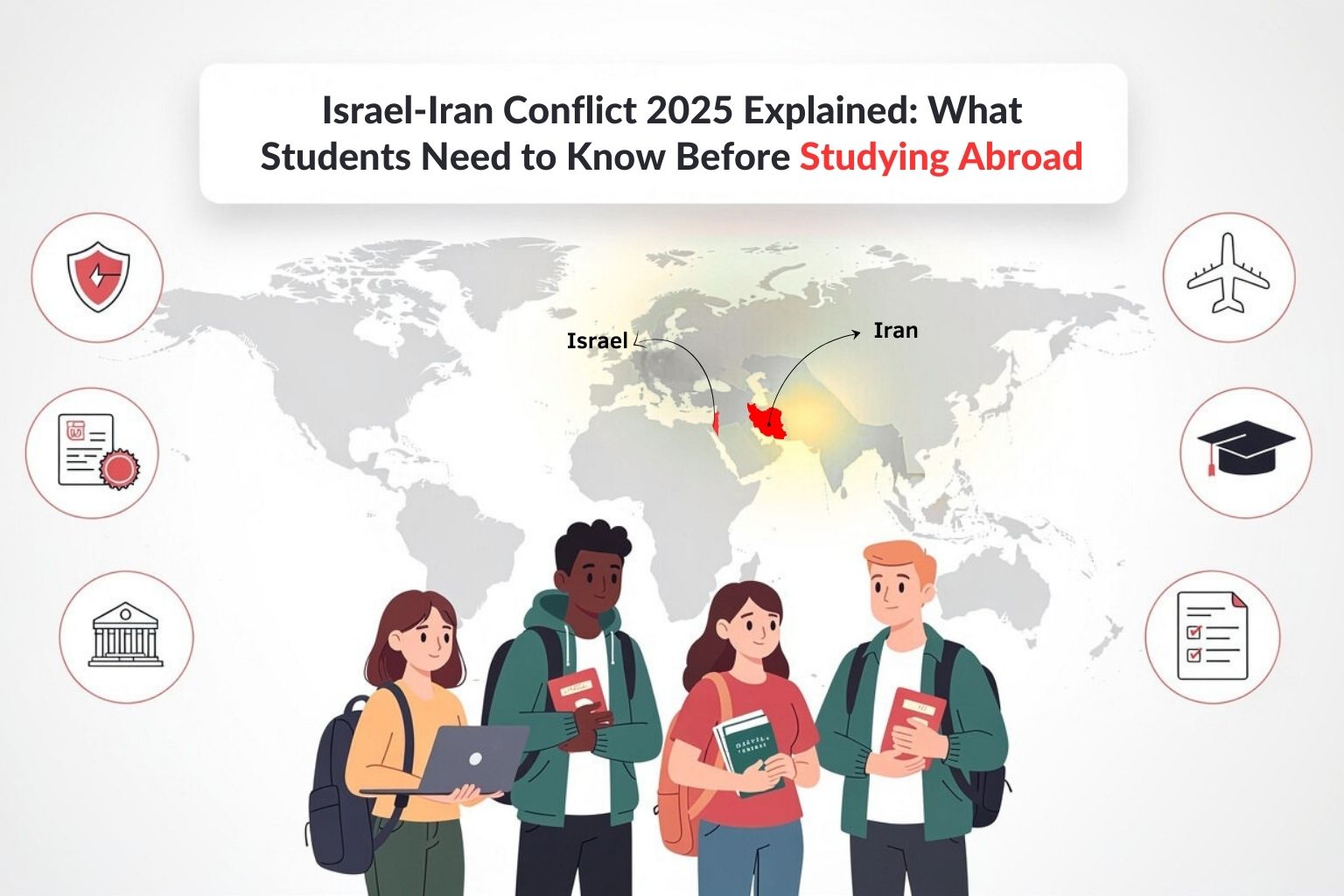
Global education is no longer just about academics; it’s about navigating a complex world filled with dynamic political landscapes. The recent tensions between Israel and Iran, among other geopolitical conflicts, underscore the risks and realities international students face today. Such conflicts raise critical questions for students, parents, and institutions.
This blog offers a detailed exploration of how conflicts like the Israel-Iran tensions affect the safety, mental well-being, academic prospects, and future planning of students aiming to study abroad.
About the Israel-Iran Conflict- A Brief Context
The Israel-Iran conflict is a long-standing and complex geopolitical struggle rooted in political, ideological, religious, and security tensions between the two nations. It is not a conventional war with open battles but rather a multifaceted confrontation that influences global diplomacy, regional security, and international relations. Before delving into the impacts on study abroad, it’s crucial to grasp why tensions like those between Israel and Iran hold global significance-
Historical Background:
- Post-1979 shift- Relations between Iran and Israel drastically deteriorated after the 1979 Iranian Revolution. Iran’s new Islamic regime, led by Ayatollah Khomeini, declared Israel an illegitimate state and a sworn enemy.
- Support for opposing factions: Iran supports anti-Israel groups like Hezbollah (Lebanon) and Hamas (Gaza Strip), providing them with funding, weapons, and training. Israel views this as a direct threat to its security.
- Nuclear tensions- Iran’s nuclear ambitions have intensified Israel’s concerns. Israel fears that a nuclear-armed Iran would pose an existential threat. Consequently, Israel has reportedly engaged in covert actions, including cyberattacks and sabotage, to delay Iran’s nuclear progress.
Key Issues Fueling the Conflict:
- Ideological Hostility- Iran’s leadership frequently calls for the destruction of Israel, framing the conflict as both religious and political.
- Military Engagements- Though not at war officially, the nation engages indirectly through proxy wars, airstrikes (especially in Syria), and covert operations.
- Regional Influence- Both nations vie for influence across the Middle East. Iran seeks to expand its “Shia Crescent” while Israel aligns with Sunni Arab states opposed to Iran’s influence.
- Alliances:
- Israel has strong ties with the U.S. and certain European nations.
- Iran maintains relationships with Russia, China, and regional militias.
Recent Growth
- Israel's strikes on Iranian military sites in Syria.
- Retaliation from Iran via proxies in Iraq, Syria, and Lebanon.
- Cyber and drone warfare.
- Increasing hostilities along the southern border between Gaza and Lebanon.
- A growing military build-up on both sides in anticipation of potential escalation.
Why does this matter for students?
International education doesn’t exist in isolation. Travel bans, flight disruptions, heightened security risks, visa uncertainties, and even xenophobia can stem from such conflicts, influencing both student safety and academic continuity.
Impact on Safety and Security of International Students
A. Direct Threats to Physical Safety
Countries embroiled in or neighbouring conflicts often experience-
- Terror attacks
- Civil unrest
- Military actions
- Heightened anti-foreign sentiment
Students from or studying in these regions may face-
- Physical harm during protests or attacks.
- Evacuations are disrupting their academic year.
- Seclusion as a result of martial law and curfews.
B. Indirect Threats: Hate Crimes and Xenophobia
Even students outside the conflict zone might experience:
- Racial profiling
- Religious discrimination
- Hate crimes are linked to perceived associations with the conflict.
For example, during heightened Israel-Iran tensions-
- Jewish students have reported increased antisemitism.
- Middle Eastern students have faced suspicion or hostility in Western countries.
C. Institutional Responses to Safety
Universities respond by:
- Increasing campus security
- Issuing travel advisories
- Providing emergency support contacts
- Collaborating with governments on evacuation plans
How does this matter affect visa and immigration complications?
A. Travel Restrictions and Bans-
During conflicts, governments may-
- Halt visas for certain nationalities (e.g., Iran).
- Cancel flights to/from affected regions.
- Delay or deny student visa applications for security reasons.
Example
In past escalations, Iranian students faced increased scrutiny in the U.S. and Europe, delaying their study abroad plans.
B. Impact on Mobility and Internships
- Difficulty travelling to neighbouring countries for internships, conferences, or research.
- Restrictions on accessing international campuses in certain regions (e.g., UAE-Israel student exchanges disrupted).
C. Legal Risks
- Students may inadvertently violate sanctions if they engage with restricted countries through internships or partnerships.
Visit More: How to Avoid Student Visa Rejection
Academic disruptions due to the Israel-Iran geopolitical conflict
A. Interrupted Studies
Universities in conflict zones might:
- Suspend classes
- Shut campuses temporarily
- Moving entirely online affects lab work and field research.
B. Program Deferrals
Students might need to:
- Postpone enrollment
- Transfer programs mid-way
- Have trouble getting credit for studies that are just partly finished.
C. Global University Networks
Some institutions offer flexible options-
- Temporary relocation to partner campuses
- Virtual learning options
- Academic credit adjustments
Mental health and emotional well-being
A. Increased Anxiety
Students often face anxiety over:
- Safety of the family at home
- Their security abroad
- Academic and career uncertainties
B. Isolation and Cultural Misunderstandings
- Misunderstood by peers about the conflict
- Stereotyped or marginalised
- Hesitant to engage socially for fear of judgment
C. Institutional Support-
Proactive universities provide:
- Counseling services
- Peer support groups
- Crisis helplines
- Safe spaces for dialogue
Financial Implications
A. Currency Devaluation
Countries involved in conflicts often suffer:
- Currency crashes
- Economic sanctions
- Inflation, making tuition and living expenses harder for students abroad.
Example: Iranian students abroad may struggle with transferring funds due to sanctions or banking restrictions.
B. Disruptions to Scholarships and Funding
- Some scholarships tied to home governments may freeze.
- International fund transfers may be blocked.
C. Insurance Costs Rise
Health, travel, and evacuation insurance premiums often increase for conflict-affected regions.
What are the long-term career planning challenges concerning the Israel-Iran conflict?
The ongoing Israel-Iran conflict poses various indirect and long-term challenges to career planning, particularly for those considering careers in the Middle East, international relations, global business, or fields impacted by geopolitical instability. Below are the key challenges categorized under relevant subheadings-
Geopolitical Uncertainty
- Unstable job markets- Constant tension can destabilise the job market, especially in the Middle East. Multinational companies may limit hiring or relocate operations from high-risk regions.
- Changes in diplomatic relations- Shifts in alliances and diplomatic ties can suddenly close doors to career opportunities in certain countries.
Travel and work restrictions-
- Visa and immigration barriers- Countries may impose strict visa restrictions on individuals who have studied, worked, or lived in conflict regions. Middle Eastern passports may face increased scrutiny due to security concerns.
- Restricted mobility for career growth- Career plans requiring international travel (e.g., conferences, training, relocation) may be interrupted due to security risks and flight bans.
Safety and security risks-
- Workplace safety concerns—Organisations operating in volatile regions may face physical security threats, which can affect employee well-being and job satisfaction.
- Risk of regional conflicts escalating- Escalation could spread to neighbouring countries, affecting career opportunities across the broader Middle East.
Impact on industry-specific careers-
- Defence and security industries- Opportunities may increase, but carry higher personal risk and ethical considerations.
- Energy sector volatility- Oil and gas industries may see frequent disruptions, leading to uncertain career stability and growth.
- Finance and trade- Sanctions, embargoes, and fluctuating markets tied to conflict regions can impact careers in banking, finance, and international trade.
Academic and research limitations-
- Research restrictions- Geopolitical tensions limit collaborations between institutions in the Middle East and Western countries, affecting careers in academia and research.
- Reduced opportunities for fieldwork- Careers requiring field studies in the region (e.g., archaeology, political science, cultural studies) may face long-term access issues.
Mental health and professional burnout-
- Stress from instability- Continuous exposure to conflict-related uncertainty can lead to burnout, anxiety, and long-term mental health issues, affecting career performance and decisions.
Reputational risks-
- Association with conflict zones- Employers or governments may scrutinise candidates who have lived, worked, or studied in regions closely linked to the conflict.
Shifting demand for skills-
- Demand for crisis management skills- There may be growing demand for experts in risk assessment, security consulting, and international diplomacy, shifting traditional career trajectories.
- Changes in language and cultural requirements- Geopolitical shifts influence which languages and cultural competencies are valued in international careers.
Delayed professional development-
- Interrupted education or training- Study abroad and professional training in the region might be delayed or cancelled, slowing down career advancement.
- Postponed work assignments- Overseas assignments, internships, or job postings may be frozen due to heightened risks.
Economic instability-
- Fluctuating economies- War risks and sanctions can cause economic downturns in affected regions, leading to fewer job openings and slower career growth.
- Investment and business hesitancy—Companies may delay investments and expansions in conflict-prone regions, limiting opportunities for professionals in those markets.
Institutional and government policy Shifts due to conflicts
A. Changes in University Admission Policies
- Some institutions may pause or limit admissions from high-risk regions.
- Background checks become stricter.
B. Diplomatic Relations Affecting Education
- A breakdown in relations can cancel educational partnerships (e.g., joint research between Israel and Iran).
- Academic collaborations are suspended, affecting current students.
C. Government Advisories
Students should monitor-
- Foreign Office travel warnings
- Embassy updates
- Health and safety advisories
Insurance and Risk Management for Students
A. Importance of Comprehensive Insurance
- Evacuation coverage
- Health coverage during war/civil unrest
- Tuition reimbursement for interrupted studies
B. Risk Assessment by Institutions
Universities use risk matrices to evaluate:
- Whether programs can proceed safely
- How to support students in unstable regions
The Role of Study Abroad Consultants and Advisors
A. Providing Clear Guidance
- Up-to-date on conflict impacts on visas, travel, and policies
- Advising on alternative destinations if needed
- Clarifying insurance and legal implications
B. Helping Families Understand Risks
- Providing reassurance with clear contingency plans
- Advising on safer countries or regions
Tips for Students Planning to Study Abroad During Geopolitical Tensions
- Research safety and stability- Stay updated with government travel advisories and global news about your destination.
- Choose safer regions- Opt for countries with minimal involvement in conflicts or stable diplomatic relations.
- Secure comprehensive insurance- Get travel and health insurance covering emergencies, war, and evacuation.
- Have a contingency plan- Prepare alternatives, such as transferring programs or online study options.
- Stay connected with your embassy- Register with your embassy for updates and emergency support.
- Maintain flexibility- Be prepared for sudden changes in visas, flights, or academic schedules.
- Prioritise mental health- Manage stress through campus resources and support networks abroad.
Countries and regions that are typically considered safer
For students worried about the Middle East tensions, consider these traditionally safer alternatives-
|
Region |
Safer Countries |
|
Europe |
Germany, France, Netherlands, Ireland |
|
Asia-Pacific |
Japan, South Korea, Singapore |
|
North America |
Canada, USA (varies by state) |
|
Oceania |
Australia, New Zealand |
Examples of previous impacts of geopolitical tensions on study abroad
|
Conflict |
Impact on Students |
|
Russia-Ukraine |
Visa delays, campus closures, evacuations |
|
US-China Tensions |
STEM students denied visas, blocked partnerships |
|
Israel-Palestine |
Travel warnings, insurance spikes, flight bans |
|
Iran-West Tensions |
Sanctions disrupting fund transfers, visa bans |
Long-term implications on global education trends
A.Shift to safer Hubs
Countries with political neutrality and strong education systems (e.g., Canada, Australia) will likely see increased demand.
B. Virtual and Hybrid Learning
More universities might offer flexible hybrid options as standard practice.
C. Increased Demand for Insurance and Security Services
Universities will invest more in:
- Global risk management
- Student protection policies
- Emergency evacuation partnerships
D. Focus on Conflict-Resilient Skills
Curricula may increasingly include:
- Crisis management
- Conflict resolution
- International diplomacy
What will be the impact of this Israel-Iran Conflict on Indian students and Indian foreign policy?
Impact on Indian Students (Especially those planning to study abroad)
a) Safety and security concerns
- Indian students studying in conflict-prone regions like Israel, or even nearby Middle Eastern countries, might face heightened security risks.
- Families might hesitate to send students to such regions, even if universities continue operations.
b) Change in study abroad destinations
- Students considering Israel (for tech, agriculture, defense studies) might now shift focus to safer destinations like Europe, Australia, or Canada.
- Educational collaborations between Indian and Israeli institutions could face temporary disruptions.
c) Visa and travel restrictions
- Flight routes between India and Israel/Iran might be disrupted.
- Some countries could impose new travel advisories affecting student mobility indirectly.
d) Impact on exchange programs and research ties
- Indian-Israel research collaborations in sectors like cybersecurity, AI, and defense might slow down, impacting academic exchanges.
- New MOUs and collaborations could be delayed.
e) Psychological stress on Indian students abroad
- Those already studying in Israel or nearby might experience anxiety, fear, and mental health issues due to uncertainty and war-related risks.
Impact on Indian Foreign Policy
a) Balancing Act Between Israel and Iran
India has traditionally maintained cordial ties with both Israel and Iran:
- With Israel- Strong defense, technology, agriculture, and intelligence cooperation.
- With Iran- Energy security (oil), Chabahar port (geopolitical access to Central Asia), and cultural-historical ties.
India will likely adopt strategic silence or neutrality, avoiding taking sides openly to protect its interests on both ends.
b) Energy Security Risks
- Iran plays a significant role in India’s oil import history.
- Escalation could disrupt global oil supply chains, increase prices, and hurt India’s economy.
c) Geopolitical Strategy in the Middle East
- India will work to preserve its Gulf relations (UAE, Saudi Arabia), which are crucial for remittances, energy, and trade.
- Any perception of India leaning too much toward Israel might upset Iran and, indirectly, India's ties with these nations.
d) Diplomatic Pressures from the West
- The U.S. might expect India to align with Israel, given the Quad and I2U2 groupings.
- India, however, may resist overt alignment to maintain strategic autonomy.
e) Impact on Defense Procurement and Trade
- Defense imports from Israel (missiles, drones, radars) might face delays if Israel is fully focused on the conflict.
- Exports of Indian agricultural products, IT services to Israel, and pharma supplies could see disruptions.
Conclusion
Geopolitical tensions like the Israel-Iran conflict create a ripple effect on global education, impacting everything from visas to mental health. While the risks are real, they are also manageable with informed planning, support from institutions, and a willingness to adapt.
Students should weigh their options carefully, prioritize safety, and remain flexible in their plans. Institutions and governments must continue offering transparency, support, and alternatives to ensure education remains accessible, even in uncertain times. The world of study abroad is evolving rapidly. Awareness, preparedness, and resilience will shape the future of international education far more than any one conflict.
FAQs
Q.1 How do geopolitical tensions like the Israel-Iran conflict impact study abroad plans?
Ans- They create uncertainties in safety, visa policies, and travel regulations, often leading to disruptions or cancellations of study abroad programs.
Q.2 Are students directly at risk due to such geopolitical conflicts?
Ans- Not always, but heightened tensions can increase risks such as terrorism, civil unrest, and sudden border closures, which may indirectly affect students.
Q.3 Should you avoid studying in regions affected by conflicts like Israel-Iran?
Ans- It’s advisable to reconsider or delay plans if the country is directly involved or if neighboring regions face spillover effects.
Q.4 How can you stay updated about safety when planning to study abroad during such tensions?
Ans- Follow government travel advisories (like the US State Department or UK FCDO) and monitor international news sources regularly.
Q.5 Can geopolitical conflicts affect your student visa approval?
Ans- Yes, countries often tighten visa policies or halt processing for applicants from regions involved in active conflicts.
Q.6 Will your university support you if a conflict escalates during your studies?
Ans- Most reputable universities offer support through risk management teams, evacuation plans, and health insurance coverage.
Q.7 How do conflicts affect flight availability and travel routes?
Ans- Airlines may cancel flights, alter routes, or avoid airspace over conflict zones, complicating travel logistics.
Q.8 Should you buy special insurance for studying abroad during geopolitical tensions?
Ans- Yes, comprehensive travel and health insurance with coverage for war, terrorism, and evacuation is strongly recommended.
Q.9 How can you ensure your safety abroad during such uncertain times?
Ans- Stay informed, register with your embassy, follow local laws, avoid protests, and have contingency plans ready.
Q.10 Can you transfer to a different country if conflicts worsen after you have started your program?
Ans- Some universities offer transfer options or relocation assistance, but this depends on institutional policies and individual circumstances.


Leave a Comment
Your email address will not be published.