Top Government Scholarships That Help Rural Students to Study Abroad
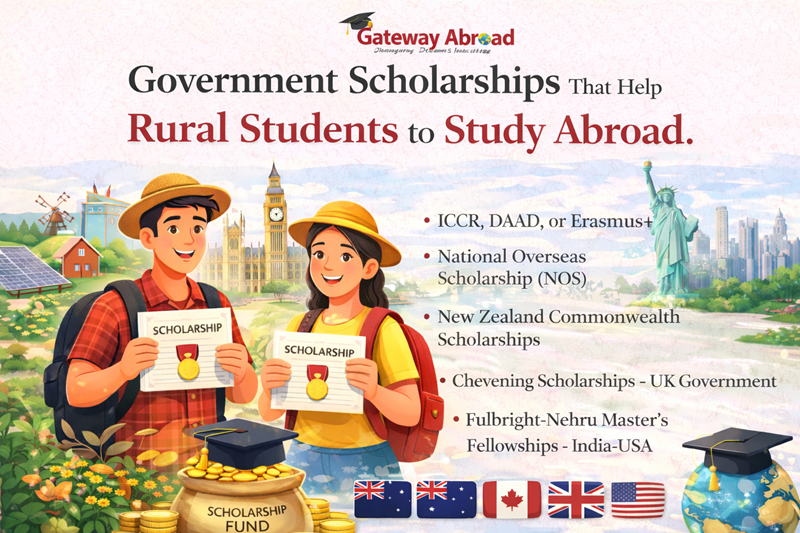
Table of Contents
Studying abroad is a dream for many students in rural areas, but the cost can often be a significant barrier. The overall cost of international education can be daunting, from tuition and living expenses to travel and visa charges. However, fully funded government scholarships offer a lifeline, especially for students from underrepresented and economically disadvantaged regions. This article explores the top government scholarships like ICCR (India), DAAD (Germany), Erasmus+ (Europe), and more that rural students can apply to for a completely free international education in 2025 and beyond.
Why are government scholarships crucial for rural students?
Many students from rural backgrounds are academically talented but lack the financial means and information access that urban students often enjoy. Here's why government scholarships matter-
1. Financial Support Removes the Biggest Obstacle-
- Tuition fees, travel costs, living expenses, and visa charges can be overwhelming for rural families.
- Government scholarships offer fully funded opportunities, lifting the financial burden entirely.
- This ensures that economic background doesn’t limit talent or ambition.
2. Equal Access to Global Education-
- Students from cities often have better access to coaching centers, online resources, and study-abroad consultants.
- Rural students lack exposure, internet access, and guidance, but scholarships level the playing field.
- Many government programs now prioritize equity and inclusivity, offering special quotas or support for underrepresented regions.
3. Encourages Brain Gain, Not Brain Drain-
- When rural students return with international degrees, they contribute to local development, improving education, health, agriculture, or governance in their hometowns.
- This reverses the traditional trend of brain drain and promotes brain circulation.
4. Exposure to New Cultures and Ideas-
- Studying abroad builds confidence, communication skills, and global awareness.
- Government scholarships open doors to cross-cultural experiences, which rural students might never get otherwise.
- This boosts their ability to compete globally and lead locally.
5. Empowers the Entire Community-
- A student from a village studying in Germany or the UK becomes a role model for others.
- It inspires younger generations and encourages families to prioritize education, especially for girls.
- One scholarship can ignite a chain reaction of social progress in an entire village.
6. Provides Structured Guidance and Mentorship-
- Most government scholarships offer pre-departure orientation, visa support, and academic counselling.
- This guidance is essential for rural students who may be first-generation learners.
7. Bridges the Urban-Rural Skill Gap-
- Rural students who return with international training contribute new skills, innovation, and perspectives to their communities.
- This helps bridge the urban-rural divide in employment, healthcare, technology, and education.
Top Government Scholarships for Rural Students to Study Abroad for Free
Below are fully funded government-backed scholarships available to Indian and global rural students, explained in detail with the latest updates.
Indian Council for Cultural Relations (ICCR) Scholarship – India-
ICCR is a government initiative under the Ministry of External Affairs that offers scholarships to international students studying at Indian universities. But through bilateral programs, it also supports Indian students going abroad, particularly under educational and cultural exchange.
· Key features-
§ It covers full tuition fees, a living allowance, a contingency grant, medical insurance, and international airfare.
§ Offers placements across Asia, Africa, Europe, and Latin America under cooperation programs.
· Eligibility-
§ Indian citizens, including students from rural and underprivileged backgrounds.
§ Strong academic background (minimum 60–70% marks).
§ English language proficiency (IELTS/TOEFL may be required for certain countries).
· Application Timeline-
§ Opens: February to April each year.
§ Apply via the A2A Portal.
· Popular Destinations-
§ Russia, China, Bangladesh, Mauritius, and African nations.
Latest Update (2025)-
ICCR is expanding cooperation with more African, Central Asian, and Latin American countries to send Indian students abroad under cultural exchange initiatives. A new quota has been created specifically for aspiring rural candidates.
DAAD Scholarships – Germany-
The German Academic Exchange Service (DAAD) is one of the most prestigious scholarship programs in the world. It offers various fully funded programs for Indian and international students, particularly for postgraduate studies.
· Key Features-
§ It covers 100% tuition, a monthly stipend (~€934), a travel grant, health insurance, and research allowances.
§ Offered for Master’s and PhD programs.
§ No requirement for German language proficiency in many courses.
· Eligibility-
§ Bachelor's degree with strong academic records.
§ Minimum 2 years of work or research experience (varies by program).
§ Open to students from all states of India, including rural backgrounds.
· Application Timeline-
§ Deadlines: August–October 2024 (for 2025 intake).
§ Apply via the DAAD India Portal.
· Target Fields-
§ Engineering, Economics, Public Policy, Environmental Studies, and Arts.
Latest Update (2025)-
DAAD now has an “EPOS – Development-Related Postgraduate Courses” category focused on students from rural and disadvantaged backgrounds in developing countries, including India.
3. Erasmus+ – European Union
· Erasmus+ is a European Commission program that supports education, training, youth, and sport. Its fully funded flagship programs are the Erasmus Mundus Joint Master's Degrees (EMJMD).
· Key Features-
§ Full tuition waiver, monthly living stipend (€1,400–€1,800), travel allowance, and insurance.
§ Students study in 2–3 different European countries, gaining multi-campus experience.
· Eligibility-
§ Undergraduate degree from a recognized institution.
§ Strong academic record and English proficiency.
§ No age limit and special encouragement for students from rural or economically weak zones.
· Application Timeline-
§ Applications open between October and January for the following year.
§ Apply via the Erasmus Mundus Catalogue.
· Popular Countries-
§ France, Germany, Spain, the Netherlands, Belgium, and Italy.
Latest Update (2025)-
Erasmus+ now prioritizes inclusivity, with higher quotas for students from underrepresented regions, including rural India and the Global South.
4. Fulbright-Nehru Master’s Fellowships – India-USA
This fellowship, a collaborative initiative between the United States-India Educational Foundation (USIEF) and the U.S. Government, offers fully funded opportunities for Indian students to study in the United States. Key point for Fulbright Nehru Fellowships:
· Key Features-
§ It covers tuition, airfare, a living stipend, books, and health insurance.
§ It focuses on public health, urban planning, education, arts, and environmental studies.
· Eligibility-
§ Bachelor’s degree with at least 55%.
§ Demonstrated leadership and community work (advantageous for rural students).
§ English language proficiency (TOEFL required).
· Application Timeline-
§ Opens: February–June each year.
§ Apply via USIEF.
Latest Update (2025):
A new initiative encourages applications from Tier-2 and rural districts of India with support in TOEFL preparation and document writing.
5. Chevening Scholarships – UK Government
Chevening is the UK Government’s global scholarship program, offering future leaders a chance to pursue a fully funded Master’s in the UK.
· Key Features-
§ Full tuition fees, monthly stipend, travel, and visa support.
§ Opportunities for networking with leaders and policymakers.
· Eligibility-
§ Undergraduate degree.
§ At least 2 years of work experience (including internships, community work, etc.).
§ English proficiency (IELTS or equivalent).
· Application Timeline-
Opens: August–November.
Apply via Chevening.org.
Latest Update (2025)-
Chevening launched the “Rural India Cohort”, offering tailored mentorship and pre-application webinars to candidates from small towns and villages.
6. New Zealand Commonwealth Scholarships-
This scholarship, offered by the New Zealand Government, enables students from developing countries (including India) to study in New Zealand universities.
· Key Features-
§ It covers tuition, living allowance, establishment grants, travel, insurance, and research support.
· Eligibility-
§ Bachelor’s degree.
§ Strong academic and community service record.
§ Preference to candidates from marginalized or rural backgrounds.
· Application Timeline-
§ Opens: February–March each year.
§ Apply via New Zealand Scholarships.
Latest Update (2025)-
New Zealand announced a new funding focus under its “Global South Education Initiative” for students from the Asia-Pacific and rural India.
7. National Overseas Scholarship (NOS) – India
A special scheme by the Ministry of Social Justice and Empowerment, NOS, is available for SC/ST, landless laborers, and minority candidates, many of whom are from rural areas of India.
· Key Features-
§ Full funding for Master’s and Ph.D. programs abroad.
§ It covers tuition, travel, visa, insurance, and an annual contingency grant.
· Eligibility-
§ Family income less than ₹8 lakh/year.
§ Must belong to SC/ST/OBC/Minority/De-notified Tribes.
§ Should have admission to the top 500 QS-ranked universities abroad.
· Application Timeline-
§ Usually between February and April.
§ Apply via NOS Portal.
Latest Update (2025)-
The government expanded the NOS scheme to allow more rural SC/ST students to apply abroad for STEM, humanities, and vocational subjects.
Read More: National Overseas Scholarship
How can rural students increase their chances of getting a scholarship?
Securing a government scholarship as a rural student may seem challenging, but it is achievable with the right strategy and preparation. Here's a detailed guide on how rural students can significantly boost their chances of winning fully funded international scholarships like ICCR, DAAD, Erasmus+, Fulbright, etc.
1. Start Early and Research Deeply-
- Prepare at least 12–18 months before your intended course start date.
- Regularly check official scholarship websites and trusted platforms like:
- DAAD India
- USIEF
- ICCR A2A Portal
- Erasmus Mundus Catalogue
- Make a list of eligible scholarships, deadlines, and required documents.
2. Gather Strong Documentation-
- Collect and maintain:
- Academic transcripts and certificates (high school, UG).
- Domicile certificate to prove rural background.
- Income certificate for scholarships with economic criteria.
- Caste or minority certificate (for schemes like National Overseas Scholarship).
- Valid passport.
- Ensure all documents are clear, verified, and translated into English (if needed).
3. Write a Compelling Statement of Purpose (SOP)-
- Your SOP should tell your story, highlight your struggles, achievements, and aspirations.
- Emphasize how your rural background shaped your determination and how you plan to give back.
- Tailor your SOP to each scholarship’s goals (development focus, leadership, academic merit, etc.).
- Use clear, honest language, and show long-term vision. and avoid exaggeration; stay authentic.
4. Excel Academically-
- Most scholarships require a minimum GPA or percentage (e.g., 60–70% and above).
- Focus on subjects relevant to your target course abroad.
- Consider enrolling in free online courses (MOOCs) to strengthen your academic profile (e.g., Coursera, edX, Swayam).
5. Prepare for Language Proficiency Tests-
- Most scholarships require English proficiency through tests like:
- IELTS
- TOEFL
- Duolingo English Test (accepted by some universities)
- Use free/low-cost prep tools:
- British Council resources
- Magoosh YouTube channel
- Indian Government’s SWAYAM platform
- Practice regularly and book your test well before the deadline.
6. Get Strong Letters of Recommendation-
- Ask teachers, principals, or community leaders who know you well.
- Explain your goals so they can write personalized, detailed recommendations.
- Ensure letters highlight your work ethic, leadership, community service, or any obstacles you've overcome.
7. Highlight Community Service and Rural Impact-
- Mention any volunteer work, social initiatives, or efforts you’ve taken to uplift your village or school.
- Scholarships like Chevening or Fulbright value students who aim to give back to their communities.
- Small acts like tutoring younger students or organizing a school event can make your application stand out.
8. Use Support Platforms and NGOs-
Several organizations help rural students apply for scholarships:
- Buddy4Study – lists scholarships with step-by-step help.
- EducationUSA – offers free sessions on U.S. education and scholarships.
- DAAD Information Centres – conduct free webinars for Indian students.
- Local NGOs or youth clubs can guide or mentor.
9. Choose the Right Programs-
- Don’t just look at popular universities; focus on those offering full scholarships.
- Choose programs with development or sustainability themes if you want to apply for DAAD, Erasmus+, or Fulbright.
- Prioritize public universities abroad, as they often have lower or no tuition.
10. Apply Early and Carefully-
- Avoid last-minute submissions. Apply at least a week before the deadline.
- Double-check:
- All documents are uploaded.
- The application form is complete.
- SOPs and essays are within word limits.
- Save confirmation emails and application IDs.
Bonus tips for long-term success-
|
Tip |
How it helps |
|
Set realistic goals |
Focus on programs that match your interests and academic level. |
|
Improve communication |
Practice spoken English with friends or online apps. |
|
Read successful essays |
Learn from past scholarship winners (blogs, forums, YouTube). |
|
Think global, act local |
Show how your global degree will help your rural community. |
|
Stay connected |
Join scholarship Telegram groups, LinkedIn communities, or Reddit forums for alerts. |
Read: Scholarships vs. Fellowships: Brief Analysis for Studying Abroad
Which strategy should you opt for to stay ahead?
To maximize your chances of winning a fully funded government scholarship as a rural student, adopt the following clear and actionable strategies-
- Start Early
- Begin preparing 12–18 months before the intake deadline.
- Research scholarships, countries, courses, and document requirements.
- Focus on Fully Funded Scholarships Only
- Prioritize programs that cover all costs, like DAAD, Erasmus+, Fulbright, ICCR, Chevening, etc.
- Maintain Strong Academic Records
- Aim for 60–70% and above in your previous qualifications.
- Take online certifications to strengthen your profile.
- Improve English Language Skills
- Prepare for IELTS/TOEFL through free resources and mock tests.
- Practice speaking and writing daily.
- Create a Powerful Statement of Purpose (SOP)
- Highlight your rural background, goals, and intent to give back to your community.
- Keep your SOP honest, focused, and personalized.
- Get Quality Letters of Recommendation
- Ask teachers, principals, or community leaders who know you well.
- Ensure they highlight your determination and potential.
- Organize All Documents in Advance
- Keep scanned copies of all necessary documents: marksheets, passport, income certificate, etc.
- Stay Informed About Deadlines
- Follow official websites and scholarship portals.
- Set reminders for application start and end dates.
- Use Reliable Guidance Platforms
- Register on Buddy4Study, EducationUSA, DAAD India, or attend scholarship webinars.
- Practice for Interviews
§ Prepare answers to common questions about goals, academics, and social impact.
§ Conduct mock interviews with mentors or peers.
- Apply for Multiple Scholarships
§ Don’t depend on a single option—simultaneously apply to 4–5 scholarships.
§ Join Online Communities for Alerts and Tips.
- Stay connected via Telegram groups, Reddit forums, and YouTube channels for updates.
§ Be Consistent and Never Give Up.
§ Rejections may learn, improve, and reapply.
§ Consistency is key to eventual success.
Conclusion-
In 2025, government scholarships will have become more inclusive, providing rural students with a real chance to study abroad completely free of cost. From ICCR and DAAD to Erasmus+ and Chevening, these programs are designed to empower deserving students with global exposure and high-quality education. If you are a student from a village or a remote area, remember: your dreams are valid, and with the correct information, preparation, and persistence, you can become a global scholar and a beacon of change for your community.
Frequently Asked Questions
Q1. Can rural students study abroad for free?
Ans- Yes, through fully funded government scholarships like DAAD, Erasmus+, ICCR, NOS, and Fulbright.
Q2. Is English proficiency necessary?
Ans- For most programs, yes. IELTS or TOEFL is often required.
Q3. How do you prove that you are from a rural background?
Ans- You may need to submit domicile certificates, proof of income, or documents from your village panchayat.
Q4. What if you didn’t get selected?
Ans- Apply to multiple scholarships and improve your application with each cycle.
Q5. Can you apply without work experience?
Ans- Many Master’s programs accept fresh graduates, though some may prefer 1–2 years of experience.
Q6. Are there scholarships for vocational or diploma courses?
Ans- Yes, programs like NOS and some ICCR tracks offer such opportunities.
Q7. Do these scholarships cover airfare and insurance?
Ans- Most fully funded scholarships cover all major expenses, including airfare and medical insurance.
Q8. Can you bring your family with you on the scholarship?
Ans- Depends on the program. DAAD and Fulbright allow it under specific conditions.
Q9. Is there an age limit?
Ans- Most scholarships have an upper age limit (30–35 years for Master’s), but it varies.
Q10. Where can you find the application links?
Ans- Use official portals like daad.de, chevening.org, usief.org.in, a2ascholarships.iccr.gov.in, and erasmus-plus.ec.europa.eu.
Author
Sakshi Taneja
Content Writer & International Education Specialist
Sakshi Taneja is a content writer specializing in international education, study abroad opportunities, university admissions, student visas, scholarships, and career guidance. She creates accurate, research-driven, and student-focused content to help aspiring international students make informed decisions about their global education journey.
Comments (0)
No comments yet
Be the first to share your thoughts!
Contact Details
Please provide your contact information
Free Counselling
Latest Articles
Germany vs UK Study Costs 2026: Tuition Fees, Living Costs & Scholarships
Oct 16, 2026
Universities With the Highest Acceptance Rates for International Students In 2026: A Complete Guide
Oct 15, 2026

Why Italy and Spain Are Becoming the New Favorites for English-Taught Degrees in 2026
Oct 14, 2026
IRCC 2026 Student Work Permit Updates for Canada
Aug 13, 2026
The Hidden Costs of Studying Abroad in 2026: Rent, Remittances, and Resilience
Aug 10, 2026
Categories
Have a question about Articles?
Want some help figuring out what kind of information you need?
Help and Support
Leave a Comment
Your email address will not be published.