
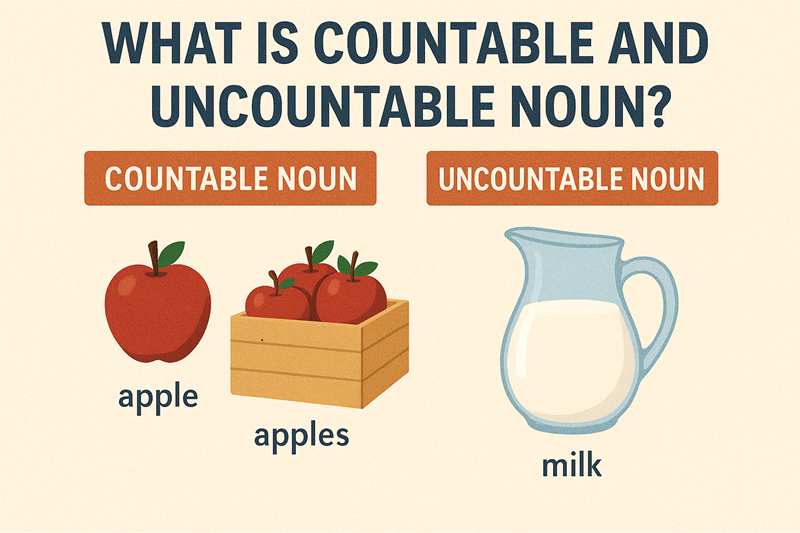
The English language is full of grammatical rules that help us express ourselves with clarity and precision. One essential concept every learner should understand is the difference between countable and uncountable nouns. Whether you're writing essays, speaking fluently, or preparing for language exams like IELTS, TOEFL, or PTE, mastering this topic is crucial. This blog will guide you through the definitions, rules, examples, usage, and common mistakes related to countable and uncountable nouns in a detailed and straightforward manner.
What are Nouns?
Nouns are words that name people, places, things, or ideas. They play a central role in the structure of sentences. However, nouns are not all the same—some can be counted, and some cannot. That brings us to two main categories-
- Countable Nouns (e.g., books, apples, cars)
- Uncountable Nouns (e.g., water, sugar, advice)
Understanding the difference is vital for using the correct verbs, articles, and quantifiers.
What are Countable Nouns?
Countable nouns are nouns that refer to things that can be counted individually. They have both singular and plural forms, and you can use numbers or quantifiers with them (e.g., one apple, two apples).
Key features of countable nouns-
- They can be singular or plural.
§ book → books
§ car → cars
- They can be used with a/an in the singular form.
§ a pen, an apple
- They are used with numbers and quantifiers like many, few, and several.
§ Three chairs, many students, few ideas
Examples-
- Singular- a cat, an idea, one chair
- Plural- two cats, many ideas, five chairs
Example Sentences-
- I have two pens in my bag.
- She saw a bird in the tree.
- There are many books in the library.
What are Uncountable Nouns?
Uncountable nouns (also known as mass nouns) refer to substances, concepts, or things that cannot be counted individually. They are treated as singular and do not have a plural form. These nouns represent things that are seen as a whole or mass and are measured by quantity rather than number.
Key features of countable nouns-
- They do not have plural forms.
§ (Not: waters, sugars, information)
- You cannot use a/an before them.
§ (Not: an advice, a milk)
- Used with quantifiers like some, much, a little, and a lot of.
§ some rice, much information, a little butter
- Measured with containers, units, or quantities if needed.
§ A bottle of water, a piece of advice, a bag of rice
Examples-
- Water, rice, furniture, music, advice, happiness
Example sentences-
- I need some water.
- He gave me advice on the project.
- We don’t have much time left.

What are the key differences between countable and uncountable nouns?
- Ability to be counted-
§ Countable nouns refer to items that can be counted individually.
§ Uncountable nouns refer to items that cannot be counted separately.
- Singular and plural forms-
§ Countable nouns have both singular and plural forms.
§ Uncountable nouns do not have plural forms and are always treated as singular.
- Use of Articles-
§ Countable nouns can be used with articles like “a” or “an.”
§ Uncountable nouns do not take “a” or “an.”
- Use of numbers-
§ Countable nouns can be used directly with numbers.
§ Uncountable nouns require units of measurement when referring to quantity.
- Appropriate quantifiers-
§ Countable nouns are used with quantifiers such as many, few, and several.
§ Uncountable nouns are used with quantifiers such as much, little, and a bit of.
- Verb agreement-
§ Countable nouns in the plural form take plural verbs.
§ Uncountable nouns always take singular verbs.
- Measurement-
§ Countable nouns do not typically need measurement units to specify quantity.
§ Uncountable nouns often need measurement units or containers to quantify them.
- Meaning and nature-
§ Countable nouns often refer to concrete objects.
§ Uncountable nouns often refer to substances, concepts, or abstract ideas.
|
Feature |
Countable Nouns |
Uncountable Nouns |
|
Can be counted? |
Yes |
No |
|
Singular/Plural |
Both |
Only singular |
|
Use of a/an |
Yes |
No |
|
Use of many/few |
Yes |
No |
Articles and quantifiers-
Correct use of articles and quantifiers depends on the noun type.
For Countable Nouns-
- a/an → a pencil, an egg
- some → some apples
- many, few, several, a couple of → many cars, few ideas
For Uncountable Nouns-
- some → some milk
- much, a little, a bit of, a lot of → much information, a little butter
§ Incorrect: He gave me advice
§ Correct: He gave me some advice
Plural forms of countable and uncountable nouns-
Understanding plural forms is essential when using countable and uncountable nouns correctly in English. Here's a clear breakdown:
Plural forms of countable nouns-
Countable nouns can be singular or plural. The plural form is typically created by adding -s or -es to the singular noun.
Common rules-
- Add -s to most nouns-
§ book → books, dog → dogs
2. Add -es to nouns ending in -s, -sh, -ch, -x, or -z
§ box → boxes, dish → dishes
3. Change -y to -ies if preceded by a consonant-
§ baby → babies
4. Add -ves for some nouns ending in -f or -fe-
§ leaf → leaves, knife → knives
5. Irregular plurals-
§ child → children, man → men, mouse → mice
6. Same singular and plural-
§ sheep → sheep, deer → deer
Plural forms of uncountable nouns-
Uncountable nouns do not have a plural form. They are always treated as singular, even when referring to large quantities.
Key points-
- You cannot add -s or -es to uncountable nouns.
- They require measurement words (e.g., a piece of, a glass of) or quantifiers (e.g., some, much, a lot of).
Incorrect plurals (Examples of Common Mistakes)-
- Incorrect- informations → Correct- information
- Wrong- furnitures → Right- furniture
- Incorrect- advices → Correct-advice
Rules and regulations of countable and uncountable nouns-
Understanding the rules and regulations of countable and uncountable nouns is essential for constructing grammatically correct sentences and using proper articles, quantifiers, and verb agreements. Below is a structured guide-
Rules for countable nouns-
- It can be counted individually- These nouns refer to things you can count one by one.
- Have singular and plural forms
- Singular form- used with “a” or “an”.
- Plural form- usually formed by adding -s or es.
- Used with numbers- It can be directly quantified with numerals (e.g., one apple, three cars).
- It can be used with quantifiers- Common quantifiers: many, few, several, some, a couple of.
- Verb agreement- A Singular countable noun takes a singular verb. A plural countable noun takes a plural verb.
Rules for uncountable nouns-
- It cannot be counted individually- These nouns refer to masses, substances, or abstract ideas that are not separable into individual elements.
- No plural form- They always remain singular and do not take an -s or -es ending.
- Not used with A/An- “A” or “an” is not used with uncountable nouns. Use quantifying phrases instead.
- Used with quantifiers- Common quantifiers: much, little, a bit of, a great deal of, some.
- Require measuring units or containers for counting- Use units or packaging: a cup of tea, a bottle of water, a piece of advice.
- Verb agreement- Always takes a singular verb, even when referring to large quantities.
Shared and overlapping rules-
1. Some nouns can be both-
- Depending on the context, a noun can be countable or uncountable.
- Example: “Chicken” as a meat (uncountable), “a chicken” as an animal (countable).
2. Use of “Some” and “Any”-
- Both types of nouns can use “some” or “any”-
- “Some apples” (countable)
- “Some milk” (uncountable)
Common examples in daily use-
Countable Nouns-
|
Singular |
Plural |
|
apple |
apples |
|
car |
cars |
|
idea |
ideas |
|
bottle |
bottles |
|
table |
tables |
Uncountable Nouns-
|
Category |
Examples |
|
Liquids |
water, milk, oil, juice |
|
Food |
rice, sugar, flour, bread |
|
Abstract |
advice, information, knowledge, patience |
|
Materials |
wood, metal, plastic, paper |
How to use countable and uncountable nouns in sentences?
Countable Nouns-
- There are three students in the classroom.
- I bought a laptop last week.
- She has many friends in Europe.
Uncountable Nouns-
- Can I have some milk, please?
- We need a little sugar for the cake.
- Music helps me relax.
What are the common mistakes you should avoid while using countable and uncountable nouns?
- Using "a" or "an" with uncountable nouns- Uncountable nouns should not be preceded by indefinite articles.
- Using plural forms for uncountable nouns- To avoid adding “-s” or “-es” to uncountable nouns, as they do not have plural forms.
- Incorrect use of quantifiers- Using quantifiers like "many" or "few" with uncountable nouns, or "much" or "little" with countable nouns, is incorrect.
- Wrong verb agreement- Matching plural verbs with uncountable nouns or singular verbs with plural countable nouns causes grammatical errors.
- Not using measuring words for uncountable nouns- Uncountable nouns require measurement units or containers to specify quantity.
- Confusing dual-use nouns- Some nouns can be both countable and uncountable based on context; misusing them leads to confusion.
- Using numbers directly with uncountable nouns- Uncountable nouns cannot be quantified using direct numerals without a unit.
- Translating from other languages incorrectly- Literal translations may lead to misapplying countability, especially with abstract or material nouns.
- Using incorrect articles or determiners- Applying determiners like “each,” “every,” or “a few” incorrectly with uncountable nouns is a common mistake.
- Forgetting that some plural-looking words are uncountable- Words that appear plural may still be uncountable and require singular treatment.
Which is the strategy you should adopt to master countable and uncountable nouns?
Mastering countable and uncountable nouns requires a combination of learning, practice, and awareness. Here's a straightforward, step-by-step strategy to help you become confident in using them correctly-
- Understand the core concepts clearly- Learn the definitions, rules, and differences between countable and uncountable nouns. Focus on key grammar points: plural forms, quantifiers, articles, and verb agreement.
- Memorize common uncountable nouns- To make a list of frequently used uncountable nouns (e.g., advice, information, furniture). Group them by category (food, liquids, abstract ideas) for easier recall.
- Learn quantifiers and their correct usage- Practice matching appropriate quantifiers-
- Countable → many, few, several
- Uncountable → much, little, a bit of
- Use visual aids and flashcards- To create flashcards with examples of each noun type. Use color codes (e.g., blue for countable, red for uncountable) to enhance memory.
- Practice with real-life sentences- Write your sentences using both noun types. Use them in speaking or journaling about your daily routine.
- Read English materials regularly- Read newspapers, blogs, or storybooks to observe how native speakers use countable and uncountable nouns naturally.
- Do grammar exercises and quizzes- Practice grammar worksheets and online quizzes specifically focused on this topic. Review mistakes to reinforce correct usage.
- Watch and listen to native content- Watch videos, movies, and news in English to hear the correct usage in context. Pay attention to quantifiers, articles, and verbs used with each noun type.
- Review and revise regularly- Revisit your notes and examples frequently to reinforce learning. Keep a personal grammar notebook to track tricky words and confusing cases.
Practice Exercise-
Identify whether the following nouns are countable or uncountable:
- Information
- Bottle
- Bread
- Chairs
- Music
- Advice
- Pen
- Time
- Water
- Apples
Answers:
- Uncountable
- Countable
- Uncountable
- Countable
- Uncountable
- Uncountable
- Countable
- Uncountable
- Uncountable
- Countable
Conclusion-
Understanding the difference between countable and uncountable nouns is essential for accurate grammar, better writing, and fluent communication in English. It affects the articles and quantifiers you use, the verb agreement, and the overall clarity of your message. While it may seem tricky at first, especially with abstract or dual-meaning words, practice and exposure will help solidify this concept. Whether you are writing an academic essay, speaking in a formal setting, or casually chatting with a friend, knowing when a noun can be counted (and how) gives your English a professional and polished touch. Keep learning, keep practicing, and soon it will become second nature.
FAQs on Countable or Uncountable Nouns-
Q.1 What is a countable noun?
Ans- A countable noun refers to something that can be counted individually and has both singular and plural forms.
Q.2 What is an uncountable noun?
Ans- An uncountable noun refers to something that cannot be counted individually and does not have a plural form.
Q.3 Can a noun be both countable and uncountable?
Ans- Yes, some nouns can be both, depending on the context and meaning.
Q.4 Do uncountable nouns use "a" or "an"?
Ans- No, uncountable nouns do not take "a" or "an" directly.
Q.5 How do you measure uncountable nouns?
Ans- Use units or containers like “a piece of,” “a bottle of,” or “a cup of” for measurement.
Q.6 What quantifiers are used with countable nouns?
Ans- Quantifiers like many, few, several, and several are used with countable nouns.
Q.7 What quantifiers are used with uncountable nouns?
Ans- Use much, little, a bit of, and a great deal of with uncountable nouns.
Q.8 Can you use numbers with uncountable nouns?
Ans- No, you need to use a measurement unit with numbers for uncountable nouns.
Q.9 Do uncountable nouns take plural verbs?
Ans- No, uncountable nouns are always treated as singular and take singular verbs.
Q.10 Why is it important to know the difference?
Ans- Knowing the difference helps you use correct grammar, quantifiers, and verb agreements in English communication.






Leave a Comment
Your email address will not be published.