
Study Abroad Blogs
Abroad Insights: News and Tips for Students

Why is Dubai Becoming a Popular Study Destination for International Students?
In the last decade, Dubai has rapidly emerged as a leading hub for international education, drawing students from across the globe. Once known mainly for its luxury tourism, futuristic skyline, and thriving business environment, Dubai is now becoming synonymous with world-class education. But what is it exactly that makes this city such an attractive study destination?
In this blog, we will explore the key reasons why international students are choosing Dubai as their academic home, what makes it an attractive place to study in Dubai, and what sets it apart from other global education hubs.
Why is Dubai gaining popularity as a study-abroad destination among international students?
Dubai is becoming a more popular study destination for international students because of its excellent educational system, diversified environment, advantageous location, robust employment market, and safe and stimulating academic atmosphere. The following factors contribute to Dubai's appeal as a study-abroad location.
World-class universities and international branch campuses
Dubai is home to a growing number of reputable universities and branch campuses of globally ranked institutions. Dubai International Academic City (DIAC) and Dubai Knowledge Park house prestigious institutions such as:
University of Birmingham Dubai
Heriot-Watt University Dubai
Middlesex University Dubai
Murdoch University Dubai
American University in Dubai (AUD)
Canadian University Dubai (CUD)
These institutions offer globally recognized degrees and maintain the same academic standards as their main campuses abroad. For students who seek an international degree without travelling too far from home, Dubai is the perfect place.
Strategic global location
Dubai's geographical position makes it a convenient choice for students from Asia, Africa, and Europe. Located at the crossroads of East and West, Dubai is easily accessible via direct flights from major cities around the world. This accessibility is especially beneficial for international students who may need to travel home during holidays or emergencies.
Diverse and inclusive multicultural environment
Dubai is among the world's most multicultural cities. With over 200 nationalities living and working in the city, students are immersed in a melting pot of cultures, languages, and perspectives. This exposure not only enriches their academic experience but also fosters global awareness and intercultural skills — traits highly valued in today’s job market.
The city also promotes a culture of inclusivity and religious tolerance, which allows students of all backgrounds to feel welcomed and respected.
English as the medium of instruction
For many international students, language can be a major barrier when considering a study destination. In Dubai, however, English is widely spoken and used as the medium of instruction in nearly all universities. This makes it easier for international students to adapt and succeed in their academic programs without having to learn a new language.
Safety and quality of life
Dubai is frequently included among the world's finest cities. It boasts a low crime rate and a strong rule of law, giving parents peace of mind when sending their children abroad. The city also offers a high standard of living, with modern infrastructure, reliable public transportation, excellent healthcare, and a vibrant social scene. Students can enjoy a wide range of leisure activities, from desert safaris and beach days to world-class shopping and cultural festivals.
Employment and internship opportunities
Dubai’s economy is highly diversified and booming, offering students numerous opportunities to gain real-world experience. Fields such as finance, hospitality, engineering, media, and information technology are thriving in Dubai. Many universities have strong industry ties and offer internship programs that allow students to gain hands-on experience while studying. The UAE has also introduced policies that allow students and recent graduates to stay and work in the country, making it easier for international students to transition into the workforce.
Modern and innovative learning facilities-
Universities in Dubai are equipped with state-of-the-art campuses that offer the latest learning technologies, libraries, labs, and recreational spaces. Many institutions also encourage innovation and entrepreneurship through incubators and startup programs, helping students turn their ideas into viable business ventures. Dubai’s focus on smart city initiatives and digital transformation makes it a particularly appealing destination for students in tech-related fields.
Wide range of programs and courses
Dubai offers a diverse portfolio of undergraduate and postgraduate programs. It offers degrees in business, engineering, media, healthcare, IT, architecture, arts, and more. Whether a student is interested in traditional disciplines or emerging fields, they are likely to find a program that matches their interests and career goals. Many universities also offer flexible study schedules, including evening and weekend classes, to cater to working professionals or students with other commitments.
Scholarships and financial support
To attract top talent from around the world, many Dubai-based universities offer generous scholarships, tuition discounts, and financial aid. Scholarships are available based on merit, financial need, or specific achievements in sports, arts, or community service. This financial support makes studying in Dubai more accessible for international students whose tuition fees might otherwise be determined.
Gateway to the middle east and beyond
Studying in Dubai opens up opportunities beyond the classroom. As a major business and trade hub, Dubai provides students with networking and career opportunities throughout the Gulf Cooperation Council (GCC) countries and beyond. Graduating from a university in Dubai can open doors to careers not only in the UAE but also across the Middle East, Asia, Europe, and Africa.
Lifestyle and recreational opportunities
Life in Dubai is anything but dull. The city is packed with entertainment options, from theme parks and world-record-holding landmarks like the Burj Khalifa to music festivals, art exhibitions, and sporting events. For students, this translates into a balanced lifestyle where education meets recreation. Plus, with sunny weather year-round, beaches, and a dynamic nightlife, there’s always something fun to do outside the classroom.
Visionary government policies supporting education
The UAE government has made significant investments in education, recognizing its importance to the country's future. Initiatives such as the UAE Vision 2030 and the National Strategy for Higher Education 2030 aim to make the country a leader in academic excellence and innovation. Dubai’s education sector is thus highly regulated and supported by policy frameworks that prioritize quality, student success, and global competitiveness.
Conclusion-
Dubai’s transformation into a global education hub is no accident. It is the result of strategic planning, investment, and a vision to become a center of knowledge and innovation. Dubai offers a dynamic combination of top-notch education, cutting-edge facilities, and career-enhancing possibilities, making it an alluring location for international students in 2026. Dubai is a prominent and reasonably priced choice for students from all over the world, offering a variety of scholarships and courses designed to satisfy changing industry demands.
The opportunity to work part-time and gain access to internships at prestigious firms both improve the educational experience by giving students financial assistance and real-world experience. The option to switch to a work visa after landing a job increases the allure even if there is no specific post-study work visa. Whether you are looking to earn a prestigious international degree, expand your global network, or launch your career in a thriving market, Dubai has everything you need to make your educational journey successful and memorable.
FAQs on Dubai
Q.1 Why is Dubai attracting international students?
Ans- Dubai offers world-class education, international universities, a safe environment, and diverse cultural exposure, making it an ideal choice for students worldwide.
Q.2 Do degrees from institutions in Dubai have worldwide recognition?
The answer is that a large number of colleges in Dubai are branch campuses of esteemed international organizations and grant degrees that are accepted all around the world.
Q.3 Does the educational system in Dubai make extensive use of English?
Ans- Absolutely! English is the primary language of instruction in most universities, making it easier for international students to adapt.
Q.4 What are the living conditions like for students in Dubai?
Ans- Dubai offers modern infrastructure, safe neighborhoods, excellent healthcare, and a high standard of living for students.
Q.5 Are there job opportunities for students in Dubai?
Ans- Yes, Dubai's growing economy provides internships and part-time job opportunities, along with post-graduation work options.
Q.6. How safe is Dubai for international students?
Ans- Dubai is considered one of the safest cities in the world, with low crime rates and strong laws protecting residents and visitors.
Q.7 What kind of universities are in Dubai?
Ans- Dubai hosts both local and international universities, including branches of institutions from the UK, US, Australia, and Canada.
Q.8 Can students get scholarships to study in Dubai?
Ans- Yes, many universities in Dubai offer scholarships based on academic merit, financial need, or extracurricular achievements.
Q.9 Is Dubai affordable for international students?
Ans- While living costs vary, scholarships, tuition flexibility, and part-time work opportunities help make Dubai more affordable for students.
Q.10 What makes student life in Dubai unique?
Ans- Students in Dubai enjoy a vibrant lifestyle with multicultural exposure, global networking, exciting leisure activities, and year-round sunshine.
The Best Courses to Study in Dubai for International Students
Dubai has emerged as a global education hub, offering a diverse range of academic programs that cater to the needs of international students. With its world-class universities, cutting-edge facilities, and strategic location, Dubai provides excellent opportunities for higher education and career growth. If you’re considering higher education and planning to study in Dubai, go through this blog. Here, we have discussed some of the best courses for international students.
What are the top courses to study in Dubai for international students?
Popular and in-demand degrees for international students looking to pursue degrees in Dubai include engineering, business and management, hospitality and tourism, information technology and computer science, and architecture and design. A more comprehensive look at a number of the top courses offered to international students in Dubai is provided below-
Business Administration and Management-
Dubai is a major business hub with a thriving economy, making it an ideal place to study business administration and management. Universities like the University of Dubai, American University in Dubai (AUD), and the University of Wollongong in Dubai (UOWD) offer top-notch business programs. Specializations include:
International Business
Finance and Accounting
Marketing
Entrepreneurship
Human Resource Management
Graduates from these programs can leverage Dubai’s dynamic business environment to secure positions in multinational companies and startups or even launch their own businesses.
Engineering and Technology-
Engineering remains one of the most sought-after fields of study in Dubai. The city’s rapid infrastructural development and focus on smart technologies make it a great place for engineering students. Some of the top specializations include:
Civil Engineering
Mechanical Engineering
Electrical and Electronics Engineering
Artificial Intelligence and Robotics
Sustainable Energy Engineering
Institutions such as Heriot-Watt University Dubai, BITS Pilani Dubai, and Middlesex University Dubai provide globally recognized engineering degrees that prepare students for rewarding careers in Dubai’s expanding engineering sector.
Artificial Intelligence and Data Science-
With Dubai’s vision of becoming a smart city, there is a high demand for professionals in artificial intelligence (AI) and data science. Courses in these fields equip students with expertise in:
Machine Learning
Big Data Analytics
Internet of Things (IoT)
Cybersecurity
Cloud Computing
The University of Dubai and Dubai Institute of Design and Innovation (DIDI) offer cutting-edge programs in AI and data science that align with the city’s technological advancements.
Hospitality and Tourism Management-
Dubai is one of the world’s most visited cities, known for its luxurious hotels, shopping destinations, and cultural experiences. This makes hospitality and tourism management a lucrative course to study. Universities like The Emirates Academy of Hospitality Management and the University of West London in Dubai offer specialized programs in:
Hotel Management
Event Planning
Culinary Arts
Tourism and Travel Management
Graduates have vast opportunities to work in leading hotels, resorts, and tourism companies across the UAE.
Medicine and Healthcare-
Dubai is investing heavily in its healthcare sector, and there is a growing demand for medical professionals. International students can pursue courses in:
Medicine and Surgery (MBBS)
Nursing
Pharmacy
Biotechnology
Healthcare Management
Dubai Medical College and Gulf Medical University are some of the best institutions offering these programs, providing students with state-of-the-art learning facilities and practical training opportunities.
Fashion and Design-
Dubai has a growing fashion and design industry, making it an exciting destination for creative students. The Dubai Institute of Design and Innovation (DIDI) and Esmod Dubai offer top programs in:
Fashion Design
Interior Design
Graphic Design
Product Design
These courses allow students to explore the intersection of creativity and business, preparing them for careers in the global design industry.
Media and Communication-
Dubai’s media landscape is booming, with many international media companies setting up offices in the city. Courses in media and communication provide students with the skills needed in journalism, digital media, and public relations. Some key areas of study include:
Mass Communication
Digital Marketing
Film and Television Production
Public Relations
Middlesex University Dubai and American University in Dubai offer excellent programs in these fields, helping students develop their skills in media and communication.
Law and International Relations-
Dubai’s legal framework is unique, combining civil law and Islamic law principles. Studying law or international relations in Dubai offers students insights into global legal systems and diplomatic affairs. Some popular specializations include:
Business Law
International Law
Human Rights Law
International Relations and Diplomacy
Top institutions offering these courses include the University of Dubai and Middlesex University Dubai.
Finance and Accounting-
With Dubai being a financial hub, courses in finance and accounting are in high demand. Universities such as the University of Wollongong in Dubai and the University of Dubai offer programs specializing in:
Financial Management
Investment Banking
Taxation
Auditing
Graduates can explore career opportunities in global banks, investment firms, and corporate finance departments.
Aviation and Aerospace Engineering-
Dubai is home to one of the busiest airports in the world and a thriving aviation industry. Students interested in aviation and aerospace engineering can enroll in programs specializing in:
Aeronautical Engineering
Aviation Management
Air Traffic Management
Aircraft Maintenance Engineering
Emirates Aviation University is one of the best institutions for these courses, offering students hands-on training in the aviation industry.
What are the eligibility criteria for the best courses in Dubai?
The eligibility criteria for studying in Dubai vary based on the course and university. However, general requirements include:
Business Administration & Management
High school diploma or equivalent
Minimum GPA (varies by university)
English proficiency test (IELTS 6.0+ or TOEFL 80+)
Engineering & Technology
High school diploma with strong grades in Mathematics and Physics
English proficiency test
Some universities may require an entrance exam
Artificial Intelligence & Data Science
Strong background in Mathematics and Computer Science
High school diploma with good grades
English proficiency test
Hospitality & Tourism Management
High school diploma with a minimum GPA
English proficiency test
Some institutions require a personal statement or interview
Medicine & Healthcare
High school diploma in Biology, Chemistry, and Physics
Minimum GPA requirement (varies by university)
Entrance exams such as MCAT (if required)
English proficiency test
Fashion & Design
High school diploma
Portfolio submission (for design courses)
English proficiency test
Media & Communication
High school diploma
English proficiency test
Some programs may require a personal statement
Law & International Relations
High school diploma
English proficiency test
Some universities may require an entrance exam or interview
Finance & Accounting
High school diploma with strong Mathematics scores
English proficiency test
Some universities may require prior coursework in Economics or Accounting
Aviation & Aerospace Engineering
High school diploma in Physics and Mathematics
English proficiency test
Medical fitness test (for pilot training programs)
Conclusion-
Dubai offers a diverse range of high-quality courses for international students, catering to various industries such as business, engineering, healthcare, technology, and hospitality. With globally recognized universities, state-of-the-art facilities, and a thriving job market, Dubai provides an excellent platform for academic and professional growth. The city’s strategic location, multicultural environment, and focus on innovation make it an attractive destination for higher education. Whether you aim for a corporate career, entrepreneurship, or a creative profession, Dubai’s education system ensures you are well-prepared for global opportunities. Choosing the right course in Dubai can be a stepping stone to a successful future.
FAQs on The Best Courses to Study in Dubai for International Students-
Q.1 What are the most popular courses for international students in Dubai?
Ans- Business administration, engineering, artificial intelligence, hospitality management, medicine, fashion design, media and communication, law, finance, and aviation are among the top courses in Dubai.
Q.2 Which universities in Dubai offer business management courses?
Ans-Top universities offering business management courses include the University of Dubai, American University in Dubai (AUD), and University of Wollongong in Dubai (UOWD).
Q.3 Is Dubai a good destination for studying engineering?
Ans-Yes, Dubai is an excellent choice for engineering studies, with institutions like Heriot-Watt University Dubai and BITS Pilani Dubai offering world-class engineering programs.
Q.4 Can international students study medicine in Dubai?
Ans-Yes, international students can pursue medical degrees at institutions like Dubai Medical College and Gulf Medical University.
Q.5 What are the best courses for students interested in technology?
Ans- Artificial intelligence, data science, cybersecurity, cloud computing, and software engineering are some of the best tech-related courses in Dubai.
Q.6 Are there scholarships available for international students in Dubai?
Ans- Yes, many universities in Dubai offer scholarships and financial aid based on academic merit and need.
Q.7 What courses should you study for a career in Dubai’s tourism industry?
Ans- Hospitality management, hotel management, event planning, and tourism management are ideal for careers in Dubai’s thriving tourism industry.
Q.8 Can you work while studying in Dubai?
Ans- International students can work part-time during their studies, but they must obtain permission from their university and meet visa requirements.
Q.9 What are the career prospects after studying in Dubai?
Ans- Dubai offers excellent job opportunities in business, engineering, healthcare, finance, aviation, and hospitality, with many multinational companies based in the city.
Q.10 How do you choose the right course to study in Dubai?
Ans- Consider your career goals, industry demand, university rankings, and scholarship options when selecting a course in Dubai.

Studying in Dubai: Cultural Insights & Essential Tips for International Students
Dubai, the crown jewel of the United Arab Emirates (UAE), has rapidly transformed from a desert port town into a bustling global city. Known for its towering skyscrapers, luxury shopping, and futuristic innovation, Dubai also offers a rich tapestry of culture and tradition. For international students, choosing to study in Dubai is not only an academic journey but also an immersive cultural experience. Understanding the cultural landscape can significantly enrich your time in the emirate and help you adapt more smoothly.
In this blog, we will explore the cultural aspects you can expect when studying in Dubai, including social norms, etiquette, religion, food, lifestyle, language, and the unique blend of modernity and tradition.
What are the key things students should know when studying in Dubai?
The United Arab Emirates (UAE), which is surrounded by the Arabian desert and sits on the Persian Gulf, has Dubai as part of its biggest and most populous metropolitan region.
Dubai is a well-liked study location because of its skyscrapers, excellent quality of life, and respectable universities. Students from all over the world are drawn to this genuinely global metropolis. Dubai is a city that embraces the contemporary era while yet preserving its cultural legacy. In addition to providing international students with many excellent options, Dubai is also home to Arab cultures that may differ from those of the West. There are certain things that you should keep in mind while studying in Dubai.
1. A Melting Pot of Cultures
Dubai is one of the most multicultural cities in the world. Over 85% of its population comprises expatriates from around the globe. While Dubai is open to international cultures, it's important to respect the Emirati customs and values that underpin life in the city. This means students will encounter a diverse range of cultures, languages, and traditions.
- A cosmopolitan lifestyle where you can meet people from India, the Philippines, Pakistan, Europe, Africa, the Americas, and beyond.
- Exposure to a variety of global cuisines, fashion, and festivals.
- Networking opportunities with peers from different nationalities can be advantageous both socially and professionally.
2. Respect for Islamic Culture
Islam is the official religion of the UAE, and it deeply influences the laws, social behaviors, and cultural norms of Dubai. Understanding basic Islamic customs, such as greeting with "As-salaam alaykum," shows cultural respect and can help you bond with locals. While Dubai is relatively liberal compared to other parts of the Middle East, students are expected to respect Islamic traditions.
- Prayer Times: You'll hear the call to prayer five times a day. Some public places and universities might observe short breaks during prayer times.
- Ramadan: During the holy month of fasting, eating, drinking, or smoking in public during daylight hours is prohibited.
- Dress Code: While there's no strict dress code, modest clothing is encouraged in public places.
3. Social Etiquette and Behavior
Dubai is known for its high standards of public behavior. Social etiquette here combines traditional Middle Eastern values with global cosmopolitanism. It is always a good idea to observe how locals and long-term residents behave in public spaces and follow suit.
Do's
- Be polite and respectful in conversation.
- Use your right hand for greeting or giving/receiving items.
- Dress appropriately, especially in religious or traditional areas.
Don'ts
- Avoid public displays of affection.
- Refrain from offensive language or gestures.
- Don't photograph people, especially women, without permission.
4. Legal and Lifestyle Differences
Dubai's legal system is based on a combination of Sharia law and civil law. Some behaviors that are acceptable in your home country might be restricted in Dubai. Stay updated on local laws, especially if you plan to work part-time, drive, or engage in any freelance activity.
- Alcohol: Legal but restricted to licensed venues like hotels and bars. Public intoxication is punishable by law.
- Relationships: Cohabitation laws have been relaxed recently, but it's still advisable to be cautious and respectful.
5. Language: English Is Widely Spoken
Arabic is the official language, but English is the lingua franca in business, education, and daily life. Most universities conduct courses in English. Even more so than Arabic, English is the most widely spoken language in Dubai. You will encounter people who speak the same language as you because Dubai is a cultural melting pot. There, people are likewise eager to meet new people. Because of the documentation involved in wishing to study in the city, some Arabic is still necessary. Your time in Dubai will be more meaningful if you can learn a few words in the language. Learning a few Arabic phrases can enhance your cultural experience and earn appreciation from locals.
Useful Arabic Phrases
- Shukran – Thank you
- Marhaba – Hello
- Afwan – You're welcome
- La Shukran – No, thank you
6. Hospitality and Generosity
Emirati culture places a strong emphasis on hospitality. You may find yourself being offered coffee (Gahwa) or dates as a gesture of welcome. If invited to an Emirati home, remove your shoes before entering, bring a small gift, and always compliment the host's generosity.
- Guests are treated with immense respect.
- Sharing food is a common practice and symbolizes friendship and community.
7. Festivals and Celebrations
Dubai celebrates a variety of festivals throughout the year, reflecting its multicultural society. Participate in multicultural celebrations on campus—whether it's Diwali, Christmas, Chinese New Year, or Eid—to make new friends and learn about global traditions.
- Eid al-Fitr and Eid al-Adha: Celebrated by Muslims with prayers, feasts, and family gatherings.
- Dubai Shopping Festival: A month-long extravaganza of sales, entertainment, and global performances.
- National Day (December 2): Marked with fireworks, cultural shows, and parades.
8. Gender Norms and Interactions
While Dubai is progressive in many ways, gender norms are influenced by Islamic values. Always maintain professionalism in interactions and be sensitive to cultural boundaries.
In Educational Institutions
- Male and female students study together in most universities.
- Respectful and professional interaction between genders is the norm.
In Public Spaces
- There may be women-only sections in public transport or gyms.
- Flirting or unsolicited attention is considered inappropriate.
9. Campus Culture and Student Life
Student life in Dubai is vibrant, thanks to its array of international universities and student communities. Take full advantage of campus events to integrate into the student community and network for future opportunities.
On-Campus Activities
- Clubs for arts, sports, literature, debate, and technology.
- Cultural days where students wear traditional attire and share cuisines.
- Internship fairs, seminars, and workshops by industry professionals.
Off-Campus Life
- Beaches, malls, desert safaris, and global cuisine await exploration.
- Cultural hubs like the Al Fahidi Historical District and Dubai Opera are worth visiting.
10. Food and Dining Culture
Dubai is a food lover's paradise. You'll find everything from street shawarmas to Michelin-star restaurants. Try traditional Emirati food at local heritage restaurants to get a taste of the region's culture and hospitality.
- Local favorites: Machboos, Harees, Falafel, Hummus.
- International cuisine: Indian, Italian, Chinese, Korean, Japanese, African—you name it.
- Dining etiquette: Tipping is appreciated but not mandatory (usually around 10%).
11. Transportation and Mobility
Dubai's transport system is modern, efficient, and student-friendly. Apply for a student NOL Card for discounted metro and bus fares.
- Metro: Clean, safe, and covers major parts of the city.
- Buses and Trams: Affordable and extensive routes.
- Taxis and Ride-Sharing: Widely available with apps like Careem and Uber.
12. Climate and Clothing
Dubai has a desert climate, hot and sunny for most of the year. Always carry sunglasses, sunscreen, and a water bottle during the summer months. Dress in layers for air-conditioned indoor settings.
- Summer (May to September): Can exceed 45°C. Light, breathable clothing is best.
- Winter (November to March): Pleasant and ideal for outdoor activities.
13. Balancing Tradition and Innovation
One of the most striking features of Dubai is its ability to blend tradition with modernity seamlessly. Embrace this duality; it reflects Dubai's unique position as a global city with deep cultural roots.
- Modern skyscrapers beside traditional souks.
- Cutting-edge universities offering Islamic studies programs.
- Women in abayas working in AI, science, and engineering fields.
14. Safety and General Living
Dubai is one of the safest cities in the world, with very low crime rates. While the city is safe, always stay alert, follow laws, and respect local customs to avoid misunderstandings.
- Strict laws ensure public order and safety.
- Women feel secure walking alone, even at night.
15. Dubai Has Vibrant Nightlife
Dubai has a vibrant nightlife that appeals to young people. You may visit early to experience the city's vibrant nightlife, even if it doesn't begin until 9 p.m. It is illegal to buy or consume alcohol in Dubai due to Sharia law; therefore, when you go out to drink, make sure you have your license with you.
16. Specific Dress Codes Must Be Followed
Dubai also has very severe dress standards. Women of all faiths ought to always dress decently and only wear swimsuits on beaches or in swimming pools. There are also a lot of traditional tourist attractions that have religious importance, so when you visit, be polite at all times and refrain from making public displays of affection or disparaging the royal family or Islam.
17. Dubai Has a Hot Climate
The environment in Dubai is scorching, so if there's one thing you should be especially aware of while there, it's the weather. The weather in Dubai is scorching. The sun's scorching beams surround the city for nearly the whole year. There are plenty of options to enjoy outdoor activities like tanning at the beach in this environment, but if that's not your thing, there are always stores, pubs, and restaurants to choose from. In Dubai, every store has air conditioning.
Conclusion
Studying in Dubai offers a unique blend of academic excellence and rich cultural immersion. From its deep-rooted Islamic traditions to its vibrant multicultural environment, students gain more than just a degree—they gain a global perspective. Understanding and respecting local customs, social norms, and legal expectations not only ensures a smoother transition but also enriches your overall experience. With its safety, diversity, and world-class infrastructure, Dubai is an exciting destination where tradition meets modernity. Embracing these cultural insights will help you thrive academically, socially, and personally during your study journey in this dynamic and welcoming city.
FAQs on Cultural Insights: What to Expect When Studying in Dubai
Q.1 Is English widely spoken in Dubai?
Ans: Yes, English is widely spoken and is the primary language used in universities, businesses, and public spaces.
Q.2 Do you need to know Arabic to study in Dubai?
Ans: No, Arabic is not required for studying, but learning a few basic phrases can help you connect with locals and show respect for the culture.
Q.3 What is the dress code for students in Dubai?
Ans: Students should dress modestly, especially in public spaces. Universities usually allow casual attire, but revealing clothing should be avoided.
Q.4 Can you practice my religion in Dubai?
Ans: Yes, Dubai is religiously tolerant, and people of different faiths are allowed to worship and celebrate their religious practices freely.
Q.5 Is Dubai safe for international students?
Ans: Absolutely. Dubai is considered one of the safest cities globally, with very low crime rates and strong law enforcement.
Q.6 Are there any cultural taboos you should avoid?
Ans: Yes, avoid public displays of affection, swearing, dressing inappropriately, or disrespecting religion or the local culture.
Q.7 What happens during Ramadan for students?
Ans: During Ramadan, eating, drinking, or smoking in public during the day is discouraged. Many university services may adjust hours in observance.
Q.8 Can women study and work freely in Dubai?
Ans: Yes, women can study, work, and participate in all areas of public life. Gender equality is supported, especially in education and the workplace.
Q.9 What kind of food is available for students?
Ans: Dubai offers a wide range of food from local Emirati dishes to international cuisines.
Q.10 How should you greet locals or professors?
Ans: A polite verbal greeting like "Hello" or "As-salaam alaykum" is common. Avoid overly casual gestures like hugs or high-fives unless you know the person well.
Scholarships and Financial Aid for Studying in Dubai: A Comprehensive Guide
Dubai has emerged as a premier destination for higher education, attracting international students with its world-class universities, cutting-edge facilities, and multicultural environment. However, choosing to study in Dubai can be expensive, making scholarships and financial aid crucial for international students seeking to fund their education. This guide explores the various scholarships, financial aid options, and strategies available for students planning to study in Dubai.
Why Study in Dubai?
Dubai has rapidly become a leading global education hub, attracting students from around the world. The city boasts world-class universities such as the American University in Dubai, Middlesex University Dubai, and the University of Dubai, offering globally recognized degrees. With a strategic location connecting East and West, Dubai provides excellent networking and career opportunities.
Students benefit from a multicultural environment, with peers from over 200 nationalities, fostering a diverse and inclusive learning experience. The city’s modern infrastructure, high-tech campus facilities, and innovative teaching methods enhance education quality. Moreover, Dubai is known for its safety, quality of life, and job opportunities, particularly in fields like finance, technology, and hospitality.
Financially, Dubai offers scholarships and financial aid, making education more accessible. With a booming economy, tax-free income, and thriving industries, studying in Dubai is a stepping stone to a successful global career.
How many categories do to get a scholarship in Dubai universities?
For overseas students, Dubai offers a range of scholarships that fall into three categories: institution-specific, non-government, and government-funded. These programs seek to promote academic achievement and diversity while lowering the cost and increasing access to higher education.
- Merit-based scholarships- They cover all or a portion of your tuition costs. They are given to students who have demonstrated great academic accomplishment and high marks on standardized tests.
- Need based scholarship- Tuition and other associated expenses are covered by need-based scholarships, which are intended for students who have a need for financial assistance.
- Sports scholarships- These grants, which are awarded to gifted players, help you pursue your academic and athletic goals at the same time.
- Research scholarships- By offering funding for research projects and postgraduate coursework, these awards encourage individuals who are interested in conducting research.
- Cultural scholarships- Encourage cross-cultural interaction by providing financial aid to students from various backgrounds and countries.
- Women in STEM scholarships- Scholarships specifically for women pursuing STEM degrees can help promote gender diversity in STEM areas.
- Scholarships through industry partnerships- These scholarships, which are offered in association with top businesses, may involve internships or cooperative education programs to provide hands-on experience.
- Scholarships for community impact- given to students who have a great desire to improve society and do community service.
- Alum scholarships-These scholarships, which are only available to graduates of partner schools, let international students and alums feel more connected to one another.
- Government scholarships-Funded by UAE government programs, these scholarships assist overseas students with living expenses, tuition, and other educational expenditures.
What kind of scholarships are available in Dubai?
Scholarships are offered by the government, a number of schools, and organizations to assist students in covering their living expenses and tuition. The following are some of the main categories of scholarships that are offered:
Government Scholarships-
Dubai’s government and UAE-based institutions offer scholarships to outstanding students, often covering tuition fees, accommodation, and other expenses.
a. Sheikh Mohammed Bin Rashid Al Maktoum Foundation Scholarships
- Aimed at talented students from various nationalities.
- Covers tuition fees and living expenses.
- It concentrates on students seeking advanced degrees in disciplines such as engineering, business, and technology.
b. UAE Government Scholarships for International Students
- Available for students applying to public and private universities in Dubai.
- Includes full and partial scholarships.
- Qualifications according to activities and educational achievements.
University-Specific Scholarships-
In Dubai, a number of colleges provide dependent-on-need and merit-based financial aid. Some notable ones include:
a. American University in Dubai (AUD) Scholarships
- Merit-based scholarships for high-achieving students.
- For learners in need of financial assistance, necessity-based financial support is available.
- Special grants for students excelling in sports and extracurricular activities.
b. University of Dubai Scholarships
- Offers academic excellence scholarships for top-performing students.
- Provides tuition fee waivers ranging from 10% to 50%.
- There are additional opportunities for need-based financial help.
c. Middlesex University Dubai Scholarships
- High Achievers Scholarship: For students with outstanding academic records.
- International Study Grant: Aims to support international students with partial tuition fee waivers.
- Sports scholarships are offered to students who succeed in athletics.
Corporate and Private Scholarships-
Many companies and private organizations provide scholarships for students pursuing higher education in Dubai.
a. Al Qasimi Foundation Scholarships
- Supports students in various disciplines, particularly education and social sciences.
- Offers partial and full tuition coverage.
- Provides mentorship and research opportunities.
b. Emirates Aviation University Scholarships
- Available for students pursuing aviation and engineering courses.
- Offers full and partial tuition waivers based on merit.
c. Dubai International Academic City (DIAC) Scholarships
- DIAC collaborates with universities to provide scholarships to talented students.
- Provides financial aid to students who achieve academically.
What possibilities do international students have for financial help in Dubai?
In addition to grants and loans, students can look into other forms of financial assistance to help pay for their education.
Student Loans-
Many banks and financial institutions in Dubai offer student loans with low interest rates and flexible repayment plans.
a. Emirates NBD Student Loans
- Designed for undergraduate and postgraduate students.
- Low interest rates and flexible repayment periods.
b. Mashreq Bank Student Loans
- Provides education loans for international students.
- • Pays for living expenses, housing, and tuition.
Work-study Plans-
Students can fund their studies by working part-time at many of Dubai's institutions.
- Students can work on-campus in administrative roles, libraries, or research projects.
- Dubai’s free zones allow students to work part-time with university approval.
- Helps students gain work experience while managing expenses.
Grants and Fellowships-
Some universities and organizations provide research grants and fellowships for postgraduate and Ph.D. students.
- Khalifa University Fellowships: Available for postgraduate research students.
- Mohammed Bin Rashid School of Government Grants: Supports students pursuing public policy and governance studies.
How to submit financial aid and scholarship applications?
It takes preparation to apply for financial assistance and scholarships. Here are some key steps:
1. Research Available Scholarships
- Explore university websites, government portals, and private organizations for scholarship opportunities.
- Contact admissions offices for detailed information.
2. Check Eligibility Criteria
- Ensure you meet the academic, financial, and extracurricular requirements before applying.
3. Prepare Necessary Documents
Most scholarship applications require:
- Academic transcripts
- Letters of recommendation
- Personal statement or essay
- Financial statements (for need-based scholarships)
4. Apply Before Deadlines
- Apply for many scholarships and grants to improve your possibilities.
- Some scholarships have multiple rounds, so be aware of the timelines.
5. Apply for Multiple Scholarships
- Pay attention to the application due dates and file your applications early.
6. Follow Up on Applications
- After submission, follow up with the scholarship providers or universities for updates.
Conclusion-
Studying in Dubai can be a rewarding experience, but financial constraints can be a major challenge. Fortunately, numerous scholarships and financial aid options are available to help students achieve their academic goals. By researching opportunities, preparing strong applications, and exploring financial aid programs, students can make their dream of studying in Dubai a reality.
FAQs on Scholarships and Financial Aid for Studying in Dubai: A Comprehensive Guide-
Q.1 What types of scholarships are available for students in Dubai?
Ans- Dubai offers government scholarships, university-specific scholarships, private and corporate-funded scholarships, and merit-based or need-based financial aid.
Q.2 Who is eligible for scholarships in Dubai?
Ans- Eligibility varies by scholarship, but common criteria include academic excellence, financial need, extracurricular achievements, and nationality requirements.
Q.3 Which universities in Dubai offer scholarships to international students?
Ans- Top universities like the American University in Dubai, the University of Dubai, Middlesex University Dubai, and Emirates Aviation University offer scholarships.
Q.4 How can you apply for a scholarship in Dubai?
Ans- You can apply through the university’s website or scholarship provider, submitting necessary documents such as transcripts, recommendation letters, and personal statements.
Q.5 Are there full scholarships available for international students?
Ans- Yes, some scholarships, such as those from the Sheikh Mohammed Bin Rashid Al Maktoum Foundation, offer full tuition coverage along with living expenses.
Q.6 Can you work while studying in Dubai to support my education?
Ans- Yes, Dubai allows students to work part-time in designated free zones or on campus with university approval.
Q.7 Do banks in Dubai offer student loans for international students?
Ans- Yes, banks like Emirates NBD and Mashreq Bank offer student loans with flexible repayment options for higher education.
Q.8 When should you apply for scholarships in Dubai?
Ans-Deadlines vary by scholarship, but it is recommended to start applying at least 6–12 months before your course begins.
Q.9 What documents are needed for a scholarship application?
Ans-Typically, you need academic transcripts, a personal statement, recommendation letters, and proof of financial need (if applicable).
Q.10 Are there research grants or fellowships available in Dubai?
Ans- Yes, postgraduate and Ph.D. students can apply for research grants and fellowships from universities and organizations like Khalifa University and Mohammed Bin Rashid School of Government.
Living in Dubai as a Student: Costs, Housing, and Lifestyle
Dubai, a global hub of business, technology, and tourism, has become an attractive destination for international students. With world-class universities, a multicultural environment, and a thriving economy, Dubai offers a unique experience for students. However, living in this vibrant city comes with its challenges and costs. This guide will walk you through the expenses, accommodation options, and lifestyle in Dubai, especially for those planning to study in dubai for indian student.
What about the cost of living in Dubai for students?
Living in Dubai can be expensive compared to other student-friendly destinations, but careful budgeting can help students manage their expenses effectively. Below is a summary of the main expenses-
Tuition fees-
Tuition fees in Dubai vary depending on the university, program, and whether the institution is private or public. On average, annual tuition fees range from AED 40,000 to AED 100,000 (USD 10,800 to USD 27,000). Some top universities, like the University of Dubai, American University in Dubai (AUD), and Heriot-Watt University Dubai, have higher fees for specialized courses.
Accommodation costs-
Housing is one of the biggest expenses for students in Dubai. There are various options available:
University Accommodation: Ranges between AED 20,000 to AED 45,000 (USD 5,500 to USD 12,300) per year, depending on the university and room type (shared or private).
Private Apartments: Renting a one-bedroom apartment in Dubai can cost AED 3,000 to AED 6,000 (USD 820 to USD 1,630) per month, depending on the location.
Shared Housing: A more affordable option, shared apartments or studio rentals range from AED 2,000 to AED 4,000 (USD 550 to USD 1,100) per month.
Student Hostels: Some hostels cater to students, with rates starting at AED 1,500 (USD 410) per month.
Food and grocery expenses-
Individual tastes determine the price of food.
Eating out at budget restaurants costs around AED 25 to AED 50 (USD 7 to USD 14) per meal.
Monthly grocery shopping can range from AED 800 to AED 1,500 (USD 220 to USD 410).
Cooking at home is the most economical option for students.
Transportation costs-
Dubai has an efficient and affordable public transport system, which includes the Metro, buses, and taxis:
A student Nol card offers discounted metro and bus fares, with a monthly pass costing around AED 200 to AED 300 (USD 55 to USD 80).
Taxis are more expensive, with short rides costing AED 20 to AED 50 (USD 5.50 to USD 14).
Many students opt for car rentals or carpooling for flexibility.
Entertainment and leisure-
Dubai is famous for its entertainment options, and students have a range of budget-friendly activities:
Movies: AED 35 to AED 50 (USD 10 to USD 14)
Theme Parks and Attractions: AED 100+ (USD 27+)
Gym Membership: AED 150 to AED 300 (USD 40 to USD 80) per month
Shopping & Social Events: Varies based on personal preferences.
Miscellaneous expenses-
Internet & Mobile Plans: AED 150 to AED 300 (USD 40 to USD 80) per month
Health Insurance: Mandatory for students, costing AED 2,000 to AED 4,000 (USD 550 to USD 1,100) per year.
Books & Study Materials: AED 1,000 to AED 3,000 (USD 270 to USD 820) per year.
Housing options for students in Dubai-
Students in Dubai have several accommodation choices, each with its pros and cons:
On-Campus Housing- Many universities offer student housing within or near their campuses. These accommodations are secure and convenient and come with basic amenities like furnished rooms, Wi-Fi, and meal plans.
Private Apartments- Private rooms are available for students who would like to be more independent. Areas such as International City, Al Nahda, and Silicon Oasis are popular for their affordability and connectivity to universities.
Shared Apartments- A budget-friendly option, shared apartments allow students to split rent and utility costs. Many online portals help students to find roommates and apartments within their budget.
Student Hostels- Some institutions collaborate with hostels to provide budget accommodation. Hostels are cheaper and offer social engagement opportunities for students.
What is the lifestyle of students in Dubai?
Dubai offers a dynamic lifestyle, balancing academics, leisure, and career-building opportunities. Here’s what student life in Dubai looks like-
Multicultural environment- Dubai is home to students from over 200 nationalities, making it a diverse and inclusive city. This cultural mix provides a global learning experience and fosters new friendships.
Part-time work opportunities- Students in Dubai can work part-time if they hold a student visa and a work permit. Common part-time jobs include retail, hospitality, and internships—the pay ranges between AED 30 to AED 50 (USD 8 to USD 14) per hour.
Recreational Activities
Beaches: JBR Beach, Kite Beach, and La Mer offer relaxation and watersports.
Shopping: Dubai is famous for malls like Dubai Mall and Mall of the Emirates.
Outdoor Activities: Students can explore desert safaris, hiking at Hatta, and waterparks.
Cultural Experiences: Museums, heritage sites, and festivals provide insights into Emirati culture.
Public safety- Dubai is one of the safest cities in the world, with strict laws ensuring public safety. Crime rates are low, and students can feel secure even at night.
What about Networking and Career Growth in Dubai for international students?
Dubai hosts numerous career fairs, workshops, and networking events, allowing students to connect with industry professionals. Universities often have career services that help students find internships and job placements after graduation. Dubai is not just a global education hub but also a thriving center for career opportunities and professional networking. International students in Dubai have access to a dynamic job market, industry events, and internship programs that help them build strong career foundations. The city’s multicultural environment and business-friendly policies make it an ideal place for students looking to expand their professional horizons.
University Career Services and Internship Opportunities-
Most universities in Dubai have dedicated career service centers that assist students with job placements, internships, and career counseling. Institutions like the University of Dubai, American University in Dubai (AUD), and Middlesex University Dubai frequently organize career fairs, resume-building workshops, and networking sessions with recruiters. Internships are a crucial stepping stone for students, allowing them to gain real-world experience and establish industry connections. Many multinational companies, particularly in sectors like finance, hospitality, technology, and media, offer internships that often lead to full-time employment upon graduation.
Professional Networking and Industry Events-
Dubai is home to numerous business conferences, trade expos, and networking events that connect students with potential employers and industry leaders. Events like GITEX, Expo Dubai business forums, and DIFC networking events attract professionals from around the world. Students who attend these events can build relationships with recruiters, explore career trends, and even secure internships or job offers. Additionally, platforms like LinkedIn, Meetup.com, and Eventbrite host networking sessions tailored for young professionals and graduates.
Part-Time Jobs and Entrepreneurship Opportunities-
While studying, international students in Dubai can take up part-time jobs, provided they obtain the necessary work permit. Popular part-time job sectors include retail, hospitality, customer service, and tutoring. These roles help students develop essential skills and financial independence while studying. Moreover, Dubai has a fast-growing startup ecosystem, with incubators and accelerators like Dubai Startup Hub, Dubai Future Accelerators, and Dubai Internet City supporting young entrepreneurs. Aspiring business owners can leverage these resources to launch their ventures and connect with investors.
Post-Graduation Career Prospects and Visa Options-
After graduation, students have various pathways to remain in Dubai and pursue careers. The UAE government has introduced the Golden Visa for outstanding students, allowing them to stay and work in Dubai for up to 10 years. Additionally, graduates can apply for a job seeker visa, which permits them to remain in Dubai while searching for employment. Dubai’s tax-free income policy and booming industries make it an attractive destination for young professionals looking to advance their careers.
Tips for Managing Student Life in Dubai-
In a city like Dubai, surviving requires more than just covering the "expenses." It also involves sharing a good tune with others and integrating into the varied workplace and culture. As a result, we've included some extra survival advice for Dubai below.
Track your expenses, prioritize necessities, and take advantage of student discounts on transport, food, and entertainment.
Opt for shared apartments, university dorms, or budget-friendly areas like International City and Al Nahda to save on rent.
Get a student Nol card for discounted metro, bus, and tram fares instead of relying on taxis or private cars.
Eating out can be expensive, so cooking meals at home helps save money and maintain a healthier diet.
If working part-time, ensure it doesn’t affect your academic performance by managing your time effectively.
Attend university career fairs, industry events, and professional meetups to build valuable career connections.
Dubai’s climate is hot, so always carry water and take precautions to avoid dehydration and heat exhaustion.
Follow UAE regulations on dress codes, public behavior, and social interactions to avoid legal issues.
Join clubs, sports teams, or social groups to make friends and enjoy a well-rounded student life.
Explore visa options, job opportunities, and internships early to secure a smooth transition into the workforce after completing studies.
Acquire some basic Arabic language skills to interact with locals and maybe bargain for better prices.
Dubai is known for its opulent lifestyle, culture, and beauty. Therefore, be courteous, shake hands when you meet new people, and put your shoes outside of houses and mosques.
Benefit from Dubai's many annual bargains and promotions, particularly during shopping events like Dubai Summer Surprises.
Take into account obtaining a Dubai resident's card, which provides savings on a range of facilities and services.
Conclusion-
Living in Dubai as a student offers a unique blend of academic excellence, cultural diversity, and exciting lifestyle opportunities. While the cost of living can be high, careful budgeting, choosing affordable housing, and utilizing student discounts can make it manageable. The city provides excellent public transport, a vibrant social life, and numerous career growth opportunities through networking and internships. Safety, modern infrastructure, and global exposure make Dubai an attractive destination for international students. By balancing academics, finances, and social life, students can enjoy a fulfilling experience in one of the world’s most dynamic cities while preparing for a bright future.
FAQs on Living in Dubai as a Student: Costs, Housing, and Lifestyle:
Q.1 Is Dubai an expensive city for students?
Ans- Yes, Dubai is relatively expensive compared to other student destinations, but smart budgeting and student discounts can help manage costs effectively.
Q.2 What is the average cost of living for a student in Dubai?
Ans- The cost of living varies, but on average, students spend AED 3,000 to AED 6,000 (USD 820 to USD 1,630) per month, including rent, food, transportation, and entertainment.
Q.3 What are the most affordable housing options for students in Dubai?
Ans- Shared apartments and university dormitories are the most budget-friendly options, ranging from AED 1,500 to AED 4,500 (USD 410 to USD 1,230) per month.
Q.4 Can students work part-time while studying in Dubai?
Ans- Yes, international students can work part-time if they have a student visa and a work permit. They are allowed to work up to 15 hours per week during academic sessions.
Q.5 What are the best areas for students to live in Dubai?
Ans- Affordable areas for students include International City, Al Nahda, Silicon Oasis, and Dubai Academic City due to lower rents and proximity to universities.
Q.6 How much does public transport cost for students in Dubai?
Ans- Students can get a discounted Nol card, and a monthly public transport pass costs AED 200 to AED 300 (USD 55 to USD 80).
Q.7 What are some affordable food options in Dubai for students?
Ans- Students can save money by eating at university cafeterias, budget restaurants, or cooking at home. A meal at an inexpensive restaurant cost around AED 25 to AED 50 (USD 7 to USD 14).
Q.8 Is Dubai a safe city for international students?
Ans- Yes, Dubai is one of the safest cities globally, with low crime rates and strict regulations ensuring public safety.
Q.9 What are some fun activities for students in Dubai?
Ans- Students can enjoy beaches, desert safaris, shopping malls, theme parks, cultural sites, and outdoor sports. Many attractions offer student discounts.
Q.10 Is health insurance mandatory for students in Dubai?
Ans- Yes, international students must have health insurance, which costs around AED 2,000 to AED 4,000 (USD 550 to USD 1,100) per year.
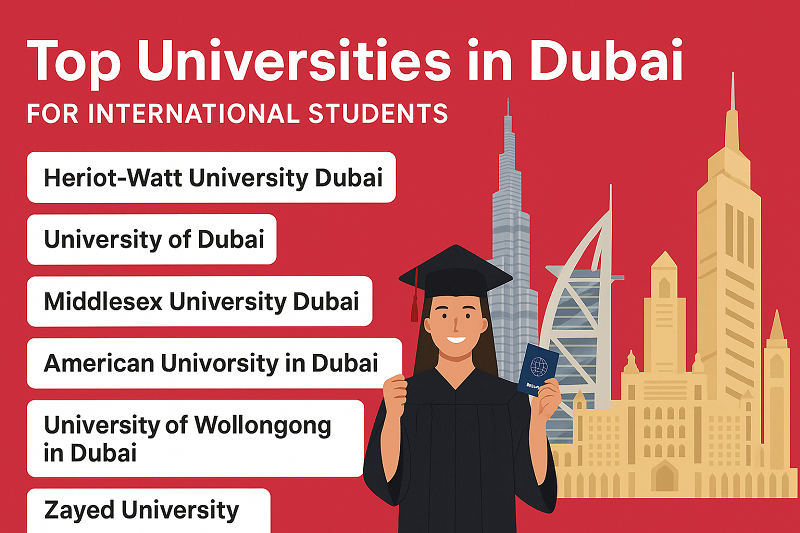
Top Universities in Dubai for International Students
Dubai, well-known for its opulent lifestyle, tall skyscrapers, and rich cultural heritage, has recently gained popularity among international students. Since the UAE is home to several international universities, many Indian students are growing more interested in studying there. Dubai has emerged as a global hub for education, attracting students from all over the world. Since the UAE is home to several international universities, many Indian students are growing more interested in studying there and planning to study in dubai for indian student. Here’s a look at the top universities in Dubai that cater to international students.
Why is Dubai important for international students studying abroad?
Dubai has become a top destination for international students due to its world-class education system, strategic location, and vibrant multicultural environment. Here are some key reasons why Dubai is an essential study-abroad destination:
Home to top-ranked universities- Dubai hosts branch campuses of prestigious global universities like:
The University of Birmingham Dubai
Heriot-Watt University Dubai
Middlesex University Dubai
American University in Dubai (AUD)
These institutions provide internationally recognized degrees, allowing students to study in a dynamic business hub.
Global recognition and accreditation- Dubai's universities follow high academic standards, and many programs are accredited by international bodies like AACSB (business), ABET (engineering), and CIMA (finance and accounting).
Career opportunities in a thriving economy—Dubai is a global business hub with opportunities in finance, technology, hospitality, healthcare, and engineering. Through internships, job placements, and networking events, students gain practical experience in a booming job market.
Student-friendly visa policies- Student residence visas make it easy for international students to stay and study. Dubai offers a 5-year visa for outstanding students, and many graduates can get a Golden Visa for long-term residency.
Tax-free income and post-study work opportunities- Dubai has no income tax, making it financially attractive for graduates who want to work in the UAE after completing their studies.
Multicultural environment and English as a primary language- Dubai is home to 200+ nationalities, providing an inclusive and diverse atmosphere. English is the primary language of instruction, making it easy for international students to adapt.
Advanced infrastructure and modern lifestyle- Dubai offers state-of-the-art university campuses, excellent transportation, safety, and high living standards. It is one of the safest cities globally and has a high quality of life.
Affordable education compared to other study destinations—While Dubai is a premium destination, its tuition fees are often more inexpensive than those in the UK, US, or Australia, making it a cost-effective choice for quality education.
Strategic location for global exposure- Located between Europe, Asia, and Africa, Dubai offers easy access to international markets, making it a perfect place for students aiming for global careers.
University highlights in the UAE-
Universities in the United Arab Emirates accept new students in January, February, etc. The UAE's colleges and universities provide a variety of courses, including MS, BS, BTech, MBA, and BBA. The following are a few highlights for UAE universities-
Parameter | Statistics |
No. of universities in UAE | 26+ |
Tuition fees of universities in UAE | Max INR 10 L: 13 Max INR 40 L: 26 |
English exams required | IELTS / TOEFL / PTE / Duolingo GMAT / GRE |
Top universities of Dubai-
University of Dubai (UD)-
The University of Dubai is one of the most prestigious institutions in the UAE. Accredited by the Ministry of Education and international accreditation bodies, it offers business, law, IT, and engineering programs. The University of Dubai, situated in the heart of Dubai City, is nationally and internationally recognized. UD was founded to fill the employment skills gap. In addition, it currently offers master's degree programs in business administration (MBA), information systems (MScIS), and law (LLM). However, bachelor's degree programs in business administration, marketing, finance, financial services, accounting, human resources management, entrepreneurial activity management, economics, supply chain and logistics management, and information technology.
American University in Dubai (AUD)-
AUD is among the top choices for international students seeking an American-style education in Dubai. The American institution in Dubai is a private institution that began as an Atlanta, Georgia (US) affiliate of American InterContinental University. The AUD, which is based in Dubai and is close to Dubai Media City, Dubai Internet City, and the Palm Islands, is accredited by both the US (SACSCOC) and the UAE (MOHESR) for all of its programs and welcomes both foreign and UAE national students. With its departments organized as the School of Arts and Sciences, the School of Business Administration, the School of Architecture, Art, and Design, the Mohammed bin Rashid School for Communication, the School of Engineering, and the School of Education, AUD provides an education in the United States.
University of Al Ghurair (AGU) -
Al Ghurair Institution, a private local institution inside DIAC, was founded to give students the information and abilities they need to support the growth and well-being of their communities. The College of Business Studies (COBS) teaches business administration, the College of Computing offers computer information systems courses, and the College of Engineering and Applied Sciences teaches computer science with engineering and electrical and electronics engineering. MOHESR licenses AGU and offers bachelor's degrees in all three colleges. Additionally, AGU provides a School of Design that prepares students academically for careers in interior design.
University of Wollongong in Dubai (UOWD)
This university is one of the oldest international universities in Dubai, offering Australian-accredited degrees. A private institution in Dubai's Knowledge Village, the institution of Wollongong was established in 1993 as a branch campus of the University of Wollongong in Australia. Undergraduate and graduate programs offered at UOWD include business and management, engineering and information studies, finance and accounting, and the arts and humanities (the latter only as a postgraduate degree). Along with a specialized Language Studies Centre (LSC) that provides a variety of language courses and communication development programs, the institution also offers several scholarships for domestic and international students.
The Emirates' American University (AUE) -
It is located in Dubai International Academic City, a private university with a CAA license. AUE provides undergraduate and graduate degrees (but not PhD programs) and collaborates with several US and foreign universities. The College of Business Administration, College of Media and Mass Communication, College of Computer and Information Technology, College of Fine Arts and Design, College of Education, and College of Law are the six colleges that offer undergraduate programs. The Master of Business Administration (MBA), Master of Diplomacy (MDIP), and Master of Library and Information Science (MLIS) are available postgraduate degrees. AUE also provides several other facilities, such as a facility for professional training, a technological incubation center, and a language learning institution.
British University in Dubai (BUiD)-
The British institution in Dubai is a postgraduate research institution that collaborates with numerous top UK universities, including King's College London, Cardiff University, the University of Edinburgh, and the University of Manchester. Business administration (MBA), informatics, information technology management, project management, education, finance and banking, architecture and the sustainable built environment, human resource management, systems engineering, construction law, intelligent building design, and construction management are among the MOHESR-accredited programs offered by BUiD, which is situated in the Dubai International Academic City. The BUiD has gained popularity with regional and global organizations that have granted funding and scholarships, and it also offers a variety of approved postgraduate certifications and degrees.
Middlesex University Dubai-
An extension of the UK’s Middlesex University, this institution offers a British curriculum and a diverse student body. The university offers programs in Business, Media, Law, Psychology, and IT. Internationally recognized degree transfer opportunities are available on the UK campus.
Heriot-Watt University Dubai-
A branch of the renowned UK-based Heriot-Watt University, it is known for its emphasis on research and innovation. The university offers courses in Engineering, Business, Psychology, and Data Science. It offers high employability rates and strong industry links.
Manipal Academy of Higher Education (MAHE) Dubai
MAHE is a globally recognized Indian university with a branch in Dubai that offers diverse programs. The university offers courses in Engineering, Business, Design, and Biotechnology.
Conclusion-
Dubai is home to several world-class universities that cater to international students with diverse interests and career goals. Whether you are looking for an American, British, Australian, or Canadian curriculum, Dubai has an institution to meet your needs. With excellent academic facilities, multicultural student environments, and strong industry ties, studying in Dubai offers a pathway to a successful global career.
FAQs on top universities in Dubai for international students-
Q.1 What are the top universities in Dubai for international students?
Ans- Some top universities include the University of Dubai, American University in Dubai, Heriot-Watt University Dubai, and Middlesex University Dubai.
Q.2 Can you study in Dubai with a scholarship?
Ans- Many universities in Dubai offer scholarships and financial aid for international students based on merit and need.
Q.3 Are degrees from Dubai universities recognized internationally?
Ans: most universities in Dubai are accredited by international bodies and recognized globally.
Q.4 What is the average cost of studying in Dubai?
Ans- Tuition fees vary by university and program but range between AED 35,000 and AED 90,000 annually.
Q.5 Do you need a student visa to study in Dubai?
Ans- International students need a student visa, which the university usually facilitates.
Q.6 Can you work while studying in Dubai?
Ans- Some universities allow part-time work opportunities, but students need approval from the UAE authorities.
Q.7 Is Dubai a safe city for international students?
Ans- Yes, Dubai is one of the safest cities in the world, and strict laws ensure security.
Q.8 Which is the language, of course?
Ans- Most courses are available in English, but some universities also offer Arabic programs.
Q.9 Are there hostel facilities for international students?
Ans Yes, many universities provide on-campus accommodation and private housing options.
Q.10 Can you stay in Dubai after graduation?
Ans- Dubai offers post-study work opportunities, and graduates can apply for employment visas.

How to Get a Student Visa for Dubai: A Step-by-Step Guide
Dubai has become one of the top destinations for international students, offering world-class education, modern infrastructure, and a diverse cultural experience. If you're planning to study in Dubai, securing a student visa is a crucial step in the process. This guide will walk you through the step-by-step procedure for obtaining a Dubai student visa, eligibility criteria, required documents, and key things to keep in mind.
What about a Dubai Student Visa?
A Dubai student visa is a legal document that allows international students to reside in the UAE for study purposes. It is typically issued for one year and can be renewed annually until the completion of the student's education.
Types of Student Visas in Dubai-
Regular Student Visa: A UAE student visa is granted once a year, renewed according to the length of the course, and includes an extra grace time for entering and leaving the nation.
Golden Visa: This 10-year resident visa is available to excellent students who fulfill certain academic or entrepreneurial requirements. The most appropriate candidates for this method are shareholders, entrepreneurs, renowned scientists, gifted students, and volunteers.
University-Sponsored Visa: Issued by universities in Dubai for students enrolled in full-time courses.
Family-Sponsored Visa: If a student's parents or relatives reside in the UAE, they can sponsor the student.
Long-Term Residency Visa: The UAE government offers a five-year visa for outstanding students with exceptional academic performance.
Eligibility criteria for a Dubai student visa-
To be eligible for a student visa in Dubai, you must meet the following requirements:
Acceptance into a reputable Dubai-based college or university.
Proof of tuition fee payment and enrollment confirmation.
A passport that is currently valid for at least six months.
Financial proof showing the ability to cover living and tuition expenses.
Medical fitness certificate issued by a UAE-approved health center.
A clean criminal record.
Documentation needed for a student visa to Dubai -
The following paperwork is required to apply for a student visa-
A valid passport that is at least six months old.
Passport-sized photographs (as per UAE specifications).
An admission letter from a Dubai-based university.
Proof of tuition fee payment.
Bank records or evidence of sound financial standing.
Health insurance is valid in the UAE.
Medical fitness test results from an approved UAE health center.
Visa application form (provided by the university or sponsor).
No-objection certificate (if required).
What is the student visa application process for Dubai?
· Step 1: Receive Admission Confirmation-
Before applying for a student visa, secure admission at a Dubai-based university. Ensure that you have paid the necessary tuition fees and have received an official admission letter.
· Step 2: Visa Sponsorship-
Student visas in Dubai must be sponsored by either a university or a resident family member. Check with your institution if they provide visa sponsorship and follow their instructions for the application.
· Step 3: Medical Examination-
As part of the visa application process, students must undergo a medical test at an approved health center in Dubai. The test typically includes screening for infectious diseases such as tuberculosis and HIV.
· Step 4: Apply for a Student Visa-
Your university will typically handle the visa application process if they are sponsoring you. Your family member must apply through Dubai's General Directorate of Residency and Foreigners Affairs (GDRFA) if they are sponsoring you.
· Step 5: Pay Visa Fees-
The cost of a visa varies according to its kind and term. Ensure that you pay the required fees as per the regulations of the UAE authorities.
· Step 6: Visa Processing and Approval-
After submitting all necessary documents, the visa processing may take anywhere between two to four weeks. You will receive a visa approval notification once the process is complete.
· Step 7: Get Your Visa-
Students can live and study in Dubai if their visa is granted and provided as a resident visa.
· Step 8: Emirates ID and Residency Permit-
Upon arriving in Dubai, students must apply for an Emirates ID, which is an essential identity document for all UAE residents. Additionally, a residency permit is issued as part of the student visa process.
What is the cost of a Dubai student visa?
The cost of a Dubai student visa varies depending on the university, visa duration, and additional services required. Below is a broad summary of the costs-
Student visa processing fee: AED 3,000 - AED 7,000
Medical test fee: AED 300 - AED 700
Emirates ID application: AED 100 - AED 300
Health insurance: AED 1,000 - AED 2,500 per year
These costs may vary based on the institution and UAE immigration policies. Always check with your university for the most accurate and updated fees.
What is the renewal process for a Dubai Student Visa?
A Dubai student visa is typically valid for one year and must be renewed annually until the student completes their studies. Below are the steps to renew your visa:
Obtain proof of continued enrollment- The university must provide an enrollment certificate confirming that you are still a registered student.
Undergo a medical examination- Students must take another medical fitness test at an approved UAE health center—the test screens for infectious diseases such as tuberculosis and HIV.
Submit renewal application- The university will handle the renewal process. If a family member is your sponsor, they must apply through the General Directorate of Residency and Foreigners Affairs (GDRFA) in Dubai.
Pay renewal fees- The renewal cost typically includes visa processing fees, medical test fees, Emirates ID renewal, and health insurance. Estimated renewal costs range from AED 3,000 to AED 7,000, depending on your university and visa type.
Wait for Approval- Visa renewal processing takes about 2 to 4 weeks. You will receive a notification once your visa has been successfully renewed.
Update your Emirates ID and residency permit- After visa renewal, students must also renew their Emirates ID, which serves as their official identification in the UAE.
What about working facilities for international students while studying in Dubai?
International students in Dubai are not typically allowed to work on a student visa. However, certain universities offer internships or part-time opportunities under specific conditions. Students must check with their institutions and the UAE labor laws for clarification. However, there are some options available under specific conditions.
Part-time work: Generally, students cannot take up jobs on a student visa unless their university allows them to work under certain conditions.
Internships & On-Campus Jobs: Many universities offer internship programs or on-campus jobs that allow students to gain work experience.
Freelancing: Students can explore freelance work, but they must check legal requirements and whether a freelance permit is required.
Eligibility to work as a student in Dubai-
Students may be eligible to work under the following conditions:
They are enrolled in a university within a free zone (such as Dubai Knowledge Park), which may allow part-time work.
They receive a work permit from the UAE’s Ministry of Human Resources and Emiratization (MOHRE).
They work in a university-approved internship program.
Key things to keep in mind while applying for a student visa in Dubai-
Apply for your student visa at least two months before your course start date.
Ensure that your passport is valid for the entire duration of your study program.
In order to prevent fines, usually extend your visa before it lapses.
Keep your medical coverage up to date when visiting Dubai.
Conclusion-
Securing a student visa for Dubai is a straightforward process if you follow the necessary steps and provide the required documents. Whether you’re pursuing undergraduate or postgraduate studies, Dubai offers an excellent academic environment and numerous opportunities for international students. Make sure to stay updated with UAE immigration policies and work closely with your university’s admissions office to ensure a smooth visa application process.
FAQs on how to get a student visa for Dubai:
Q.1 Who can apply for a student visa in Dubai?
Ans- International students who have been accepted into a recognized university or educational institution in Dubai can apply for a student visa.
Q.2 How long is a Dubai student visa valid?
Ans- A Dubai student visa is typically valid for one year and can be renewed annually until the completion of the student’s studies.
Q.3 Who can sponsor my student visa?
Ans- Universities in Dubai or a resident family member can sponsor student visas.
Q.4 What documents are required for a Dubai student visa?
Ans- You will need a valid passport, an admission letter from a Dubai university, passport-sized photos, proof of financial stability, health insurance, a medical fitness certificate, and a completed visa application form.
Q.5 How long does it take to process a student visa for Dubai?
Ans- Visa processing typically takes 2 to 4 weeks, depending on the university and UAE immigration authorities.
Q.6 Can you work in Dubai on a student visa?
Ans- Generally, students on a visa cannot work. However, some universities allow part-time work or internships under specific conditions.
Q.7 What is the cost of a Dubai student visa?
Ans- The visa costs range from AED 3,000 to AED 7,000, with additional charges for medical tests, Emirates ID, and health insurance.
Q.8 How do you renew your student visa in Dubai?
Ans- To renew, students must provide proof of continued enrollment, undergo another medical exam, and pay the renewal fees before the visa expires.
Q.9 What happens if your student visa expires?
Ans- If your visa expires without renewal, you may face fines or legal consequences. You must update prior to the deadline for renewal.
Q.10 Can you convert your student visa to a work visa after graduation?
Ans- Yes, students can transition to a work visa if they secure a job in the UAE and their employer sponsors their work permit.
Post-Graduation Opportunities in Dubai for International Students
Dubai, a global hub of innovation, commerce, and culture, offers international students more than just world-class education. Upon graduation, many students find that the city presents a wide array of opportunities—professional, entrepreneurial, and academic. From working in multinational companies to launching startups, pursuing research, or obtaining professional licenses, Dubai stands as a land of possibilities. This blog explores the various post-graduation opportunities for international students in Dubai and how to make the most of them. For Indian students considering higher education in the UAE, Dubai can be an attractive destination for those planning to study in dubai for indian student and build an international career in a growing global business hub.
Why Consider Staying in Dubai After Graduation?
Before diving into specific opportunities, it's important to understand why Dubai is an attractive destination for international graduates:
Strategic Global Location: Located at the crossroads of Europe, Asia, and Africa, Dubai serves as a gateway to global markets.
Multicultural Environment: With over 200 nationalities, the city offers a vibrant and diverse professional landscape.
Business-Friendly Policies: Tax-free income, streamlined business setup processes, and free zones make it appealing for professionals and entrepreneurs alike.
Government Support: The UAE government actively promotes innovation and economic diversification, creating more job and business opportunities.
Quality of Life: High safety standards, modern infrastructure, and a high standard of living make it an attractive place to build a life.
Career Growth Opportunities- Dubai hosts numerous multinational companies, startups, and organizations looking for skilled graduates.
Long-Term Residency Options- The UAE Golden Visa and job-seeker visa make it easier for international graduates to stay, work, and build a future in Dubai.
What about the post-graduation opportunity for students in Dubai?
Studying overseas may change your life and provide special chances for both professional and personal development. Due to its contemporary infrastructure, excellent educational system, diversified surroundings and civilization, and fantastic post-study employment chances in Dubai upon degree completion, Dubai is one of the most alluring places for international students to study.
Employment Opportunities in Dubai-
Sectors in High Demand in Dubai- Dubai’s economy is broad and constantly evolving. Key sectors offering promising employment prospects for international graduates include:
Artificial Intelligence (AI) and Information Technology (IT)
With the Smart Dubai initiative and investment in AI, the demand for tech-savvy professionals is skyrocketing.
Finance and Banking
Dubai is a financial powerhouse in the Middle East, home to numerous banks, investment firms, and insurance companies.
Tourism and Hospitality
With millions of visitors annually, hotels, airlines, and event companies consistently seek skilled graduates.
Healthcare
The growth of medical tourism and the expansion of hospitals create demand for healthcare professionals.
Construction and Engineering
With continued urban development, there’s a steady demand for architects, civil engineers, and project managers.
Education and Research
International schools, universities, and research centers are frequently hiring qualified educators and researchers.
Logistics and Supply Chain
Dubai’s location as a trade hub makes logistics a vital sector offering numerous roles.
Get the details about work permits and visa regulations after post-graduation in Dubai-
For international students planning to stay in Dubai after completing their studies, understanding the visa regulations and work permit processes is crucial. The UAE government has introduced several visa schemes to make the transition from student to professional smoother, including job seeker visas, work permits, and long-term residency options like the Golden Visa. These initiatives are designed to attract and retain global talent, especially in sectors like tech, healthcare, engineering, and education.
Transitioning from Student Visa to Work Visa-
Universities typically sponsor student visas in Dubai, which are valid for the duration of the academic program. Once you graduate, this visa expires, and you must shift to a new visa category to remain in the country legally for employment or job hunting.
Available Options for Post-Graduation Visa Transition:
Job Seeker Visa
Allows recent graduates to stay in Dubai for a limited time while searching for employment.
Valid for 60, 90, or 120 days, depending on the application.
Applicants must hold a Bachelor’s degree or higher from one of the world’s top 500 universities or a local accredited UAE institution.
Employment Visa (Work Permit)
Sponsored by an employer once a job is secured.
Includes a residency visa, Emirates ID, and labor card.
Valid for 2 years and renewable based on the employment contract.
Freelance Visa
Ideal for graduates pursuing self-employment in fields like media, design, tech, or education.
Issued by free zones such as Dubai Media City or Dubai Design District.
Grants legal permission to work as an independent contractor and invoice clients.
Green Visa
Targets skilled workers, freelancers, and investors.
Offers 5-year residency without the need for a sponsor.
It is ideal for those with high professional qualifications or business plans.
Golden Visa
Long-term residency (5–10 years) for exceptional students, professionals, researchers, and investors.
Eligibility is based on academic performance, salary level, investment in business or property, or contribution to UAE's development.
Allows family sponsorship and multiple entries.
What about Internships and Training Programs after post-graduation in Dubai?
Internships and training programs are excellent gateways for international graduates who want to enter the Dubai job market but may not yet have full-time job offers. These opportunities provide hands-on experience, professional networking, and a deeper understanding of industry-specific practices in the UAE. For many, internships often lead directly to permanent employment, especially within multinational companies and large local firms.
Dubai’s dynamic economy and international corporate presence mean that there is no shortage of internship opportunities across various industries, from finance and hospitality to tech and healthcare. These programs also help bridge the gap between academic learning and workplace expectations, giving graduates a competitive edge in their careers.
Benefits of Post-Graduation Internships and Training:
Practical Work Experience- Apply theoretical knowledge in real-world scenarios. Understand the day-to-day operations of your chosen industry.
Career Exploration- Test different roles or sectors before committing to a long-term career path. Gain exposure to corporate culture and workplace dynamics in Dubai.
Networking Opportunities- Build professional relationships that can lead to full-time job referrals. Connect with mentors and industry leaders.
Increased Employability- Strengthen your CV with regional work experience. Learn skills that local employers highly value.
Pathway to Permanent Employment- Many companies use internships as a recruitment pipeline. Strong performance during training can result in a job offer.
How to find internship opportunities?
University Career Centers- Many Dubai-based universities offer placement services for graduates.
Online Job Portals- Online websites list internship openings.
Company Websites- Multinational companies often post-training program details directly on their career pages.
Networking Events- Attend job fairs, industry expos, and networking meetups to connect with recruiters.
Social media- Follow companies and industry leaders on LinkedIn to stay updated on internship openings.
Points to remember while choosing an internship program after post-graduation in Dubai-
Internship Visas: If you're on a post-study visa or job-seeker visa, you may be allowed to take up internships. Confirm with both the company and immigration authorities.
Paid vs. Unpaid: Some internships are paid, while others may offer stipends or just experience.
Duration: Internships typically last 3 to 6 months, but some graduate programs may extend up to 12 months.
Documentation: You may need a No Objection Certificate (NOC) from your university or sponsor, depending on your visa type.
Entrepreneurship and Startup Ecosystem opportunity in Dubai-
Dubai has rapidly become a hotspot for startups, thanks to a favorable business environment and robust government support.
Key Features:
Free Zones: These allow 100% foreign ownership, making it easier for graduates to start businesses.
Incubators and Accelerators: Programs like Dubai Future Accelerators and in5 support early-stage entrepreneurs with mentorship, funding, and workspace.
Funding Opportunities: Angel investors, venture capital firms, and government grants provide funding for promising ideas.
Notable Sectors for Startups:
Fintech
E-commerce
EdTech
HealthTech
Sustainability-focused ventures
International students with entrepreneurial ambitions can apply for the UAE Startup Visa or get a license via free zones such as Dubai Silicon Oasis or Dubai Internet City.
Higher Education and Research Opportunities in Dubai after post-graduation-
Graduates interested in academic progression can opt for postgraduate study or research opportunities in Dubai.
Universities Offering Postgraduate Courses:
University of Dubai
Heriot-Watt University Dubai
Middlesex University Dubai
University of Birmingham Dubai
American University in Dubai
These institutions offer Master's and PhD programs in:
Engineering
Business Administration (MBA)
Artificial Intelligence
Data Science
Law
Media and Communications
Dubai also houses several research centers and innovation hubs, offering research fellowships, assistantships, and part-time academic roles.
Freelancing and the Gig Economy-
Dubai has embraced the gig economy by legalizing and regulating freelancing through special freelance permits.
Popular Freelance Fields:
Digital Marketing
Graphic design
Photography
Writing and translation
Software development
Fitness and wellness
Graduates can obtain a freelance visa and license from hubs like:
Dubai Media City
Dubai Design District
TECOM Group
This route offers flexibility and a pathway to self-employment while remaining legally in the UAE.
Networking and Career Development-
Dubai's professional ecosystem thrives on networking, and international graduates can benefit by actively participating in the following:
Job Fairs: Hosted by universities and business councils.
Industry Conferences: STEP Conference (tech), Arab Health (medical), and GITEX (IT).
LinkedIn and Meetup Groups: These platforms host both online and offline networking events.
Professional Organizations: Chambers of Commerce, Toastmasters, and alum associations are great for connections.
Career Services:
Most universities in Dubai offer dedicated career counseling, resume workshops, interview preparation, and placement assistance for graduates.
Language and Cultural Integration
While English is widely spoken in business environments, learning basic Arabic can be a valuable asset. It helps graduates:
Better connect with locals
Open more job opportunities
Adapt to workplace culture
Cultural integration is also important for long-term success. Understanding Emirati customs, etiquette, and workplace norms shows respect and boosts employability.
Legal and Documentation Essentials
After graduation, international students must transition their student visa to another legal status. Here's what to consider:
Key Steps:
Apply for a job-seeker or work visa
Transfer visa sponsorship if hired
Ensure attestation of academic certificates
Obtain an Emirates ID (mandatory for residents)
Having these legal documents sorted ensures smoother access to housing, banking, and medical services.
How to find post-graduation job opportunities in Dubai for international students?
After completing your studies in Dubai, you’re in a strong position to enter the workforce. With your academic credentials from a local university and the advantage of already being in the UAE, you can tap into various resources to secure a job that aligns with your career goals.
Use university career services- Most universities in Dubai offer career support services to students and alums. These departments help you transition from academia to the professional world.
Resume and cover letter assistance
Mock interviews and career counseling
Job boards with exclusive listings
On-campus job fairs and networking events
Industry partnership programs with placement support
Make Use of Online Job Portals: The digital employment sector in Dubai is thriving. These platforms list thousands of job openings across industries. To get a job, create a strong professional profile. Upload an updated CV tailored to Dubai’s market. Students should set job alerts for their fields. To apply consistently and follow up to get immediate results.
Attend Job Fairs and Career Expos- Career fairs are a great way to meet employers, understand the job market, and sometimes even land interviews on the spot.
University-hosted career fairs (check your alum office)
Events at Dubai World Trade Centre and Dubai Expo Centre
Online virtual job fairs organized by recruitment firms
Why it helps:
Direct interaction with employers
Opportunity to ask questions and showcase your personality
Get insights into what companies are hiring fresh graduates
Network, Network, Network-In Dubai, networking is key. Personal referrals often speed up the hiring process and give you a competitive advantage.
Ways to build your network:
Join professional groups on LinkedIn
Attend industry meetups and workshops
Participate in alum networking events
Connect with professors and guest lecturers with industry ties
Important platforms:
LinkedIn
Meetup.com (for professional events)
Eventbrite (for local conferences and seminars)
Explore Internship-to-Job Conversion- Internships or graduate trainee programs can lead to full-time employment. Many companies in Dubai prefer hiring from within.
Popular sectors offering internship-to-job conversion:
Banking and finance (Emirates NBD, HSBC)
Consulting (PwC, KPMG, Deloitte)
Logistics (DP World, Aramex)
Retail and e-commerce (Amazon, Noon, Landmark Group)
Apply to Graduate Trainee Programs- Many multinational and local firms run graduate programs designed for fresh university graduates. These programs provide structured training and development with a pathway to permanent employment.
Fast-track leadership development
Rotational assignments across departments
Mentorship and structured learning
How to register with recruitment agencies in Dubai after post-graduation?
Recruitment agencies in Dubai can be a powerful resource for international graduates looking to secure full-time roles in various industries such as finance, IT, engineering, healthcare, hospitality, and more. These agencies act as intermediaries between job seekers and employers, helping candidates find roles that match their qualifications and career goals.
After graduation, international students can register with these agencies to gain access to exclusive job openings, receive resume feedback, and even get interview preparation support. The process is usually straightforward but requires a professional approach and proper documentation.
Steps to Register with Recruitment Agencies in Dubai
Identify the right recruitment agencies- Start by researching agencies that specialize in your field or cater to fresh graduates.
Prepare Your Documents- Before reaching out to an agency, ensure you have all necessary documents ready.
Essential documents include:
Updated resume (formatted for Dubai standards)
Cover letter (customized to your field)
Passport copy with visa page
Emirates ID (if available)
Academic certificates and transcripts
Internship or part-time job reference letters (if applicable)
Visit the agency website- Almost all recruitment agencies in Dubai allow candidates to register through their official websites.
Select the "Job Seekers" or "Register CV" area.
Enter your occupation and intimate details.
Upload your resume and supporting documents
Subscribe to job alerts based on your interests
Create a strong online profile- Some agencies have internal platforms where you can manage your applications.
Tips to optimize your profile:
Use keywords related to your skills and qualifications
Mention your degree and specialization clearly
Include internship experiences and certifications
Set job preferences like industry, role, location, and salary expectations
Apply to relevant job openings- Once registered, browse the agency’s job listings and apply directly to jobs that match your qualifications.
Tailor your CV for each application
Write a brief, customized cover letter if the system allows
Monitor application statuses via your agency dashboard
Reach out to recruiters directly- You can also contact recruitment consultants via LinkedIn or email.
Keep it professional and concise
Introduce yourself with your qualifications and goals
Attach your CV or include a link to your online profile
Mention if you’re on a job-seeker visa and available for interviews
Follow up professionally- If you have not heard back after a week or two, it's okay to send a polite follow-up email or LinkedIn message.
Reaffirm your interest
Mention any new experience or interview updates
Keep it brief and respectful
Attend walk-in interviews or open days- Some agencies conduct open recruitment drives or walk-in interviews for fresh graduates.
Check the agency’s website and social media pages
Look on platforms like Eventbrite, Dubizzle Jobs, or Gulf News classifieds
Bring printed copies of your CV and dress professionally
What advantages come with signing up with a recruiting firm?
For overseas grads, there are several benefits to signing up with a recruiting firm in Dubai. By putting you in direct contact with companies seeking skilled applicants, these agencies help you save time when looking for a job. They frequently get first dibs on unannounced employment vacancies. Recruitment consultants offer useful services, including interview coaching, resume evaluation, and insights into recruiting patterns unique to a certain business. Numerous organizations also assist with career planning and connecting positions to your qualifications. Crucially, agencies act as your advocate, increasing your chances of getting an interview. Their assistance may greatly improve your employment hunt, particularly in a market as competitive as Dubai.
Availability of exclusive job postings that aren't made public.
Expert career guidance and market insights.
Assistance with resumes and interviews.
Direction on responsibilities and pay expectations relevant to a certain sector and a higher likelihood of getting interviews through recruiter recommendations.
Conclusion-
Post-graduation opportunities in Dubai for international students are abundant and diverse. From employment to entrepreneurship, academia to freelancing, Dubai opens doors that can shape a global career. The key is to plan, leverage available resources, and fully immerse yourself in the dynamic spirit of the city. Dubai is more than just a study destination—it’s a land of opportunity for international students. Whether you aim to work, start a business, continue your education, or freelance, the city offers the resources, support, and environment to help you succeed. By leveraging career services, applying for the right visas, and tapping into Dubai’s thriving professional ecosystem, graduates can turn their academic achievements into a fulfilling and prosperous careers.
FAQs on Post-Graduation Opportunities in Dubai for International Students
Q.1 Can international students stay in Dubai after graduation?
Ans- Yes, international students can stay in Dubai after graduation by applying for a job-seeker visa or obtaining a work permit through an employer.
Q.2 Is it easy to find a job in Dubai after graduation?
Ans-It depends on your field, qualifications, and networking skills. Dubai has a competitive job market, but sectors like IT, finance, healthcare, and hospitality often hire fresh graduates.
Q.3 What is a job-seeker visa in Dubai?
Ans job-seeker visa allows graduates to legally stay in Dubai for 60, 90, or 120 days while searching for a job. No sponsor is needed to apply.
Q.4 Are internships available after graduation?
Ans-Yes, many companies offer graduate internships and training programs that can lead to full-time employment.
Q.5 Do you need a work permit to work in Dubai after graduation?
Ans-Yes. Once hired, your employer must sponsor your work permit and residency visa to allow you to work in Dubai legally.
Q.6 Which industries offer the best opportunities for graduates in Dubai?
Ans-Top industries include IT, finance, logistics, healthcare, construction, education, tourism, and digital marketing.
Q.7 Can you work part-time after graduation in Dubai?
Ans-You can work part-time if you have a valid part-time work permit approved by the Ministry of Human Resources and Emiratization (MOHRE).
Q.8 Do you need to know Arabic to work in Dubai?
Ans- No, English is widely used in the workplace. However, knowing Arabic can be a bonus, especially in customer-facing or government-related roles.
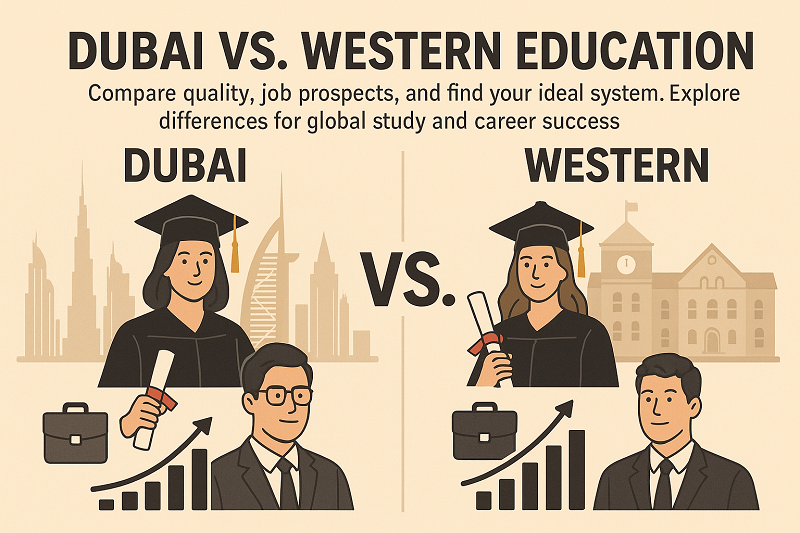
How Does Dubai's Education System Compare to Western Universities?
Dubai, a rapidly growing global hub for business, tourism, and education, has emerged as a significant player in the international academic landscape. Over the past two decades, the emirate has invested heavily in establishing a knowledge-based economy, developing world-class educational infrastructure, and inviting globally recognized institutions to set up campuses within its borders. But how does Dubai's education system stack up against established Western universities in the US, UK, Canada, Australia, and Europe?
In this blog, we will explore the similarities and differences between Dubai’s higher education system and that of Western countries, helping students understand what to consider when choosing to study in dubai compared with traditional Western destinations., examining key areas such as curriculum, academic quality, faculty, student life, tuition, global recognition, and post-graduation opportunities.
What is the factor that compares the Education System and Western Universities?
In contrast to Western institutions, which frequently emphasize research and critical thinking, Dubai's educational system focuses on a combination of global curriculum, industrial integration, and an intercultural atmosphere, all while striving for worldwide standards. A more thorough comparison may be found here-
Educational Landscape and Global Partnerships-
- Dubai- Dubai’s higher education scene is dominated by a unique model of international branch campuses (IBCs). Prestigious institutions such as the University of Birmingham, Heriot-Watt University, and the University of Wollongong have set up campuses in areas like Dubai International Academic City (DIAC) and Dubai Knowledge Park. These campuses offer the same curricula, standards, and degrees as their parent institutions in the West. This has allowed Dubai to offer a hybrid educational model—a localized presence with global accreditation.
- Western Universities- Western universities are generally established institutions with a long legacy, large endowments, and independent governance. Their campuses are often standalone institutions with full autonomy over course offerings, research priorities, and faculty hiring.
- Difference- Dubai’s approach focuses on importing excellence, while Western systems are built around historic development and local/national education policies. Dubai offers globally recognized degrees locally, reducing the cost and distance barriers for students in the region.
Curriculum and Academic Standards-
- Dubai: The curriculum in Dubai's international universities is identical or nearly identical to that of the parent institution. This ensures consistency in academic quality. Programs follow international benchmarks and are accredited by both the UAE’s Commission for Academic Accreditation (CAA) and relevant foreign accrediting bodies. Dubai also emphasizes career-oriented courses and STEM subjects, reflecting its economic focus on innovation and technology.
- Western Universities: Western universities often have more flexibility in course design, allowing for interdisciplinary studies, electives, and experiential learning opportunities like co-ops and internships. These institutions may offer a broader array of programs in liberal arts, sciences, business, and research-based disciplines.
- Difference- While the academic quality is consistent across many Dubai-based IBCs and their parent institutions, Western universities often offer more academic freedom and research opportunities. Dubai’s programs tend to be more structured and industry-focused.
Faculty and Teaching Methodologies-
- Dubai: Dubai’s international universities typically recruit faculty from parent institutions or hire experienced professionals from across the globe. The student-faculty ratio tends to be favourable, offering more personalized attention. The teaching methodology is generally classroom-based, although hybrid and online models are increasingly adopted.
- Western Universities: Western faculty members are often highly experienced researchers with publications, grants, and field expertise. There is a strong culture of academic freedom, critical thinking, and research-led teaching.
- Difference - Western universities have a stronger research orientation, with faculty heavily involved in knowledge creation. Dubai campuses, especially IBCs, often prioritize teaching and employ practical, industry-experienced educators. Research opportunities may be limited in comparison.
Infrastructure and Campus Life-
- Dubai: Dubai offers ultra-modern campuses with high-tech facilities, smart classrooms, well-equipped labs, and recreational amenities. The city’s futuristic architecture and safety make it attractive for international students. Student life in Dubai is cosmopolitan and structured. However, cultural norms, rules around behaviour, and social conduct are more conservative compared to the West.
- Western Universities: Western institutions typically have large campuses with extensive libraries, research centres, athletic facilities, student unions, and student-led clubs. Campus life is vibrant, with a strong emphasis on independent living, freedom of expression, and diverse extracurriculars.
- Difference - Dubai excels in infrastructure and safety, while Western universities offer a more liberal and immersive campus culture. Students seeking a more independent and socially liberal environment may prefer the West.
Tuition Fees and Cost of Living-
- Dubai: Tuition at international universities in Dubai can be high, though still lower than studying at the parent campus in the West. Scholarships and financial aid are available but more limited. Living costs, including accommodation, transportation, and food, vary depending on lifestyle but are generally moderate when compared to cities like London or New York.
- Western Universities: Tuition varies widely; public universities in Europe or Canada may be more affordable, especially for domestic students, whereas US universities can be prohibitively expensive. The cost of living is high in many Western cities, but financial aid, grants, and scholarships are more abundant.
- Difference - Dubai offers a cost-effective alternative to a Western degree without the added expense of overseas travel and living. However, students with access to scholarships may find the West more advantageous in the long run.
Student Diversity and Internationalization-
- Dubai: Dubai hosts a large number of international students, particularly from South Asia, the Middle East, and Africa. The city’s strategic location makes it a melting pot of cultures. English is the primary medium of instruction, enhancing accessibility. The academic environment is international in spirit but somewhat less diverse in student nationalities compared to top-tier Western universities.
- Western Universities: Top Western universities attract a global student body from over 100 countries. This diversity fosters international exposure, collaboration, and networking opportunities.
- Difference- While Dubai is catching up in terms of diversity, Western universities still offer broader international representation, especially in elite institutions.
Accreditation and Global Recognition-
- Dubai: Degrees from international universities in Dubai are recognized globally, especially if issued by the parent institution abroad. Local universities are accredited by the UAE Ministry of Education and increasingly by international bodies. However, employers or graduate schools may sometimes perceive branch campus degrees differently, depending on the institution and location.
- Western Universities: Degrees from established Western universities often carry strong global brand value. Graduates may have an easier time accessing global job markets and prestigious graduate schools.
- Difference- Both systems offer recognized qualifications, but the prestige associated with Western institutions can be higher, especially among Ivy League or Russell Group universities.
Research Opportunities and Innovation-
- Dubai: Research is growing in Dubai, with increasing investment in innovation hubs, science parks, and research grants. Institutions like the Mohammed Bin Rashid Space Centre and Dubai Future Foundation Support R&D. However, most international branch campuses focus more on teaching than research, limiting undergraduate exposure to cutting-edge projects.
- Western Universities: Research is central to the mission of many Western institutions. Students, even at the undergraduate level, often engage in funded research, contribute to publications, and work in advanced labs.
- Difference- Western universities offer more robust research ecosystems. Dubai is expanding rapidly in this domain, but hasn’t yet reached the same level of output or funding.
Industry Integration and Employability-
- Dubai: Dubai’s economy is heavily focused on innovation, finance, tourism, logistics, and technology. Many universities maintain close links with industries, offering internships, placement support, and career-oriented training. Work opportunities for international students post-graduation are improving, with initiatives like the Golden Visa encouraging talent retention.
- Western Universities: Western countries like Canada, Australia, and the UK offer strong graduate employability rates, and students often gain valuable work experience during or after studies through co-op programs and post-study work visas.
- Difference - Both regions offer industry ties, but Western countries often have more developed and institutionalized pathways for post-graduate employment.
Cultural and Regulatory Environment-
- Dubai: Dubai offers a safe, orderly, and cosmopolitan environment with clear laws and high-quality public services. However, certain restrictions around dress code, public behaviour, and freedom of expression apply, particularly in comparison to Western liberal democracies.
- Western Universities: Western campuses typically promote free speech, activism, and social engagement. The cultural atmosphere is liberal, and students have more freedom in lifestyle choices.
- Difference -Dubai’s environment is secure and structured, ideal for students seeking stability. Western institutions, however, appeal more to those seeking a liberal, expressive, and autonomous academic experience.
Dubai's education system vs. Western universities- Which system is better?
There is no one-size-fits-all answer. Dubai’s education system offers a globally competitive, cost-effective, and safe learning environment, especially suited for students from the Middle East, Africa, and South Asia. The presence of internationally recognized branch campuses brings the best of the West to the Middle East.
On the other hand, Western universities often provide a more immersive academic culture, deeper research opportunities, and stronger global prestige. Students looking for broad academic freedom, extensive global exposure, and liberal campus life may still prefer the West.
Conclusion-
Dubai is redefining what it means to pursue quality education in the 21st century. By blending global academic excellence with regional accessibility and safety, it offers an attractive alternative to traditional Western destinations. As the emirate continues to invest in research, innovation, and talent development, its higher education sector is likely to become even more competitive on the global stage. For students and parents considering Dubai vs. the West, the decision should rest on academic goals, career plans, financial considerations, and cultural preferences. Either way, both options hold the promise of a transformative educational experience.
FAQs on Dubai's Education System Compared to Western Universities-
Q.1 Is the quality of education in Dubai the same as in Western universities?
Ans- Yes, many international universities in Dubai offer the same curriculum and degrees as their parent campuses in the West.
Q.2 Are degrees from Dubai recognized globally?
Ans- Degrees from international branch campuses in Dubai are globally recognized, especially if awarded by the parent institution.
Q.3 Is studying in Dubai cheaper than studying in the West?
Ans- Yes, tuition and living costs in Dubai are generally lower compared to countries like the US, UK, or Australia.
Q.4 Do Dubai universities offer the same research opportunities as Western universities?
Ans- Dubai is expanding its research focus, but Western universities currently have more advanced research infrastructure and funding.
Q.5 Can international students find jobs in Dubai after graduation?
Ans- Yes, Dubai offers growing job opportunities and long-term residency options like the Golden Visa for skilled graduates.
Q.6 How does campus life in Dubai differ from that in the West?
Ans- Dubai campuses are modern and diverse, but have more conservative social norms compared to the liberal lifestyle in the West.
Q.7 Is English the language of instruction in Dubai universities?
Ans- Yes, most universities in Dubai use English as the medium of instruction, similar to Western institutions.
Q.8 Are scholarships available for studying in Dubai?
Ans- Yes, scholarships are offered by many Dubai institutions, though not as widely as in Western countries.
Q.9 What types of universities are found in Dubai?
Ans- Dubai hosts international branch campuses, local private institutions, and public universities with global partnerships.
Q.10 Is Dubai a good alternative to studying in the US, UK, or Canada?
Ans- Dubai offers a globally recognized education, modern infrastructure, and a safe, multicultural environment—ideal for students seeking quality without travelling far.
Part-Time Jobs for International Students in Dubai
Dubai is one of the top destinations for international students seeking quality education and global exposure. While choosing to study in Dubai offers numerous opportunities, managing expenses can be challenging. Fortunately, international students can take up part-time jobs to support themselves financially and gain valuable work experience. This blog explores the different part-time job opportunities available, legal requirements, benefits, and tips for securing employment as an international student in Dubai.
Why would a student in Dubai work part-time?
In order to pay for living expenses, develop professional relationships, or obtain useful experience, many international students in Dubai choose to pursue part-time jobs. Here are some reasons why part-time employment is a great option-
- Flexible options: Students may manage their education and work at the same time with Dubai's assortment of 4-hour part-time employment.
- Foreign experience: Working in Dubai gives international students a better understanding of a multinational workplace.
- Developing skills: Students who work part-time can develop both technical and soft skills for their future employment.
- Financial independence: A large number of students' part-time work in Dubai pays a respectable wage.
What are the eligibility criteria for students to work part-time in Dubai?
It's crucial to comprehend Dubai's student restrictions before looking at employment opportunities-
- Work permits- The UAE Ministry of Human Resources and Emiratization (MOHRE) is the application portal for students who are sponsored by their universities and wish to work part-time.
- Age requirement- In order to lawfully work part-time, students must be at least eighteen years old. Though restricted, alternatives are still available to individuals under the age of 18.
- Hourly restrictions- Students with part-time employment can often work up to 15 hours a week during the school year and full-time during the holidays.
What are the legal regulations for international students working in Dubai?
Before applying for a part-time job, international students must understand the legal requirements and restrictions in Dubai:
- Student Visa Regulations – International students must be enrolled in a university that is licensed by the UAE’s Knowledge and Human Development Authority (KHDA) or other relevant authorities.
- Work Permits – Students need a valid work permit to engage in part-time employment. The work permit is usually issued by the Ministry of Human Resources and Emiratization (MOHRE) with the approval of the university.
- Eligible Work Hours – Generally, students can work up to 15 hours per week during academic terms and up to 40 hours per week during breaks.
- Permissible Workplaces – Students can work in designated free zones or within university campuses, but cannot take up jobs that require full-time employment contracts.
Which the top part-time job opportunities for international students in Dubai?
Dubai’s diverse job market offers various part-time work opportunities for students. Here we are discussing the available part-time jobs in Dubai-
On-Campus Jobs- Many universities in Dubai offer part-time employment opportunities on campus. These roles are ideal as they are flexible and do not require additional work permits. Some common on-campus jobs include:
- Library assistants
- Research assistants
- Administrative assistants
- Student ambassadors
- IT support
Retail and Hospitality Jobs- The retail and hospitality industry in Dubai is always in need of part-time workers, making it a popular choice for students. Common roles include:
- Cashiers and sales associates in shopping malls
- Baristas and servers in cafes and restaurants
- Hotel receptionists and concierge staff
Translator- Working in translation might be advantageous for bilingual students who wish to have flexible schedules and can put their language talents to use. Numerous companies, such as banks and schools of higher learning, frequently use independent translators. Arabic and English are the most often translated languages in Dubai. A computer and internet connection, some expertise in translating or recording, along being a native or extremely fluent speaker of Arabic and English are common prerequisites for translation employment.
Freelancing and Online Jobs- Students with skills in graphic design, content writing, programming, or digital marketing can work as freelancers. Dubai has a thriving freelance market, and students can find opportunities through platforms like Upwork, Fiverr, and Freelancer.
An employee at a call center- Using multiple languages for clients from abroad, helping with client assistance, and conducting calls for marketing are some of your duties. International students who speak English are more likely to work in call centers. Customer service skills, language proficiency, and some prior experiences are common prerequisites for contact center jobs. Many contact centers may not value experience and might not require a college degree.
Tutoring and Academic Assistance- If you excel in a particular subject, you can work as a tutor for school students or fellow university peers. Many international students earn by offering private tutoring in languages, math, science, or IT.
Event Staffing- Dubai hosts numerous events, exhibitions, and conferences throughout the year. Students can take up short-term jobs such as:
- Event coordinators
- Ushers
- Promoters
- Customer service representatives
Delivery and Ride-Sharing Jobs- Students with a valid driving license can work part-time as delivery drivers for food delivery apps. However, this option requires additional legal documentation.
What are the benefits of working part-time as a student in Dubai?
- Financial support: Earn money to cover living expenses, transportation, and leisure activities, reducing reliance on family or loans.
- Financial independence: Manage your finances, learn budgeting, and develop responsible spending habits.
- Skill development: Gain valuable soft skills like communication, problem-solving, teamwork, and time management.
- Real-world experience: Apply classroom knowledge to real situations, preparing you for post-graduation career challenges.
- Resume building: Add relevant work experience to your CV, which can boost your employability after graduation.
- Professional networking: Meet industry professionals and mentors who may assist with internships or full-time opportunities.
- Cultural exposure: Work in a multicultural environment, enhancing your adaptability and cross-cultural communication skills.
- Career exploration: Explore different roles and industries to identify your interests and long-term career goals.
- Time management: Learn how to balance academics, work, and social life effectively—a crucial life skill.
- Confidence boost: Gaining experience and earning your own money builds self-esteem and independence.
- Language practice: Improve your English and possibly learn other languages through daily interactions.
- Pathway to full-time jobs: A part-time job could lead to a full-time offer after graduation if you perform well.
How to secure part part-time job in Dubai?
- Update your CV and Cover letter – Highlight your skills, academic achievements, and previous experience.
- Use online job portals – Websites like Bayt and LinkedIn are great platforms for job hunting.
- Leverage university resources – Many universities have career centres that assist students in finding part-time jobs.
- Network with professionals – Attend job fairs and networking events to connect with potential employers.
- Apply for multiple jobs – Increase your chances by applying to different job roles and industries.
How to find part-time jobs in Dubai for students?
Without the proper approach, finding part-time employment for first-year students in Dubai might be difficult. Here are a few successful job-finding strategies-
- Online Work Portals: Students may locate the greatest part-time employment in Dubai by visiting websites that provide the best part-time work possibilities. To reduce the number of alternatives by schedule, industry, or income, use filters.
- Social media and networking: Keep up with businesses on Facebook, Instagram, and LinkedIn to learn about openings for students looking for part-time work in Dubai. Opportunities can also arise by networking with peers, instructors, and business professionals.
- Recruiting agencies: A number of Dubai-based agencies focus on temporary and part-time employment. Ask for assistance from agencies.
- Walk-ins: Some businesses in Dubai, especially those in the retail and hotel industries, take walk-in applications. Visit shopping centers or business districts with your resume to see if there are any jobs.
Conclusion-
International students might find a variety of part-time employment options in Dubai. While working alongside studies can be challenging, it is a great way to gain experience, build skills, and support oneself financially. By understanding the legal requirements, exploring the right job options, and using effective job-hunting strategies, students can successfully balance work and academics in Dubai.
FAQs on Part-Time Jobs for International Students in Dubai-
Q.1 Can international students work part-time in Dubai?
Ans- Yes, international students can work part-time, but they need a valid student visa and a work permit from the Ministry of Human Resources and Emiratization (MOHRE).
Q.2 How many hours can international students work in Dubai?
Ans- Students can work up to 15 hours per week during academic sessions and up to 40 hours per week during vacations.
Q.3 What are the best part-time jobs for students in Dubai?
Ans- Popular options include on-campus jobs, retail and hospitality roles, tutoring, freelancing, event staffing, and online jobs like content writing or graphic design.
Q.4 Do students need a work permit to get a part-time job?
Ans- Yes, a work permit is required unless the job is on campus. The employer typically assists in obtaining the necessary permit.
Q.5 Can international students work off-campus in Dubai?
Ans-Yes, but only in designated free zones or with employers who can sponsor a student work permit.
Q.6 How can students find part-time jobs in Dubai?
Ans- Students can search through university career services, online job portals, and networking events.
Q.7 Are freelancing and remote jobs allowed for students in Dubai?
Ans- Yes, students can freelance if they acquire the appropriate freelance permit, which is available in certain free zones.
Q.8 What is the average pay for part-time jobs in Dubai?
Ans- Salaries vary based on the job type, but students can expect to earn between AED 25 to AED 50 per hour on average.
Q.9 Can part-time jobs help with career growth?
Ans- Part-time jobs help students gain practical experience, improve skills, and build professional networks for future employment.
Q.10 Are there any restrictions on job types for students?
Ans- Yes, students cannot take up jobs that require a full-time employment contract or roles that involve manual labour unless approved by the authorities.