
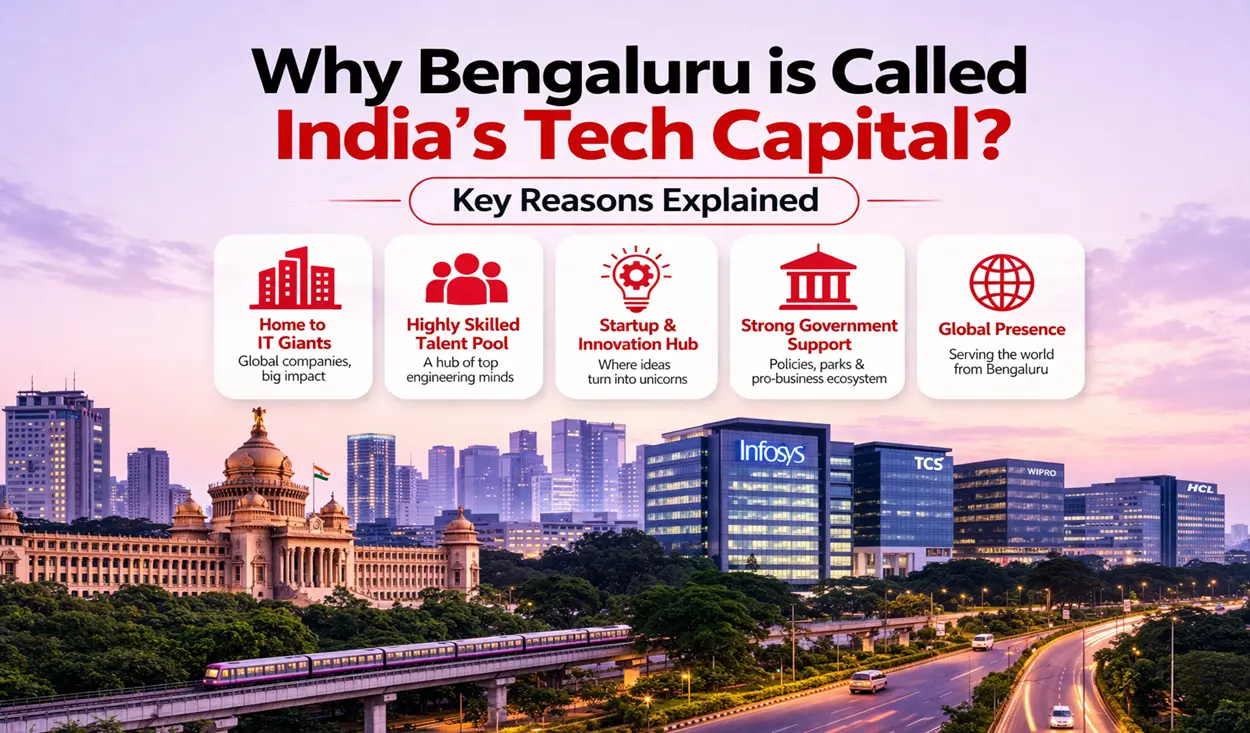
Bengaluru, also known as Bangalore, is widely called the Tech Capital of India. When people talk about technology, startups, innovation, and software development in India, Bengaluru is usually the first city that comes to mind. It is home to thousands of tech companies, millions of professionals, and some of the world’s biggest technology giants. But Bengaluru did not gain this title overnight. The city earned it through decades of growth, thoughtful planning, skilled talent, and a strong culture of innovation. This blog explains why Bengaluru is known as India’s Tech Capital, how it reached this position, what makes it special, and how it continues to lead the country’s digital future.
The early foundation of Bengaluru’s growth-
Before becoming a tech hub, Bengaluru was known for its pleasant climate, green spaces, and peaceful lifestyle. During the British era, it served as a military and administrative centre. After independence, the Indian government chose Bengaluru as a base for several scientific and industrial institutions.
Some of the early organizations that shaped Bengaluru’s future include:
- Indian Institute of Science (IISc)
- Hindustan Aeronautics Limited (HAL)
- Bharat Electronics Limited (BEL)
- Indian Space Research Organization (ISRO)
- Defence Research and Development Organization (DRDO)
These institutions attracted scientists, engineers, and researchers from across the country. They created a culture of learning, experimentation, and problem-solving. This early focus on science and research laid the groundwork for Bengaluru’s transformation into a technology-driven city.
The IT boom that changed everything-
The fundamental transformation of Bengaluru began in the 1980s and 1990s. During this time, computers and software started changing how businesses operated globally. India saw an opportunity to offer software services to international clients, and Bengaluru became the centre of this movement.
One central turning point came when Texas Instruments set up its office in Bengaluru in 1985. This was the first multinational tech company to establish a research and development centre in India. Soon after, Indian IT companies such as:
- Infosys
- Wipro
- TCS
- HCL
began expanding rapidly in the city.
These companies provided software solutions to clients around the world. They created jobs, trained professionals, and built strong global connections. Bengaluru soon became a global outsourcing hub, and the world started recognizing India as a technology powerhouse.
What about the role of the government in rising Bengaluru as a Tech capital?
The government of Karnataka and the central government of India played a decisive role in shaping Bengaluru into the technology capital it is today. While private companies, entrepreneurs, and skilled professionals contributed greatly, the foundation of this success was laid by long-term government planning, early investments in education, and consistent policy support. Without these efforts, Bengaluru might not have emerged as a global technology hub.
- Early government investment in science and research built a strong base for innovation. After India gained independence, the government selected Bengaluru as a centre for scientific research and defence-related development. Institutions such as the Indian Institute of Science (IISc), Hindustan Aeronautics Limited (HAL), ISRO, DRDO, and Bharat Electronics Limited were established in and around the city. These organizations attracted some of the brightest minds in engineering and science. Over time, they created a culture of experimentation, problem-solving, and innovation, which later supported the growth of the IT sector.
- Government support during the IT boom helped Bengaluru rise faster than other cities. When the global software industry started expanding in the 1980s and 1990s, the Karnataka government recognized its potential early. It introduced business-friendly policies, simplified regulations, and provided incentives to technology companies. These steps made Bengaluru more attractive than other cities for setting up IT operations. As a result, major Indian companies such as Infosys and Wipro expanded here, while global firms also began entering the city.
- The development of IT parks and special zones created a strong business environment. The government developed dedicated technology zones that offered modern infrastructure, reliable electricity, and high-speed internet. Electronics City became one of India’s first major IT parks, while Whitefield later developed into a global technology corridor. The Software Technology Parks of India (STPI) initiative provided strong connectivity and export support. These planned zones made it easier for companies to operate smoothly and scale their businesses.
- Policies that welcomed foreign companies brought global exposure to the city. The government played a crucial role in attracting multinational companies by easing investment rules and encouraging foreign direct investment. When Texas Instruments opened its R&D centre in Bengaluru in 1985, it marked a turning point. Many global giants followed, including Google, Microsoft, IBM, and Intel. Their presence brought advanced technology, international standards, and a global work culture to the city, strengthening its position as a world-class tech hub.
- Focus on education and skill development ensured a steady supply of talent. The government invested heavily in technical education and research institutions. It expanded engineering colleges, management schools, and skill development programs. This created a continuous flow of trained professionals who were ready to meet industry demands. Affordable education and quality training helped Bengaluru maintain its reputation as a talent-rich city, which is one of the main reasons companies continue to choose it.
- Startup-friendly government initiatives encouraged entrepreneurship- In recent years, both state and central governments have launched programs to promote entrepreneurship and digital innovation. Initiatives such as Startup India, Digital India, and various state-level incubation programs helped young founders access funding, mentorship, and infrastructure. These policies transformed Bengaluru into India’s startup capital, where new ideas find strong institutional support.
- Infrastructure development kept pace with the city’s rapid growth- To support the expanding population and business activity, the government invested in infrastructure such as the international airport, metro rail system, highways, and digital connectivity. Although challenges like traffic congestion and water scarcity remain, continuous development ensures the city remains functional and globally competitive.
- Future-focused policies aim to keep Bengaluru ahead in the global race. Today, the government actively promotes emerging sectors such as artificial intelligence, semiconductor manufacturing, space technology, electric mobility, and green innovation. This forward-looking approach ensures that Bengaluru does not rely only on its past success but continues to adapt to new technological trends.
What are the challenges faced by Bengaluru?
Bengaluru’s rise as India’s Tech Capital has brought growth, jobs, and global recognition. However, rapid development has also created serious challenges. The city now struggles to balance innovation with sustainability, comfort, and quality of life. These problems affect residents, professionals, and businesses alike.
- Traffic congestion has become one of the city’s biggest daily struggles- Bengaluru’s Road infrastructure has not grown at the same pace as its population. With millions of people commuting every day, traffic jams have become a regular part of life. Long travel hours reduce productivity, increase stress, and waste fuel. Even short distances can take a long time during peak hours, making commuting exhausting for workers.
- Overpopulation has placed heavy pressure on city resources. As people from across India move to Bengaluru for job opportunities, the population continues to rise rapidly. This sudden growth has put stress on housing, transportation, water supply, and healthcare services. Many areas have become overcrowded, which reduces comfort and creates management challenges for city authorities.
- Water scarcity remains a serious and growing concern- Bengaluru depends heavily on distant water sources, and local lakes and groundwater reserves are shrinking. Irregular rainfall and overuse of water worsen the problem. Many residential areas rely on water tankers, which increases daily expenses for families. Without long-term water conservation solutions, this issue may become more severe.
- Rising cost of living is making the city less affordable- As Bengaluru grows, the cost of housing, food, transportation, and daily needs continues to rise. Rent in major tech areas has become expensive, especially for young professionals and students. While salaries in the tech sector are competitive, not everyone benefits equally, which creates economic pressure for many residents.
- Environmental pollution threatens the city’s original charm- Bengaluru was once known as the “Garden City of India,” but rapid construction and traffic have reduced green spaces. Air and noise pollution have increased significantly. Lakes are polluted, trees are cut for development, and waste management remains a challenge. These environmental changes affect both health and quality of life.
- Infrastructure development struggles to keep up with rapid expansion- Although the government continues to invest in metro lines, flyovers, and roads, development often lags behind population growth. Many areas lack proper drainage, parking spaces, and pedestrian-friendly roads. This uneven development leads to inconvenience and safety concerns.
- Power shortages and digital load create operational challenges- As a tech hub, Bengaluru depends heavily on uninterrupted electricity and internet services. However, power cuts still occur in some areas, especially during heavy rains or peak usage periods. For IT companies and startups, even short disruptions can affect productivity and deadlines.
- Urban planning issues create long-term management problems- Unplanned growth, mixed zoning, and weak regulation have led to crowded neighbourhoods and poorly organized commercial spaces. Many residential areas now host offices, cafes, and tech parks, which increases traffic and noise. Better planning is necessary to ensure balanced development.
Comparison With Other Indian Tech Cities
India has several fast-growing technology hubs, including Hyderabad, Pune, Chennai, Gurugram, and Noida. Each of these cities plays an essential role in the country’s digital economy. However, Bengaluru continues to stand out as the Tech Capital because of its scale, diversity, startup culture, and global presence.
- Hyderabad has grown rapidly due to strong government planning and modern infrastructure. Hyderabad has emerged as a major IT destination in recent years, mainly because of focused government initiatives and well-planned tech zones like HITEC City. The city offers better traffic management and relatively lower living costs compared to Bengaluru. Many global firms operate from Hyderabad, especially in cloud computing, data services, and enterprise solutions. However, Bengaluru still leads in terms of startup density, innovation culture, and the sheer number of tech professionals working across diverse domains.
- Pune is known for its strong education base and manufacturing-tech blend. Pune has a long tradition of education and research, which makes it attractive for IT and engineering companies. It also benefits from its proximity to Mumbai, India’s financial capital. Pune has a strong presence in automobile technology, software testing, and product development. Yet, Bengaluru remains ahead because of its stronger venture capital ecosystem, global exposure, and larger concentration of multinational R&D centres.
- Chennai excels in hardware, automotive technology, and IT services- Chennai is often called the Detroit of India because of its automobile industry. It also hosts many IT service companies and electronics manufacturers. The city offers stable infrastructure and strong port connectivity. However, Chennai’s startup ecosystem is still developing compared to Bengaluru’s highly mature and globally connected innovation network.
- Gurugram and Noida benefit from their closeness to the national capital- Cities like Gurugram and Noida have grown rapidly due to their proximity to Delhi. They are home to many fintech, consulting, and enterprise software firms. These cities attract large corporations and global offices, especially in business services. Still, Bengaluru maintains a stronger creative and entrepreneurial culture, where startups, freelancers, designers, and developers collaborate more freely.
- Bengaluru leads because of its unmatched startup ecosystem- While other cities are building startup communities, Bengaluru already has one of the largest startup ecosystems in Asia. The city offers easy access to investors, mentors, accelerators, and global markets. Founders in Bengaluru find it easier to test ideas, build teams, and scale their businesses quickly.
- Bengaluru offers a broader diversity of tech sectors than any other Indian city. Most tech cities specialize in specific sectors, such as fintech, IT services, or hardware. Bengaluru, on the other hand, supports almost every modern tech field, including artificial intelligence, biotechnology, space technology, fintech, edtech, robotics, blockchain, and green technology. This diversity makes the city more resilient to market changes.
- Bengaluru attracts global talent more consistently than other tech hubs- People from all parts of India and many countries choose Bengaluru for its job opportunities, work culture, and lifestyle. The city’s cosmopolitan nature, English-speaking environment, and open-minded culture make it easier for professionals to settle and grow.
The Future of Bengaluru
Bengaluru’s future appears dynamic, ambitious, and strongly connected to the global innovation ecosystem. Having already earned the title of India’s Tech Capital, the city is moving beyond its traditional role as a software outsourcing hub. It is now transforming into a centre for original innovation, advanced research, and product development. This evolution is positioning Bengaluru alongside leading global tech hubs such as Silicon Valley and Berlin.
Emerging technologies will play a crucial role in shaping the city’s next phase. Bengaluru is becoming a key hub for artificial intelligence, machine learning, blockchain, robotics, and data science. These fields are driving innovation across healthcare, education, finance, and transportation, while also generating new job opportunities and strengthening the city’s leadership in deep technology.
Space technology and defense innovation are adding a new dimension to Bengaluru’s identity. With ISRO and numerous private aerospace startups based in the city, it is emerging as a major center for satellite development, space research, and advanced engineering. This sector is expected to attract global attention and open new career paths for scientists, engineers, and entrepreneurs.
Sustainability will be a defining focus of Bengaluru’s future growth. The city is gradually adopting eco-friendly solutions such as renewable energy, electric vehicles, innovative waste management, and water conservation technologies. These efforts aim to balance rapid urban growth with environmental responsibility, improving both livability and global appeal.
Innovative city initiatives will further reshape urban life through better traffic management, efficient public transport, digital governance, and real-time data systems. Bengaluru’s startup ecosystem will also continue to thrive, with a stronger focus on solving real-world problems in healthcare, education, agriculture, and climate change.
Ultimately, Bengaluru’s future is about transformation, not just expansion. With innovation, sustainability, and innovative governance at its core, the city is poised to remain India’s Tech Capital while emerging as an influential global technology leader.
Conclusion
Bengaluru is called India’s Tech Capital because it represents the perfect blend of innovation, talent, infrastructure, and entrepreneurial spirit. The city has consistently attracted global companies, nurtured thousands of startups, and produced skilled professionals who shape the future of technology. Its strong academic institutions, supportive government policies, and culture of experimentation have created an environment where ideas turn into impactful solutions. Bengaluru has moved beyond being just an IT services hub and is now a centre for deep tech, research, and global product development. Despite challenges like congestion and infrastructure pressure, the city continues to evolve and adapt. Its ability to reinvent itself while leading technological change makes Bengaluru not just a tech hub, but the heart of India’s digital future.
FAQs
Q.1 Why is Bengaluru known as India’s Tech Capital?
Ans: Bengaluru is known as India’s Tech Capital because it has the highest concentration of IT companies, startups, research centres, and skilled tech professionals. The city leads in software development, innovation, and digital services.
Q.2 When did Bengaluru start emerging as a central tech hub?
Ans: Bengaluru began emerging as a central tech hub in the 1980s and 1990s with the rise of the IT industry, public sector units, and the entry of global technology firms.
Q.3 Which major technology companies are based in Bengaluru?
Ans: Major companies like Infosys, Wipro, TCS, Google, Microsoft, Amazon, IBM, and many others have a strong presence in Bengaluru.
Q.4 How does the startup ecosystem strengthen Bengaluru’s tech identity?
Ans: Bengaluru’s startup ecosystem drives innovation across sectors like fintech, health tech, edtech, AI, and e-commerce, making it a global center for new ideas and entrepreneurship.
Q.5 What role do educational institutions play in Bengaluru’s growth?
Ans: Institutions such as IISc, IIM Bangalore, and top engineering colleges provide skilled talent, research opportunities, and innovation support.
Q.6 How has the government supported Bengaluru’s tech development?
Ans: The government has introduced IT parks, startup policies, innovation hubs, and digital infrastructure projects that promote business growth.
Q.7 Why do global companies prefer Bengaluru?
Ans: Global companies prefer Bengaluru due to its skilled workforce, innovation culture, startup ecosystem, and global connectivity.
Q.8 Is Bengaluru limited only to IT services?
Ans: No, Bengaluru is now a hub for AI, space technology, robotics, biotech, and deep-tech research.
Q.9 What challenges does Bengaluru face as a tech capital?
Ans: The city faces challenges such as traffic congestion, infrastructure strain, high living costs, and environmental issues.
Q.10 Will Bengaluru remain India’s Tech Capital in the future?
Ans: Yes, with continuous innovation, infrastructure development, and sustainable planning, Bengaluru is likely to maintain its technology leadership.





Leave a Comment
Your email address will not be published.