
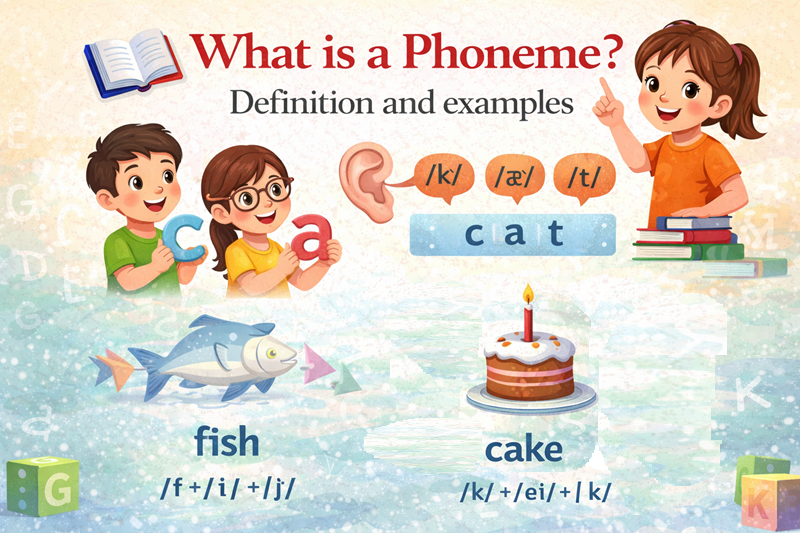
The concept of "phoneme" is fundamental to the fields of linguistics and language acquisition. Whether you're mastering a new language or analyzing how people speak, understanding phonemes helps you appreciate the smallest building blocks of speech. But what exactly is a phoneme? How do they function in communication? And why are they essential in phonetics, phonology, and even reading education? Let’s explore the answers to these questions in this comprehensive guide on phonemes with clear definitions and everyday examples.
What is a Phoneme?
In a language, the smallest unit of sound that may differentiate one word from another is called a phoneme. Phonemes are not the same as letters; instead, they are sounds that can change the meaning of a word. A sound's vibration is a phoneme if altering it alters the significance of the word.
For example-
- The words "bat" and "pat" differ by one sound: /b/ and /p/. These are two distinct phonemes in English because they change the meaning of the word.
What are the key characteristics of Phonemes?
- Smallest unit of sound- A phoneme is the smallest sound unit in a language that can change the meaning of a word.
- Abstract and mental sound unit- Phonemes are not actual physical sounds but mental representations of sounds.
- Linguistic-specific- Every language possesses its phoneme system. In specific languages, a particular sound might not be a phoneme in others.
- Identified through minimal pairs- Phonemes are recognized by comparing minimal pairs—words that differ by just one sound (e.g., bat vs pat).
- Shown by slashes- To differentiate phonemes from letters, such as /p/, /b/, and /s/, slashes are used when writing them.
- Not always one-to-one with letters- A single phoneme can be represented by different letters or combinations of letters (e.g., /f/ in fun, phone, enough).
- Can be vowels or consonants- Phonemes include both vowel sounds (e.g., /æ/ in cat) and consonant sounds (e.g., /t/ in top).
- Invisible in writing- Unlike letters, phonemes are not seen in writing but heard in speech.
- Important in pronunciation and meaning- Changing one phoneme in a word can completely alter its meaning, affecting communication.
- Essential for reading and language learning- Phonemic awareness is crucial for reading, spelling, and language development, especially in early education.
Examples of Phonemes in English-
English contains around 44 phonemes, though the number can vary slightly depending on the dialect.
§ Vowel Phonemes (Approx. 20)
§ /iː/ as in "seat"
§ /ɪ/ as in "sit"
§ /æ/ as in "cat"
§ /ʌ/ as in "cup"
§ /ɔː/ as in "saw"
§ Consonant Phonemes (Approx. 24)
§ /b/ as in "bat"
§ /d/ as in "dog"
§ /g/ as in "go"
§ /f/ as in "fan"
§ /ʃ/ as in "ship"
What are the types of phonemes?
In general, two basic categories can be used to classify phonemes: vowel phonemes and consonant phonemes. Each type has subcategories based on how and where the sounds are produced.
Types of Phonemes-
Consonant Phonemes- These are sounds made by obstructing airflow through the mouth in various ways. English has around 24 consonant phonemes.
§ Based on Place of Articulation (where the sound is made)-
o Bilabial: /p/, /b/, /m/ (both lips)
o Labiodental: /f/, /v/ (lip and teeth)
o Dental: /θ/, /ð/ (tongue and teeth)
o Alveolar: /t/, /d/, /s/, /z/, /n/, /l/ (tongue and ridge behind teeth)
o Post-alveolar: /ʃ/, /ʒ/, /tʃ/, /dʒ/
o Velar: /k/, /g/, /ŋ/ (back of the tongue and soft palate)
o Glottal: /h/ (throat)
§ Based on Manner of Articulation (how the sound is made):
o Stops (Plosives): /p/, /b/, /t/, /d/, /k/, /g/
o Fricatives: /f/, /v/, /θ/, /ð/, /s/, /z/, /ʃ/, /ʒ/, /h/
o Affricates: /tʃ/, /dʒ/
o Nasals: /m/, /n/, /ŋ/
o Liquids: /l/, /r/
o Glides (Semi-vowels): /w/, /j/
Vowel Phonemes- Vowel phonemes are produced without any significant blockage of air. English has about 20 vowel phonemes, though this can vary by dialect.
- Monophthongs (Single, pure vowel sounds)-
· Examples: /iː/ (seat), /ɪ/ (sit), /æ/ (cat), /ʌ/ (cup), /uː/ (blue), /ɒ/ (hot)
- Diphthongs (Two vowel sounds blended in one syllable)-
· Examples:
§ /aɪ/ as in my
§ /eɪ/ as in day
§ /ɔɪ/ as in boy
§ /aʊ/ as in now
§ /əʊ/ as in go
- Schwa /ə/:
§ The most common vowel sound in English, often unstressed (e.g., the 'a in about)
Optional- Phoneme Classification by Function
- Contrastive Phonemes- Change the meaning of a word (e.g., /p/ vs /b/ in pat vs bat).
- Allophones- Variations of the same phoneme that don’t change word meaning (e.g., the aspirated /pʰ/ in pin vs. the unaspirated /p/ in spin).
What do you understand by Phoneme vs. Grapheme?
Many learners confuse phonemes (sounds) with graphemes (letters or letter combinations that represent sounds).
Phoneme- The smallest unit of sound in a language that can change the meaning of a word.
- Example: The word cat has three phonemes: /k/ /æ/ /t/
- Type: Sound (heard)
- Represented by: Slash marks, like /s/, /ʃ/, /tʃ/
- Purpose: Used in speech to distinguish one word from another
- Invisible: You can’t see phonemes; you hear them
Grapheme- The smallest unit of written language that represents a phoneme in a word.
- Example: The phoneme /k/ can be written as c, k, ck, or ch (as in cat, kite, sock, chorus)
- Type: Symbol or letter(s) (seen)
- Represented by: Actual letters or letter combinations
- Purpose: Used in writing to show how words are spelled
- Visible: You see graphemes in print
Comparison Table-
|
Feature |
Phoneme |
Grapheme |
|
What it is |
A unit of sound |
A written representation of a sound |
|
Type |
Auditory (heard) |
Visual (seen) |
|
Example |
/f/ |
f, ph, gh (as in fun, phone, enough) |
|
Representation |
Written in slashes (e.g., /s/) |
Written using letters or letter groups |
|
Function |
Changes meaning in spoken language |
Shows how words are spelled |
Example to Understand Both-
- Word: "ship"
- Phonemes: /ʃ/ /ɪ/ /p/ (3 sounds)
- Graphemes: sh, i, p (3-letter combinations)
Even though "sh" is two letters, it represents one phoneme: /ʃ/.
What Are Minimal Pairs?
Minimal pairs are pairs of words that differ in only one phoneme but have different meanings. They are commonly used in language teaching to illustrate phonemic contrast.
Examples:
- bit /bɪt/ vs. beat /biːt/
- cap /kæp/ vs. cab /kæb/
- ship /ʃɪp/ vs. sheep /ʃiːp/
These help identify the exact phonemes and develop pronunciation awareness.
Why are Phonemes important?
Phonemes are essential across several fields:
- Foundation of spoken language- Phonemes form the basic sound structure of all spoken words. They help distinguish one word from another through sound contrast.
- Improves pronunciation - Understanding phonemes enables the accurate production of speech sounds. It reduces mispronunciation and enhances verbal clarity.
- Promotes phonemic recognition and reading comprehension- Interpreting written text requires the ability to recognize phonemes. It enhances the ability to blend and segment sounds for reading fluency.
- Aids in spelling and writing- It helps learners connect sounds with correct letter combinations. Even, it encourages accurate and consistent spelling practices.
- Facilitates second language acquisition- It enables learners to recognize and produce unfamiliar sounds in a new language. Phonemes improve listening, speaking, and comprehension skills in multilingual contexts.
- Essential in speech therapy- Identifying phonemic errors supports diagnosis and correction of speech disorders. It forms the basis for articulation and phonological interventions.
- Key to linguistic and phonological analysis- It provides insight into the structure and function of language systems. It facilitates the study of sound patterns in various languages by linguists.
- Enhances listening and auditory processing- Phoneme improves the ability to distinguish subtle sound differences. It supports better comprehension in spoken communication.
- Strengthens vocabulary and word recognition- Phonemes promote efficient word identification during reading and conversation. It assists in learning new words by analyzing sound structures.
Phoneme Awareness vs. Phonological Awareness
The capacity to identify, separate, and work with individual sounds (phonemes) in spoken words is known as phoneme awareness. It focuses specifically on the smallest units of sound, such as identifying the first sound in “cat” or blending sounds to form words. In contrast, phonological awareness is a broader skill that includes phoneme awareness but also involves recognizing larger sound units like syllables, rhymes, and onset-rime patterns. While phoneme awareness is essential for learning to read and spell, phonological awareness lays the foundation by helping children understand the overall structure of spoken language. Both are critical for early literacy development. While the two are related, they are not the same.
|
Aspect |
Phoneme Awareness |
Phonological Awareness |
|
Focus |
Smallest sound unit |
Broader sound structure |
|
Skills |
Blending, segmenting sounds |
Rhyming, syllables, onset-rime |
|
Example |
Breaking cat into /k/, /æ/, /t/ |
Identifying syllables in "banana" |
Phonemes in Different Languages
The quantity and variety of phonemes vary among languages. Languages differ greatly in their phonemes. Every language has a different collection of phonemes, or the discrete sounds that make up words. While some languages have a vast and intricate system of phonemes, others have a tiny inventory. This variation explains why speakers of different languages may find some sounds difficult to pronounce or distinguish.
- The number of phonemes varies- Languages can have as few as 11 phonemes or more than 100. The variation affects pronunciation, listening, and language learning.
- Language-specific phoneme sets- A phoneme in one language may not exist in another. Speakers of different languages may struggle with unfamiliar sounds when learning a new language.
- Tonal and non-tonal languages- Some languages, like Mandarin Chinese, use tone as a phonemic feature, where pitch changes the word’s meaning. Non-tonal languages, like English, rely on segmental phonemes (vowels and consonants).
Examples of Phoneme Inventory Sizes
- Rotokas (Papua New Guinea): ~11 phonemes (one of the smallest)
- Hawaiian: ~13 phonemes
- Spanish: ~24 phonemes
- English: ~44 phonemes
- Taa (Botswana): Over 100 phonemes, including clicks (one of the largest)
What are the essential techniques to learn Phonemes?
Educators and parents often use the following to teach phonemic awareness-
- Phoneme division- Work on dissecting words according to their constituent sounds.
- Blending phonemes- Learn to combine individual sounds to form complete words.
- Phoneme replacement- To make new phrases, swap out a single sound with another.
- Phoneme isolation- Identify specific sounds in the beginning, middle, or end of words.
- Rhyming and sound patterns- Use rhymes and sound-based activities to recognize similar phonemes.
- Multisensory learning- Engage visual, auditory, and kinesthetic senses to reinforce phoneme awareness.
- Listening and repetition- Focus on listening closely to sounds and repeating them accurately.
- Phonics-based games- Use interactive tools and games to match sounds with letters or words.
- Little exercise in pairs- Recognize terms that are only different in one sound.
- Use of phonetic symbols- Learn the basic International Phonetic Alphabet (IPA) for precise sound identification.
What are the common challenges with Phonemes?
- Confusion between letters and sounds- Learners often mistake letters (graphemes) for sounds (phonemes), assuming each letter represents only one sound.
- One sound, many spellings- The same phoneme can be spelled in multiple ways, confusing reading and writing.
- One letter, many sounds- In accordance with the word or information, a single letter may stand for several phonemes.
- Difficulty in distinguishing similar sounds- Learners may struggle to hear the difference between closely related phonemes, especially if those sounds don’t exist in their native language.
- Lack of phonemic awareness- Some learners have underdeveloped phonemic awareness, making it hard to segment or blend sounds.
- Pronunciation challenges- Difficulty in physically producing unfamiliar phonemes accurately, especially in second-language acquisition.
- Silent letters and irregularities- Words with silent letters or unpredictable sound-letter correspondences complicate phoneme recognition.
- Influence of dialects and accents- Regional accents may pronounce phonemes differently, making standard pronunciation harder to master.
- Limited exposure to sound patterns- Infrequent listening or reading practice limits exposure to diverse phonemes and their usage in real language.
Conclusion
To sum up, a phoneme is the smallest unit of sound in a language that has the power to alter a word's meaning. Understanding phonemes is essential for effective communication, accurate pronunciation, and strong reading and spelling skills. They are necessary for speech growth, language acquisition, and early literacy. They also provide the basis for spoken language. With around 44 phonemes in English, recognizing and manipulating these sounds enhances phonemic awareness and overall language proficiency. By learning phonemes through structured techniques and consistent practice, learners can build stronger linguistic skills and confidently navigate both spoken and written aspects of any language.
Read More: What is a Diphthong
Frequently Asked Questions
Q1. What is a phoneme in simple words?
Ans- A phoneme is a single sound that can change a word’s meaning, like /b/ in "bat" vs. /p/ in "pat".
Q2. How many phonemes are in English?
Ans- There are around 44 phonemes in English, including vowels and consonants.
Q3. Is a letter the same as a phoneme?
Ans- No. Letters are written, while phonemes are the sounds that are spoken.
Q4. Can one phoneme be spelled in different ways?
Ans- Yes. For example, the /f/ sound appears in fun, phone, and enough.
Q5. What are vowel phonemes?
Ans- These are phonemes produced without blocking airflow, such as /iː/, /æ/, or /ʌ/.
Q6. What is phonemic awareness?
Ans- It is the capacity to perceive, recognize, and work with individual phonemes in spoken language.
Q7. What is a minimal pair?
Ans- Bit and bat are examples of a pair of words that differ only in one phoneme.
Q8. Why are phonemes important for children?
Ans- By associating letters with sounds, they aid in children's reading development.
Q9. Do all languages have the same phonemes?
Ans- No. Each language has a unique set of phonemes.
Q10. What symbol represents a phoneme?
Ans- Phonemes are written between slashes, like /s/ or /ʃ/.
• Phoneme division- Work on dissecting words according to their constituent sounds.
• Blending phonemes- Learn to combine individual sounds to form complete words.
• Phoneme replacement- To make new phrases, swap out a single sound with another.
• Phoneme isolation- Identify specific sounds in the beginning, middle, or end of words.
• Rhyming and sound patterns- Use rhymes and sound-based activities to recognize similar phonemes.
• Multisensory learning- Engage visual, auditory, and kinesthetic senses to reinforce phoneme awareness.
• Listening and repetition- Focus on listening closely to sounds and repeating them accurately.
• Phonics-based games- Use interactive tools and games to match sounds with letters or words.
• Little exercise in pairs- Recognize terms that are only different in one sound.
• Use of phonetic symbols- Learn the basic International Phonetic Alphabet (IPA) for precise sound identification.
§ Vowel Phonemes (Approx. 20)
§ /iː/ as in "seat"
§ /ɪ/ as in "sit"
§ /æ/ as in "cat"
§ /ʌ/ as in "cup"
§ /ɔː/ as in "saw"






Leave a Comment
Your email address will not be published.