
Italy vs Germany Scholarships: Which Country is Better for Free Study?
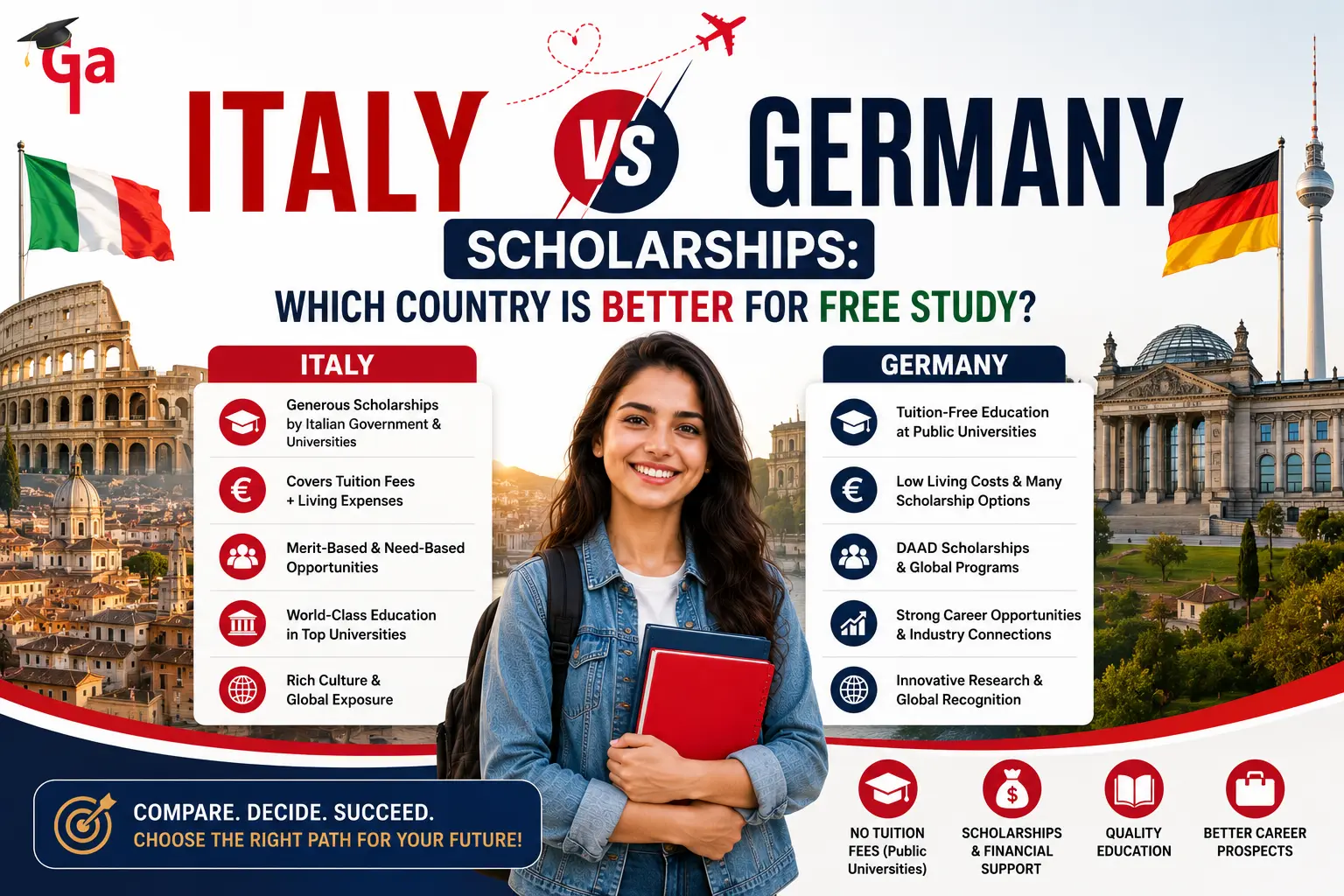
Table of Contents
Studying abroad is a dream for many students. However, the biggest challenge is often the cost. Tuition fees, living expenses, travel, and daily needs can quickly add up. Because of this, many students look for countries where they can study for free or at a very low cost. Two of the most popular options in Europe are Italy and Germany. Both countries offer high-quality education, globally recognized degrees, and many scholarship opportunities. But the question remains: which country is better for free study—Italy or Germany? In this detailed guide, you will understand everything clearly. We will compare scholarships, tuition fees, living costs, job opportunities, student life, and more. By the end, you will be able to decide which country suits you best.
Why choose Europe for free study?
- Low fees- Many European countries offer very low or no tuition fees. Public universities are affordable compared to countries like the USA or the UK. Because of this, students can study without heavy financial pressure.
- Scholarships- Europe provides many scholarships for international students. These scholarships can cover tuition, live costs, and sometimes travel expenses. As a result, students can manage their studies more easily.
- Quality education- European universities offer a strong education with modern teaching methods. Students learn both theory and practical skills. Therefore, they become ready for real-world jobs.
- Global degrees- Degrees from Europe are accepted worldwide. This helps students find job opportunities in different countries. Because of this, their career options increase.
- Cultural life- Students experience different cultures and lifestyles in Europe. They meet people from around the world. In addition, they can travel to many countries easily.
- English courses- Many universities offer courses in English. So, students can study without learning a new language first. However, learning the local language can still be helpful.
- Part-time work- Students can work part-time while studying. This helps them earn money and gain experience. As a result, they can support their daily expenses.
- Safe environment- Europe is safe and student-friendly. Universities provide support services for international students. Because of this, students feel comfortable and secure.
What is the overview of studying in Germany?
Germany is one of the most popular countries for international students. Many students choose Germany because it offers high-quality education at a low cost. In fact, most public universities do not charge tuition fees. Students only need to pay a small semester fee, which usually ranges between €150 to €350. Because of this, Germany has become one of the most affordable countries for higher education. In addition, even though tuition is already free, Germany offers many scholarships to help students manage their living expenses. Popular options include DAAD Scholarships, Erasmus+ Programs, and university-specific scholarships. These scholarships usually provide a monthly stipend, health insurance, travel support, and sometimes accommodation. As a result, students can study in Germany with very little financial burden and, in many cases, almost completely free.
What is the Overview of Studying in Italy?
Italy is a popular choice for international students who want a quality education at a low cost. Public universities charge tuition fees, but they are affordable, usually between €500 and €3,000 per year. In some cases, fees depend on family income, which makes education more accessible. In addition, Italy offers many scholarships, such as DSU, government, and university grants. These can cover tuition, accommodation, meals, and provide a monthly allowance. Because of this, many students can study at very low cost or even for free. Italian universities are well known for courses in arts, design, architecture, as well as business and science. Many programs are also available in English. For students planning to study in Italy, these affordable programs and scholarship opportunities make the country an attractive study destination. Along with studies, students enjoy a rich cultural life, making Italy a great study destination.
Germany vs Italy: Tuition Fees Comparison
| Aspect | Germany | Italy |
|---|---|---|
| Tuition Fees | Most public universities do not charge tuition fees | Public universities charge low tuition fees |
| Average Cost | Free (only semester fee required) | €500 to €3,000 per year |
| Semester Fee | €150 to €350 per semester | Usually included or minimal extra charges |
| Fee Structure | Fixed and same for most students | Depends on course and family income |
| Scholarship Role | Mainly helps with living expenses | Can cover full tuition and living expenses |
| Overall Cost | Very low, almost free education | Affordable and can become free with scholarships |
Cost of Living: Germany vs Italy-Top of Form
| Expense Category | Germany (Per Month) | Italy (Per Month) |
|---|---|---|
| Accommodation | €300 – €700 | €250 – €600 |
| Food | €150 – €250 | €120 – €220 |
| Transportation | €50 – €100 | €30 – €80 |
| Health Insurance | €100 – €120 | €70 – €120 |
| Other Expenses | €100 – €200 | €80 – €150 |
| Total Cost | €850 – €1,200 | €700 – €1,000 |
| Overall Cost | Higher in major cities | Lower in smaller cities |
What about the scholarship availability in Germany?
Germany offers many scholarships, but competition is very high. Since tuition is already free, scholarships are mainly for living expenses. Students need a strong academic record, a well-written motivation letter, and in some cases, relevant work experience to improve their chances of selection.
- DAAD Scholarships- DAAD is the most popular scholarship in Germany for international students. It mainly supports master’s and PhD students from different countries. The scholarship provides a monthly stipend, travel allowance, and health insurance. It is highly competitive, so students need strong academic records and a good application.
- Erasmus+ Program: Erasmus+ is a European Union scholarship that supports student exchange programs. It allows students to study in Germany for a short period, usually 3 to 12 months. The program offers financial support for travel and living expenses. It is a great option for students who want international exposure during their degree.
- Deutschlandstipendium- The Deutschlandstipendium is a merit-based scholarship for talented students. It gives €300 per month to selected students. Both German and international students can apply for it. Universities select students based on academic performance and achievements.
- Heinrich Böll Foundation Scholarship- This scholarship is offered to students who show strong academic ability and social interest. It supports undergraduate, postgraduate, and PhD students. The scholarship provides monthly financial support and additional benefits. It also encourages students who are interested in social and environmental issues.
- Friedrich Ebert Foundation Scholarship- This scholarship is aimed at students who are socially and politically active. It supports international students from developing countries. Students receive a monthly stipend and other financial benefits. It also focuses on promoting leadership and social responsibility.
- Konrad Adenauer Foundation Scholarship- This scholarship supports students with strong academic records and leadership qualities. It is available for postgraduate and PhD students. The program provides financial support along with mentoring opportunities. It is ideal for students interested in politics, law, and social sciences.
- Rosa Luxemburg Foundation Scholarship- This scholarship supports students who are committed to social justice and equality. It is mainly for master’s and PhD students. Students receive financial support for living expenses. It also encourages active participation in social and political issues.
- DAAD Helmut Schmidt Program- This program is designed for students interested in public policy and governance. It supports future leaders from developing countries. The scholarship covers full tuition, living expenses, and travel costs. It is a fully funded program with strong career benefits.
- Bayer Foundation Scholarship- This scholarship is offered to students in science-related fields like biology, chemistry, and medicine. It supports both undergraduate and postgraduate students. The scholarship provides funding for study and research. It is ideal for students interested in scientific innovation.
- University-Specific Scholarships- Many German universities offer their own scholarships for international students. These scholarships vary depending on the university and course. They may provide partial or full financial support. Students should check the official website of their chosen university for details.
What about the scholarship availability in Italy?
Italy offers a large number of need-based scholarships, and they are generally easier to get compared to Germany. The best part is that students do not always need top grades, as financial documents play a major role in the selection process.
- DSU Scholarship (Regional Scholarship)- The DSU scholarship is one of the most popular scholarships in Italy. Regional governments offer it to support students with low incomes. It can cover tuition fees, provide free accommodation, meals, and a yearly allowance. Students mainly need to show financial documents to apply, and high marks are not always required.
- Italian Government Scholarship- The Italian government offers scholarships to international students every year. It is available for master’s and PhD programs. The scholarship provides a monthly stipend and may also cover tuition fees. It is a good option for students who want to study in top universities in Italy.
- University-Specific Scholarships- Many universities in Italy offer their own scholarships. These scholarships can be based on merit or financial need. They may cover partial or full tuition fees and sometimes provide extra support. Students need to check each university’s website for details and deadlines.
- EDISU Piemonte Scholarship- This scholarship is offered to students studying in the Piemonte region. It supports students who have financial needs. The scholarship can provide free accommodation, meals, and financial aid. It is similar to DSU but limited to a specific region.
- LazioDisco Scholarship- It is a regional scholarship for students studying in the Lazio region. It mainly supports students in cities like Rome. The scholarship covers accommodation, meals, and provides financial support. Students must show income proof to qualify.
- Invest Your Talent in Italy Scholarship- This scholarship is for international students from selected countries. It supports students who want to study in fields like engineering, technology, and business. The program offers a monthly stipend and includes internship opportunities. It also helps students build industry connections in Italy.
- Bologna University Scholarship- The University of Bologna offers scholarships for international students. These scholarships are based on academic merit. Students receive financial support and tuition fee waivers. It is one of the most competitive scholarships in Italy.
- Politecnico di Milano Scholarships- It offers scholarships for students in engineering, architecture, and design. These scholarships are merit-based. They may cover tuition fees and provide a yearly stipend. Some scholarships also include accommodation support.
- Scuola Normale Superiore Scholarship- This is a fully funded scholarship for high-achieving students. It covers tuition, accommodation, and meals. Students also receive extra academic support and research opportunities. It is highly competitive and requires excellent academic performance.
- Padua International Excellence Scholarship- The University of Padua offers this scholarship to talented international students. It covers tuition fees and provides a yearly allowance. The scholarship is based on academic merit. It is a great option for students with strong academic records.
Comparison between Italy and Germany scholarships
- Germany offers mostly tuition-free education, so scholarships mainly cover living expenses, while Italian scholarships often cover both tuition and living costs.
- In Germany, scholarships are mostly merit-based, so students need strong academic records and good profiles. In Italy, many scholarships are need-based, so financial condition is more important.
- Scholarships in Germany are highly competitive because fewer are available. In Italy, there are more regional scholarships, so the chances of getting one are higher.
- German scholarships usually provide a monthly stipend, health insurance, and travel support. Italian scholarships often include a tuition fee waiver, accommodation, meals, and allowance.
- Germany is better for students with strong academic performance. Italy is better for students who need full financial support based on income.
- Overall, Germany focuses on low-cost education with limited support, while Italy offers wider financial coverage through scholarships.
What are the Language Requirements for Studying Abroad in Germany and Italy?
- Germany- In Germany, many universities offer programs in English, especially at the master’s level. For these courses, students usually need to show proof of English proficiency through exams like IELTS or TOEFL. However, if the course is taught in German, students must prove their German language skills through tests like TestDaF or DSH. Even if you study in English, learning basic German is very helpful for daily life and part-time jobs. Therefore, knowing some German can improve your overall experience.
- Italy- In Italy, universities also offer many programs in English, especially for international students. For these programs, students need to provide English language test scores like IELTS or TOEFL. If the course is in Italian, students must show their Italian language proficiency. Although it is not always required for English-taught courses, learning Italian helps in daily communication and finding part-time work. As a result, basic knowledge of Italian can make student life easier.
Comparison
- Germany and Italy both offer English-taught programs, especially for international students.
- In both countries, students need IELTS or TOEFL for English courses.
- Germany requires German language tests (TestDaF/DSH) for German-taught programs, while Italy requires Italian proficiency for Italian-taught courses.
- Learning the local language is not always compulsory, but it is very helpful in both countries.
- Germany may require local language skills more for jobs, while Italy also benefits from basic Italian in daily life.
What are the Work Opportunities for Students in Germany and Italy?
| Category | Germany | Italy |
|---|---|---|
| Work Hours Limit | 120 full days or 240 half days per year | Up to 20 hours per week during studies |
| Full-Time Work | Allowed during semester breaks | Allowed during semester breaks |
| Job Availability | High, especially in cities like Berlin, Munich, Frankfurt | Moderate, more opportunities in cities like Milan and Rome |
| Average Pay | €10 – €15 per hour | €7 – €12 per hour |
| Language Requirement | Basic German often needed for better jobs | Basic Italian helpful for most jobs |
| Job Types | Retail, restaurants, warehouses, internships, research assistant roles | Cafes, retail, tourism, small businesses, internships |
| Ease of Finding Job | Easier due to strong economy | Slightly harder compared to Germany |
| Overall Advantage | Better earning potential and more job options | Limited options but enough for basic expenses |
Pros and Cons of Studying in Germany
Pros
- Most public universities offer free or very low tuition fees.
- Germany provides high-quality education with strong practical learning.
- There are good job opportunities during and after studies.
- Students can work part-time to manage their expenses.
- Degrees are globally recognized, which helps in career growth.
- The country has a strong economy, especially in fields like engineering and IT.
Cons
- Scholarships are limited and highly competitive.
- The language barrier can be a challenge if you do not know German.
- Living costs can be high in major cities like Munich and Frankfurt.
- The visa process requires a blocked account with a large amount of money.
- The education system can feel strict and structured for some students.
Pros and Cons of Studying in Italy
Pros
- Tuition fees are low and affordable compared to many countries.
- Italy offers generous scholarships that can cover tuition, accommodation, and meals.
- Many scholarships are need-based, so students do not always need top grades.
- Universities provide good programs in arts, design, architecture, and humanities.
- Students enjoy a rich culture, history, and vibrant lifestyle.
- The cost of living can be lower in smaller cities.
Cons
- Tuition is not completely free if you do not get a scholarship.
- Job opportunities are fewer compared to countries like Germany.
- Knowing Italian is often important for part-time jobs and daily life.
- Administrative processes can be slow and time-consuming.
- Some scholarships may take time to process or get approved.
Which Country is Better for Free Study?
The answer depends on your goals, budget, and profile. Both Germany and Italy offer great opportunities, but they work in different ways.
- Choose Germany if you want guaranteed free tuition. Most public universities do not charge fees, so you only need to manage living expenses. It is also a better choice if you have a strong academic record and want good job opportunities after graduation.
- Choose Italy if you need full financial support. Many scholarships in Italy can cover tuition, accommodation, meals, and even give a monthly allowance. It is a good option if your financial condition is limited and you can provide income proof.
- In terms of careers, Germany offers better job opportunities due to its strong economy. However, in terms of affordability with support, Italy can become completely free with the right scholarship.
- If your priority is free tuition and strong career growth, Germany is the better choice.
- If your priority is full financial support and easier scholarships, Italy may be the better option.
Conclusion-
Choosing between Italy and Germany is not about which country is better overall. Instead, it is about which country is better for you. Germany is a great option if you want free tuition and strong career opportunities. On the other hand, Italy is ideal if you need full financial support through scholarships. Both countries offer great education, international exposure, and life-changing experiences. Therefore, you should carefully think about your goals, budget, and preferences before making a decision. Also, consider factors like job opportunities, language, and lifestyle. Take your time, research properly, and apply early. With the right preparation, you can achieve your dream of studying in Europe without financial stress. Your journey starts with one decision; make it wisely.
FAQs on Italy vs Germany Scholarships-
Q1. Which country offers completely free education?
Ans- Germany offers mostly free education at public universities.
Q2. Can you study in Italy for free?
Ans- Yes, with scholarships like DSU, you can study in Italy for free.
Q3. Which country has easier scholarships?
Ans- Italy has easier, need-based scholarships compared to Germany.
Q4. Do you need IELTS for both countries?
Ans- Yes, for English-taught programs, IELTS or TOEFL is required.
Q5. Which country has better job opportunities?
Ans- Germany has better job opportunities due to its strong economy.
Q6. Is the cost higher in Germany?
Ans- Yes, Germany is slightly more expensive than Italy.
Q7. Can you work while studying?
Ans- Yes, both countries allow part-time work for students.
Q8. Which is better for arts and design?
Ans- Italy is better for arts, design, and creative fields.
Q9. Which is better for engineering and IT?
Ans- Germany is better for technical and engineering fields.
Q10. How should you choose between the two?
Ans- Choose based on your budget, career goals, and personal preferences.
Author
Sakshi Taneja
Content Writer & International Education Specialist
Sakshi Taneja is a content writer specializing in international education, study abroad opportunities, university admissions, student visas, scholarships, and career guidance. She creates accurate, research-driven, and student-focused content to help aspiring international students make informed decisions about their global education journey.
Comments (0)
No comments yet
Be the first to share your thoughts!
Contact Details
Please provide your contact information
Free Counselling
Latest Articles

Germany vs UK Study Costs 2026: Tuition Fees, Living Costs & Scholarships
Oct 16, 2026

Universities With the Highest Acceptance Rates for International Students In 2026: A Complete Guide
Oct 15, 2026

Why Italy and Spain Are Becoming the New Favorites for English-Taught Degrees in 2026
Oct 14, 2026

IRCC 2026 Student Work Permit Updates for Canada
Aug 13, 2026
The Hidden Costs of Studying Abroad in 2026: Rent, Remittances, and Resilience
Aug 10, 2026
Categories
Have a question about Articles?
Want some help figuring out what kind of information you need?
Help and Support
Leave a Comment
Your email address will not be published.