
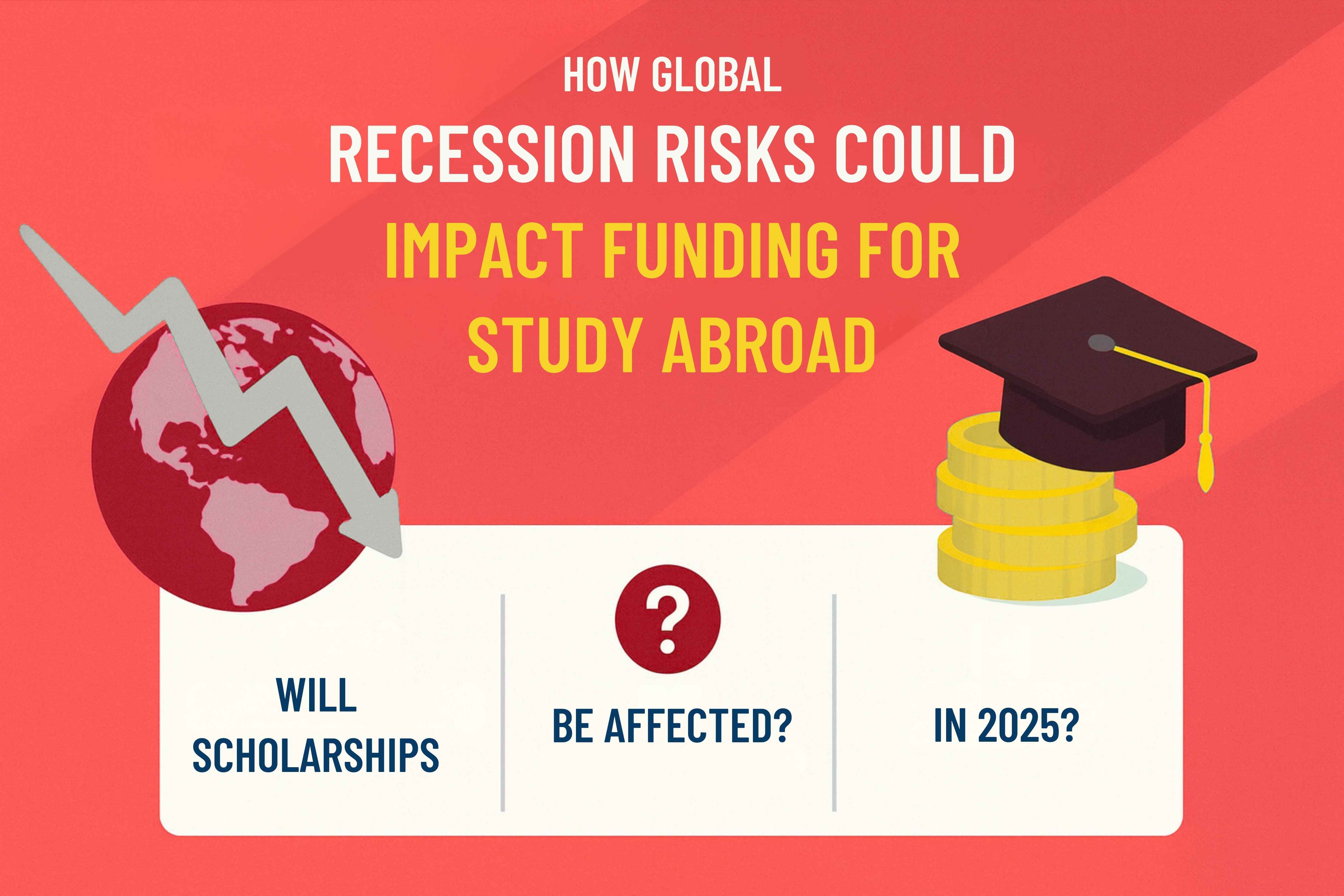
Studying abroad has long been a dream for millions of students worldwide. It promises exposure, high-quality education, and access to global job markets. However, with rising inflation, slowing global GDP, and volatile stock markets, recession fears are casting a shadow over international education dreams. One of the primary areas facing uncertainty is scholarship funding vital support system for financially-constrained but deserving students. This guide takes a deep dive into how recession concerns in 2025 are shaping the scholarship and funding landscape for international students and what they can do to adapt.
How to define the Global Recession Fears?
Global Recession Fears refer to the widespread concern or anticipation that the world economy is heading toward a significant slowdown or contraction in economic activity. These fears arise when key financial indicators such as GDP growth, employment rates, consumer spending, and business investment begin to decline across major economies simultaneously.
Factors like these often trigger them-
- High inflation and rising interest rates.
- Geopolitical tensions or wars.
- Disruptions in global supply chains.
- Decline in trade and manufacturing.
- Stock market volatility.
- Mass layoffs and corporate earnings decline.
These fears impact not only financial markets and businesses but also sectors like education, particularly scholarships and international funding. While some regions are experiencing full-blown economic contractions, others are on the brink of a downturn. Governments and private sectors are reacting with tighter budgets and reduced discretionary spending, including education aid and scholarships.
Why do Recession fears impact scholarships and study abroad funding?
Recession fears impact scholarships and study abroad funding because economic uncertainty forces governments, universities, corporations, and donors to cut or reallocate resources. Here's why-
- Government budget cuts- During economic downturns, governments often shift spending toward urgent domestic needs like healthcare, unemployment, and inflation control. This results in reduced funding for international scholarship programs or education grants.
- Decline in university endowments- Many universities rely on endowments and alums donations, which are often invested in financial markets. A recession lowers investment returns, forcing universities to reduce scholarship offerings or prioritize domestic students.
- Reduced corporate sponsorships- Corporations facing declining profits usually scale back Corporate Social Responsibility (CSR) budgets, including scholarships and education funding. They may pause new programs or cancel existing sponsorships.
- Donor fatigue in nonprofits- Philanthropic organizations and education-focused NGOs often depend on donations. In recession periods, donors contribute less, reducing the availability of grants or bursaries for international students.
- Loan restrictions and higher interest rates- Banks and financial institutions become more risk-averse during economic slowdowns. They tighten education loan policies, increase interest rates, or reduce the loan amounts available to students.
- Increased competition- With fewer scholarships available, more students compete for limited funding. This makes it harder for average applicants to secure financial aid.
- Currency fluctuations and rising tuition- Recession fears often lead to weaker currencies in developing countries, increasing the cost of studying abroad. This financial pressure can reduce the real value of scholarships, making them less impactful.
Recession fears trigger budget constraints, reduce investment capacity, and shift financial priorities, directly affecting the flow of scholarships and funding for study abroad programs.
What is the impact of Global Recession fears on government-funded scholarships?
Global recession fears significantly affect government-funded scholarships, as governments respond to economic uncertainty by tightening budgets and redirecting funds to high-priority sectors. Here are the key impacts-
- Budget cuts and reduced scholarship allocations- During recessionary periods, governments often reallocate spending from education to critical areas like healthcare, subsidies, and unemployment relief. This leads to fewer scholarships awarded, smaller financial aid packages and suspension or cancellation of some international programs.
- Stricter eligibility and selection criteria- To manage limited funds, governments may raise academic or financial need thresholds. PrioritizePrioritise applicants from strategic fields (STEM, healthcare) and favour domestic over international students. This makes it harder for average or non-priority applicants to secure aid.
- Delay in disbursement and uncertainty- Recession fears may delay scholarship announcements or fund releases, causing missed admission deadlines and delayed visa processing. Uncertainty in financial planning for students.
- Focus shift toward domestic education- Governments under economic pressure often promote local education to reduce foreign exchange outflows. It boosts domestic institutions and supports national employment goals. This shift can lead to reduced support for outbound students.
- Geopolitical and diplomatic realignment- In a global recession, scholarships based on diplomatic relations or soft power may get reshaped. Countries may cut scholarships to non-aligned nations. Refocus aid on regions critical to foreign policy goals.
- Long-term uncertainty- Even if not cut immediately, many government scholarship programs face uncertain futures. Recession fears affect future funding cycles, creating unpredictability for students planning their years.
Global Recession Fears Impact on University Scholarships and Grants-
- Decline in Endowment Income- Many universities fund scholarships through endowments invested in financial markets. During a recession, stock market declines reduce investment returns, limiting the funds available for scholarships. As a result, institutions may scale back the number or value of scholarships offered.
- Reduction in International Student Enrollment- Recession fears often lead to a drop in international student applications due to rising tuition costs, unfavourable currency exchange rates, and economic instability in home countries. Lower international enrollment translates to less revenue, prompting universities to cut back on financial aid and scholarship budgets.
- Cuts in Non-Essential Scholarship Programs- Universities typically prioritise core academic scholarships during financial stress. This means that grants for extracurriculars, travel, leadership programs, or cultural activities are among the first to be reduced or eliminated.
- Preference for Domestic Over International Students- To manage limited resources, many institutions prioritise funding for domestic students. This results in reduced scholarship availability for international applicants, especially for need-based or general merit awards.
- Stricter Eligibility and Renewal Requirements- In an effort to allocate limited funds more effectively, universities may raise the academic performance bar for scholarship applicants. They might also introduce tougher renewal conditions such as higher GPA thresholds or stricter timelines for course completion.
- Fewer Graduate Assistantships and Fellowships- Recession fears can impact research budgets, causing universities to reduce graduate teaching and research assistantships. This primarily affects master's and PhD students who rely on these roles for financial support and tuition waivers.
- Delays in Scholarship Disbursement- Economic uncertainty may lead to administrative delays in scholarship processing and fund disbursement. Students may experience late notifications, postponed awards, or unclear timelines for receiving financial aid.
- Pause in New or Pilot Scholarship Programs- Universities may cancel or delay the launch of new scholarships or pilot funding programs, opting instead to preserve existing, essential financial aid structures. This limits the opportunities for students who would have benefited from newly introduced initiatives.
- Increased Competition for Fewer Awards- As the number of scholarships declines, the competition among students intensifies. Even high-performing candidates may face rejection due to the sheer volume of applicants and limited funding pools.
- Pressure on Donor-Based and External Scholarships- University-affiliated scholarships funded by external donors or foundations may also shrink if those organizations experience financial setbacks during a recession. This puts additional pressure on internal university resources, further tightening aid availability.
Exception- Top-Tier Universities
Ivy League or elite institutions often have larger endowments and buffer funds. While they may reduce overall awards, they still offer generous aid to top international candidates.
What about private and corporate scholarships during economic downturns?
CSR (Corporate Social Responsibility) funding often funds scholarships, but during recessions:
- Companies cut non-essential expenditures
- Foundations lose equity-based wealth
- Sponsorship deals become rare
Notable Examples-
- Tech companies like Google, Meta, and Amazon have paused or cut back international education programs.
- Oil companies (e.g., Shell, Total) in resource-strapped regions are redirecting funds to operational resilience.
Still Functional Scholarships-
- Some legacy scholarships like Rhodes, Gates Cambridge, or Coca-Cola Scholars have consistent funding models and are less affected.
Global recession fears have effects on international financial aid and loans-
- Stricter Loan Eligibility Criteria- Banks and lenders tighten approval processes, requiring higher credit scores, stronger guarantors, and more detailed financial documentation from students and their families.
- Higher Interest Rates- To combat inflation, lenders increase interest rates, making education loans more expensive and increasing the long-term repayment burden.
- Reduced Loan Amounts- Financial institutions may limit loan amounts, offering partial coverage for tuition and excluding living expenses, travel, or health insurance.
- Delayed Loan Approvals and Disbursement- Processing times increase due to tighter risk evaluations, leading to delayed disbursements and missed university or visa deadlines.
- Decline in Foreign Currency Loans- Fewer loans are offered in international currencies like USD or EUR due to exchange rate volatility, making it harder to pay foreign tuition fees.
- Withdrawal of Alternative Funding Options- Peer-to-peer lending platforms and income share agreements (ISAs) reduce or pause operations due to decreased investor confidence during a recession.
- Shrinking International Financial Aid Pools- Universities cut back on need-based or merit aid for international students due to smaller endowments and lower donation inflows.
- Focus on Priority Programs Only- Funding is prioritized for high-demand or government-targeted fields (like STEM or healthcare), limiting aid for general programs.
- Shorter Grace Periods and Tougher Repayment Terms- Post-graduation repayment conditions become stricter, with shorter grace periods and fewer options for deferment, especially in weak job markets.
- Increased Competition for Loans and Aid- As scholarships shrink, more students apply for loans, leading to oversubscription, limited approval rates, and intense competition.
Regional case studies about the scholarships and funding opportunities to study abroad-
United States
- Ivy League schools still offering aid
- Decline in state-sponsored international grants
- Visa delays and inflation further burden costs
United Kingdom
- Brexit has already reduced EU student funding
- Chevening saw intake reductions in 2024 and 2025
- Russell Group schools tightening bursaries
Canada
- The government still funds some international grants
- Reduced internship funding for international students
- Banks are raising education loan rates
Australia
- The education sector is hit by inflation and the housing crisis
- Government aid shifted to domestic recovery
- Some universities are launching “pandemic recovery scholarships.”
Europe (Germany, Netherlands, France)
- DAAD is still functional, but field-specific cuts
- The Netherlands is reducing English-taught course subsidies
- France continues cultural grants, especially for African regions
Asia (India, China, Japan, South Korea)
- India’s National Overseas Scholarship Program sees tighter scrutiny
- Chinese scholarships continue to promote “soft diplomacy”
- Japan prioritises STEM and diplomacy-focused funding
- Korea Global Scholarships (GKS) are intact but more competitive
What are the strategies for students amidst reduced funding opportunities?
- Apply for scholarships and financial aid as early as possible to increase chances before funds run out.
- Diversify applications by targeting multiple scholarships from the government, universities, private foundations, and NGOs.
- Choose study destinations with lower tuition fees and living costs, such as Germany, Norway, Poland, or Malaysia.
- Strengthen your academic profile with high grades, strong test scores (IELTS, TOEFL, GRE), and extracurricular achievements.
- Write a compelling personal statement that clearly demonstrates your need, goals, and impact potential.
- Focus on in-demand fields like STEM, climate science, public health, and technology, which often attract more funding.
- Seek remote or freelance work to supplement income while studying, especially in writing, tutoring, design, or coding.
- Use crowdfunding platforms like GoFundMe, Ketto, or Milaap to raise funds from your network and community.
- Explore partial scholarships and combine multiple small awards to cover total expenses.
- Connect with alums or student associations for advice, mentorship, and lesser-known funding opportunities.
- Look for research assistantships, teaching assistantships, or on-campus part-time jobs to reduce financial pressure.
- Stay informed through university portals, embassy websites, and scholarship databases to catch newly released funding options.
How can you figure out alternatives and creative funding options?
- Remote Work or Internships- Many students are combining remote jobs or freelancing with study, creating their funding path.
- Crowdfunding Platforms- Websites like-
- GoFundMe
- Milaap
- Ketto
It allows students to raise funds from communities.
- Alumni Networks- Tapping into alum scholarships or mentorship-based funds can open doors.
- Assistantships- Graduate students should explore RA/TA positions even outside their primary department.
What is the role of education consultants and NGOs?
Many NGOs and education consultants are offering:
- Partial scholarships
- Low-interest education loans
- Application fee waivers
- Profile-building workshops
Notable names include-
- EducationUSA
- UniAssist
- DAAD India
- Campus France
- British Council
How to strengthen your scholarship applications in tough times?
- Tailor your SOP to the specific scholarship.
- Highlight financial need alongside merit.
- Include evidence of leadership and community work.
- Use strong references from academics or employers.
- Mention the impact of your education on your community.
Scholarships are still active in 2025 despite economic uncertainty-
Here are some scholarships still active and reliable-
|
Scholarship Name |
Country |
Key Eligibility |
Notes |
|
Erasmus+ |
Europe |
EU & Partner Countries |
Stable funding |
|
|
USA |
Postgrad & Research |
Still accepting |
|
DAAD |
Germany |
Masters/PhD |
Some cuts but active |
|
GKS |
Korea |
UG/PG |
Competitive but stable |
|
Swedish Institute Scholarships |
Sweden |
PG |
Intact |
|
Vanier Canada Graduate Scholarship |
Canada |
PhD |
Prestigious & active |
|
Australia Research Training Program (RTP) |
Australia |
PhD |
Running |
|
Rhodes/Gates Cambridge |
UK |
PG |
Top-tier, unaffected |
Future outlook: Will it get better?
The long-term trajectory is mixed. While recession fears persist in 2025-
- AI-driven economies are starting to rebound
- Inflation is slowing in many OECD nations
- Governments are reinvesting in higher education
We may see a renewed flow of scholarships by 2026–27, especially in STEM, green technology, and global health.
Conclusion-
Global recession fears are reshaping the landscape of scholarships and funding for international students. As governments tighten budgets and private sponsors cut back, students face reduced opportunities and increased competition. However, the situation isn’t entirely bleak—some prestigious scholarships remain intact, and new funding models are emerging. Students must adapt by applying early, diversifying their funding sources, and strengthening their profiles. Though the current climate poses challenges, resilience, planning, and creativity can help students overcome financial barriers and pursue their global education dreams. The road may be more challenging, but determined learners can still find paths to success abroad.
FAQs on Global Recession Fears Are Impacting Scholarships and Funding Opportunities for Study Abroad-
Q.1 How do global recession fears affect study abroad scholarships?
Ans- Recession fears lead to reduced budgets and investments, causing cuts in scholarship programs and tighter eligibility criteria.
Q.2 Are government-funded scholarships being reduced?
Ans- Yes, many governments are reallocating education funds to domestic priorities, leading to fewer international scholarship opportunities.
Q.3 Do universities still offer financial aid during a recession?
Ans- Some top universities continue to offer aid, but many reduce the number and value of scholarships due to financial strain.
Q.4 Are private or corporate scholarships affected by a recession?
Ans- Yes, companies often cut back on Corporate Social Responsibility (CSR) budgets, leading to fewer sponsored scholarships.
Q.5 Will education loans become harder to access?
Ans- Yes, lenders usually tighten credit requirements, raise interest rates, and reduce loan amounts during recession periods.
Q.6 Is financial aid still available for international students in 2025?
Ans- Yes, but it is more competitive. Students must apply early and strengthen their applications to improve their chances.
Q.7 Which students are most affected by reduced funding?
Ans- International students from developing countries and non-STEM fields often face the most significant impact due to limited resources.
Q.8 Are there scholarships that remain unaffected?
Ans- Some legacy and elite scholarships like Fulbright, Rhodes, and Erasmus+ remain stable despite economic downturns.
Q.9 Can students use alternative ways to fund their studies?
Ans- Yes, options like crowdfunding, part-time work, and multiple small grants can help offset rising education costs.
Q.10 What can students do to increase their chances of funding?
Ans- Apply early, maintain strong academic records, focus on high-demand fields, and seek guidance from education consultants or alums.




Leave a Comment
Your email address will not be published.