
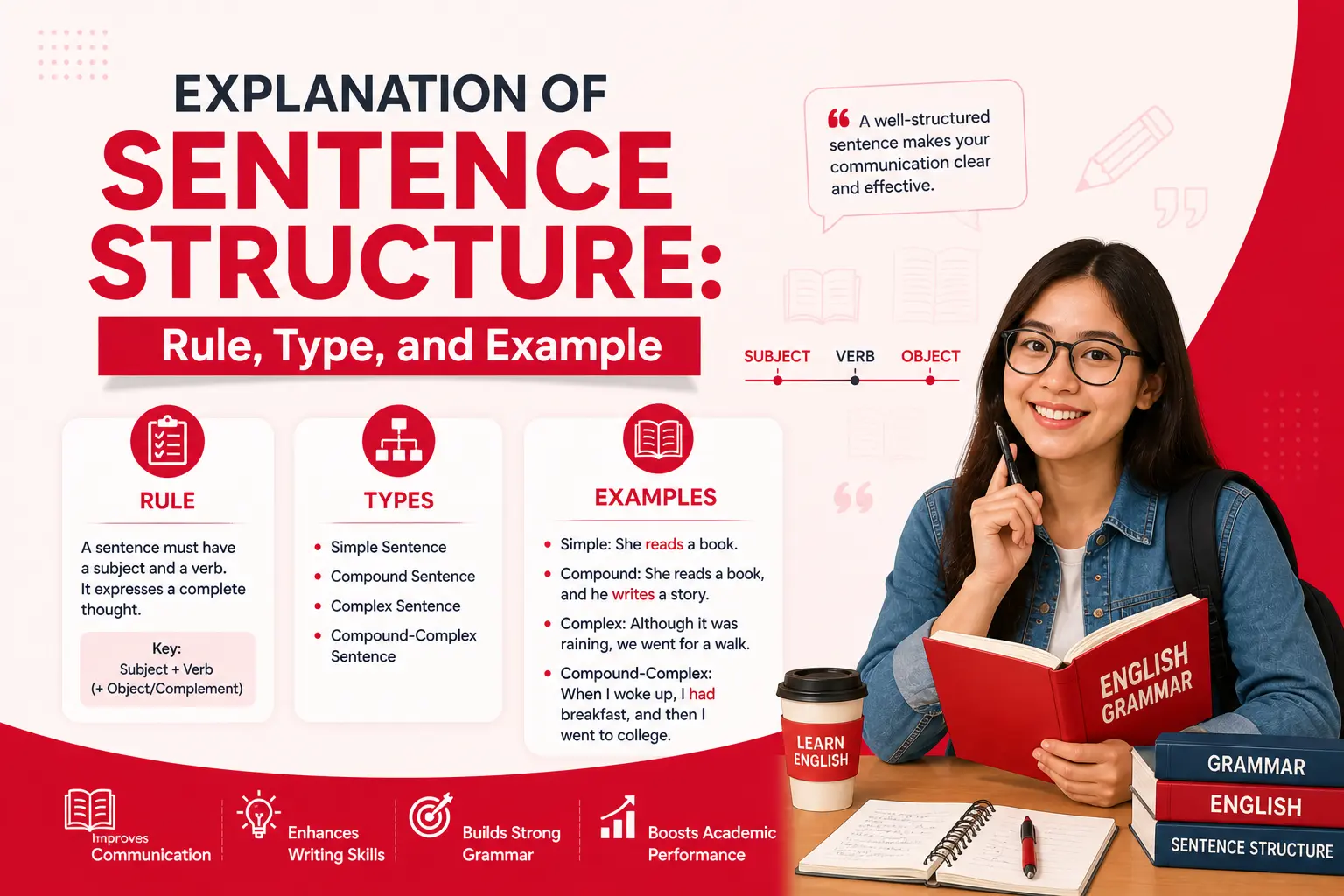
Effective communication hinges on clarity, and sentence structure plays a critical role in delivering clear, concise, and impactful messages. In English grammar, sentence structure refers to how words are organized and connected to convey complete thoughts. Understanding sentence structure isn't just important for students or academics; it's a fundamental skill for anyone aiming to write or speak English correctly and confidently.
In this blog, we will explore the rules of sentence structure, the different types of sentences, and numerous examples to solidify your understanding. Whether you're writing an email, preparing a speech, or crafting a novel, mastering sentence structure will elevate the quality of your communication.
What is Sentence Structure?
Sentence structure refers to how words and phrases are organized within a sentence to convey meaning. A properly structured sentence includes a subject and a predicate. The subject tells us who or what the sentence is about, while the predicate tells us something about the topic (usually involving a verb and possibly an object or complement).
For example-
- "The sun rises in the east."
- Subject: The sun
Predicate: rises in the east
What is the significance of knowing the structure of a sentence?
- Enhances clarity in communication—Proper sentence structure ensures your ideas are expressed clearly. Well-structured sentences eliminate confusion and help the reader easily grasp your message.
- Improves writing quality- Knowledge of sentence structure helps you write more effectively, avoiding common mistakes like run-on sentences and fragments. It enables you to vary sentence length and type, making your writing more engaging and professional.
- Builds stronger grammar skills- Understanding sentence structure strengthens your grasp of essential grammar rules, such as subject-verb agreement and correct punctuation. This foundational knowledge supports more accurate and confident writing.
- Supports academic and professional success- In academic writing, clear sentence structure is crucial for essays writing, reports, and research papers. However, in professional settings, strong writing skills enhance reports, emails, and presentations, building credibility.
- Aids in learning other languages- Mastering sentence structure in English provides a framework for understanding sentence patterns in different languages, making language learning easier.
- Enhances public speaking and communication—Knowing how sentences function makes speaking smoother and arranging ideas coherently while expressing them possible.
- Reduces common writing errors- Understanding sentence structure aids in avoiding errors such as inappropriate wording, phrase fragments, and comma splices. It increases the efficacy of editing and proofreading.
- Helps convey tone and emphasis—You may regulate the tone, emphasis, and tempo of your writing or speech by using various sentence structures, including basic, compound, and complicated ones.
- Develops critical thinking- Analyzing sentence structures sharpens your ability to break down complex information, improving both comprehension and logical thinking.
- Improves reading comprehension- Understanding how sentences are built helps you better interpret and analyze what you read, especially complex texts in literature or academic material.
What are the basic rules of sentence structure?
To write grammatically correct sentences, you must follow these foundational rules:
1. Every Sentence Must Have a Subject and a Predicate
- Subject: The doer of the action.
- Predicate: Contains the verb and tells what the subject is doing.
Example:
· She (subject) is reading a book (predicate).
2. A Sentence Must Express a Complete Thought
A sentence cannot leave the reader guessing.
· Correct:
The cat is sleeping on the couch.
· Incorrect:
Because the cat is sleeping… (incomplete)
3. Use Proper Punctuation
- Start with a capital letter.
- End with appropriate punctuation (. ? !).
Example:
· Are you coming to the party?
4. Verb Tense Agreement
Ensure the tense of the verb matches the time frame of the action.
Example:
· He writes letters. (present)
· He wrote letters. (past)
5. Subject-Verb Agreement
The verb must agree in number with the subject.
Example:
· She writes every day.
· They write every day.
6. Use of Modifiers
Modifiers should be placed close to the word they describe to avoid confusion.
· Incorrect:
She almost drove her kids to school every day.
· Correct:
She drove her kids to school almost every day.
Types of sentence structures (Based on Clauses)-
Sentences are categorized based on the number and types of clauses they contain. These categories help us create varied and engaging writing.
1. Simple Sentences
A simple sentence contains one independent clause. It expresses a complete thought and contains a subject and a verb.
Structure-
Subject + Verb (+ Object)
Examples-
- I like ice cream.
- She plays football.
- Birds fly.
Characteristics-
- One subject-verb pair
- Complete thought
- No dependent clause
2. Compound Sentences
A compound sentence contains two or more independent clauses joined by a coordinating conjunction (for, and, nor, but, or, yet, so) or a semicolon.
Structure:
Independent Clause + (Coordinating Conjunction / Semicolon) + Independent Clause
Examples:
- I wanted to go for a walk, but it started raining.
- She loves painting, and he enjoys music.
- The sun set; the stars appeared.
Characteristics
· Two or more independent clauses.
· Connected logically.
· Equal emphasis on ideas.
3. Complex Sentences
A complex sentence contains one independent clause and one or more dependent (subordinate) clauses. These are connected using subordinating conjunctions (because, although, since, unless, while, when, etc.).
Structure:
Independent Clause + Dependent Clause (or vice versa)
Examples:
- I stayed home because I was feeling sick.
- Although it was raining, we went hiking.
- She smiles when she sees her dog.
Characteristics:
· Main (independent) idea + supporting (dependent) idea.
· Subordination shows relationships
· More nuanced meaning
4. Compound-Complex Sentences
A compound-complex sentence contains at least two independent clauses and one or more dependent clauses.
Structure:
(Independent Clause + Independent Clause) + Dependent Clause (in any order)
Examples:
- Though she was tired, she finished her homework, and she submitted it on time.
- I missed the train because I woke up late, but I still made it to the meeting.
Characteristics:
· Combines complexity and coordination.
· Shows detailed relationships among ideas.
Types of Sentences (Based on Function)
Apart from structure, sentences are categorized by their function or purpose in communication.
1. Declarative Sentences
These sentences make a statement and end with a period.
Examples:
- The sky is blue.
- She loves reading novels.
2. Interrogative Sentences
These sentences ask a question and end with a question mark.
Examples:
- Where are you going?
- Have you completed your assignment?
3. Imperative Sentences
These sentences give commands, instructions, or requests. They may end with a period or an exclamation mark.
Examples:
- Please close the door.
- Stop talking!
4. Exclamatory Sentences
These sentences express intense emotion and end with an exclamation mark.
Examples:
- What a beautiful day!
- I can’t believe you did that!
Summary Table
|
Type |
Function |
Punctuation |
Example |
|
Declarative |
States facts/opinions |
Period (.) |
She loves reading books. |
|
Interrogative |
Asks a question |
Question (?) |
Where are you going? |
|
Imperative |
Gives command/request |
Period / (!) |
Please close the door. |
|
Exclamatory |
Expresses strong emotions |
Exclamation (!) |
What a fantastic performance! |
Explore More |
Examples of sentence structures in context-
Simple Sentence Examples-
- The dog barked.
- She dances beautifully.
- Books are on the table.
Compound Sentence Examples-
- He tried hard, but he failed.
- I called her, and she answered immediately.
- You can go now, or you can wait.
Complex Sentence Examples-
- Since it was raining, we stayed inside.
- I will help you if you need me.
- She cried because she was overwhelmed.
Compound-Complex Sentence Examples-
- While I was studying, my brother watched TV, and my sister played outside.
- Although I was late, I caught the bus, and I arrived on time.
Which techniques should you follow to improve your sentence structure?
Improving your sentence structure is essential for precise, professional, and effective communication. Below are practical techniques to help you enhance your sentence writing skills-
- Read regularly- Read books, articles, and essays to observe different sentence patterns and structures.
- Practice writing daily- Write regularly to strengthen your ability to construct clear and varied sentences.
- Learn grammar rules- Study essential grammar concepts like subject-verb agreement, punctuation, and proper use of clauses.
- Vary sentence length and structure- Use a mix of simple, compound, complex, and compound-complex sentences to make your writing more engaging.
- Break complex ideas into simpler sentences- To simplify long sentences by breaking them down for clarity and better understanding.
- Read your writing aloud- Reading aloud helps you identify awkward phrasing and sentence flow issues.
- Get feedback on your writing—You can seek feedback from teachers or peers or use grammar-check tools to identify and correct mistakes.
- Rewrite sentences for practice- Take an introductory sentence and rewrite it in different ways to experiment with structure.
- Study common sentence patterns- Learn and practice basic sentence structures like Subject-Verb-Object (SVO).
- Expand your vocabulary- A broader vocabulary allows you to create more precise and varied sentence constructions.
- Analyze and imitate good writing- Observe how skilled writers build sentences and try to apply similar techniques in your writing.
- Use transition words effectively- Practice using conjunctions and transitional phrases to connect ideas smoothly.
What are the typical sentence structure mistakes?
- Sentence fragments- Incomplete sentences missing a subject, verb, or complete thought
- Run-on sentences- Two or more independent clauses joined incorrectly without proper punctuation or conjunctions.
- Comma splices- Incorrectly joining two independent clauses with only a comma.
- Lack of subject-verb agreement- Using a singular subject with a plural verb or vice versa.
- Incorrect tense usage- Mixing past, present, or future tense inconsistently within the same sentence.
- Misplaced modifiers- Placing descriptive words too far from the words they modify, leading to confusion.
- Dangling modifiers- Using modifiers without clearly stating what they modify.
- Inconsistent parallel structure- Mixing different grammatical forms within a list or series.
- Confusing complex sentences- Overloading a sentence with too many clauses, making it hard to understand.
- Improper use of conjunctions- Misusing conjunctions to join clauses, leading to grammatical errors.
How can you understand sentence structure in professional writing?
- Recognize who or what the sentence is about (subject) and what is being said about it (predicate).
- Separate independent and dependent clauses to understand how they work together.
- Identify whether the sentence is simple, compound, complex, or compound-complex.
- Determine if the sentence is declarative, interrogative, imperative, or exclamatory.
- Notice how professional writing balances short and long sentences for clarity and impact.
- Understand how punctuation marks like commas, semicolons, and colons organize ideas within sentences.
- Observe how transitional phrases help connect ideas smoothly between clauses and sentences.
- Ensure the sentence maintains a consistent tense and voice (active or passive).
- Analyze how professional writing maintains logical flow through well-structured sentences.
- Reading professional writing aloud helps you hear the structure and rhythm, making it easier to understand how sentences are built.
Sentence Structure and Style
Short Sentences:
- Create impact.
- Increase clarity.
- Useful for emphasis.
Example:
He stopped. He listened. Silence.
Long Sentences:
- Develop complex ideas.
- Show relationships between concepts.
- Enhance descriptive writing.
Example:
Despite the storm raging outside, she remained calm, focusing on her breathing and reminding herself that fear was only temporary.
Conclusion-
Sentence structure is not just about rules; it's about crafting communication that resonates with clarity and purpose. Whether you're writing a formal report, a casual email, or a piece of fiction, understanding how to build sentences empowers you to control tone, clarity, and impact. By mastering the rules, recognizing the types, and practicing through examples, you can elevate your writing from basic to brilliant. Good sentence structure is the foundation of strong, effective communication — and like any skill, it improves with practice.
FAQs on Sentence Structure
Q.1 What is the simplest form of a sentence?
Ans- A simple sentence containing one subject and one predicate.
Q.2 Can a sentence start with 'Because'?
Ans- Yes, if it forms part of a complete complex sentence.
Q.3 How do you spot a run-on sentence?
Ans- Check for improperly joined independent clauses without conjunctions or proper punctuation.
Q.4 What's the difference between a clause and a phrase?
Ans- A clause contains a subject and a verb; a phrase does not.
Q.5 Should you always avoid long sentences?
Ans- Not necessarily. Long sentences can be effective if properly structured.
Q.6 How do conjunctions affect sentence structure?
Ans- They connect clauses and determine whether a sentence is compound or complex.
Q.7 What is a subordinate clause?
Ans- A dependent clause that cannot stand alone as a sentence.
Q.8 Are sentence fragments always wrong?
Ans- Fragments can be stylistically effective in creative writing, but should be avoided in formal writing.
Q.9 How important is punctuation in sentence structure?
Ans- It clarifies the meaning and separates ideas correctly.
Q.10 What is the best way to practice sentence structure?
Ans- Write regularly, read quality writing, and revise using grammar tools.






Leave a Comment
Your email address will not be published.