
Study in Australia is a dream for thousands of students worldwide. The country’s world-class universities, multicultural environment, and strong job opportunities make it one of the most preferred destinations for higher education. However, before a student can begin their journey to Australia, they must complete several vital steps—one of the most essential being obtaining a CoE, or Confirmation of Enrolment.
This document plays a critical role in the visa application process and officially verifies a student’s admission to an Australian institution. This comprehensive guide explains everything you need to know about a CoE in Australia: its meaning, purpose, structure, issuance, requirements, fees, timelines, common challenges, and frequently asked questions. By the end, you will clearly understand how the CoE works and how to use it effectively for your Australian student visa (subclass 500).
What is CoE (Confirmation of Enrolment)?
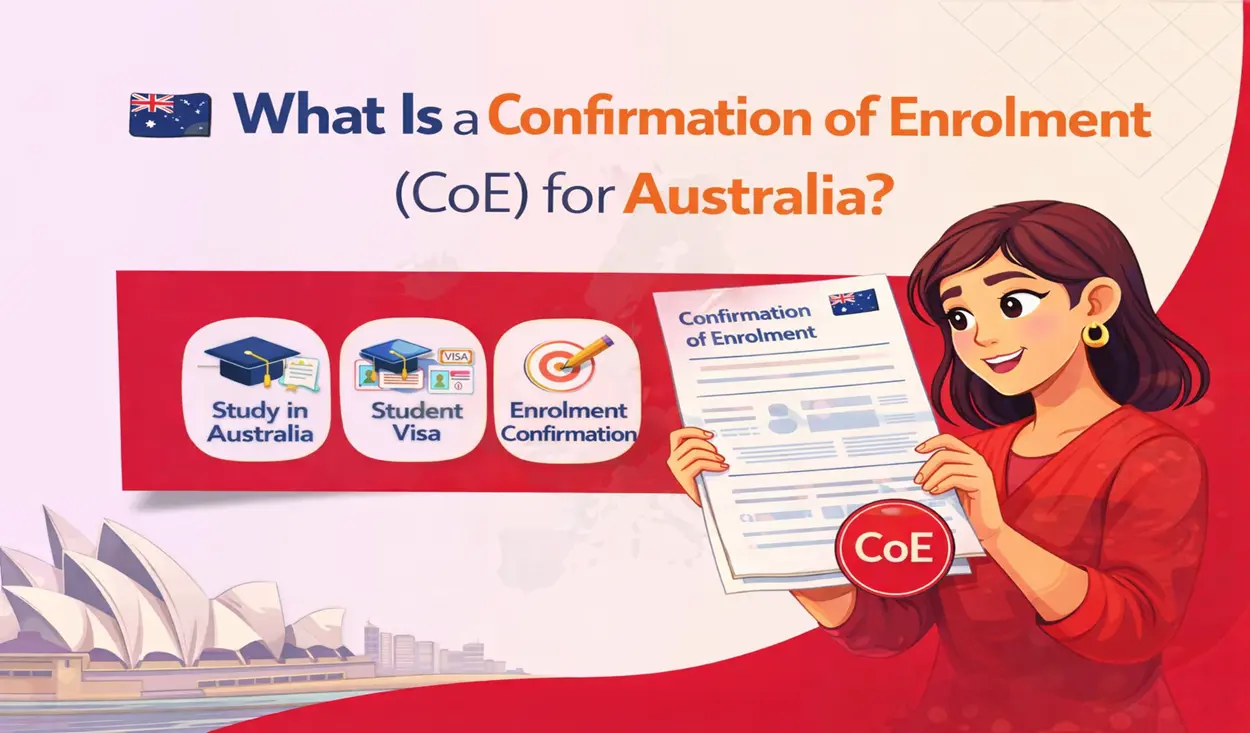
A Confirmation of Enrolment (CoE) is an official, government-recognized document issued by an Australian educational institution to confirm that an international student is enrolled in a full-time CRICOS-registered course.
It is generated through the PRISMS system, Provider Registration, and International Student Management System, and contains essential details such as:
- Student’s full name and date of birth
- Course name and CRICOS code
- Course start and end dates
- Confirmation of tuition payment
- Unique CoE serial number
- Provider code and institution details
- Study mode (usually full-time, on-campus)
The CoE is mandatory for
- Applying for the Australian Student Visa (Subclass 500)
- Maintaining visa compliance
- Re-enrolling or extending studies
- Changing courses or institutions
In simple terms, no CoE = no Australian student visa.
What is the role of CoE in the Australian student visa process?
- The Australian student visa system is structured and highly regulated to ensure that only genuine, eligible students are granted entry. One of the most critical documents required for a student visa is the Confirmation of Enrolment (CoE).
- However, without a CoE, students cannot apply for a Subclass 500 student visa. It acts as proof that a student is genuinely enrolled in a recognized Australian CRICOS-registered course.
- Many students confuse the terms Offer Letter, Acceptance Letter, Tuition Deposit, and CoE. While they are all part of the admission process, only the CoE is legally recognized by the Australian Department of Home Affairs for visa purposes.
- Understanding the CoE ensures a smooth transition from admission to visa application, ultimately helping students start their studies in Australia on time.
Why is the CoE so crucial for students?
The CoE is not just a standard admission document. It is a legal requirement under Australia's Education Services for Overseas Students Act (ESOS Act).
Key reasons why the CoE is essential-
- Mandatory for visa application- The Department of Home Affairs requires a valid CoE for all Student Visa 500 applications. Without it, the visa will be automatically refused.
- Proof of genuine enrolment- It confirms that the student has secured admission in a CRICOS-approved course, proving their intention to study and not misuse the visa.
- Ensures eligibility for OSHC and other services- A CoE allows students to purchase Overseas Student Health Cover (OSHC) for the correct duration.
- Required for course duration and visa length- The visa end date is based on the course end date mentioned on the CoE.
- Essential for travel and accommodation planning- Students can only plan arrival, accommodation, and orientation after receiving their CoE.
- Needed for re-enrolment and extensions- If a student changes their course, extends their program, or transfers institutions, a new CoE must be issued.
Key differences- CoE vs Offer Letter vs Letter of Acceptance
1. Offer Letter-
- Issued by the university offering admission.
- Can be conditional or unconditional.
- Serves as initial proof of acceptance.
- Not required for visa application.
2. Letter of Acceptance (LoA)-
- Confirms the student’s acceptance of the offer.
- Shows intention to enroll in the course.
- Not sufficient for visa purposes.
3. Confirmation of Enrolment (CoE)-
- Official document confirming full-time enrolment in a CRICOS-registered course.
- Contains course dates, fees paid, and a unique CoE number.
- Mandatory for Student Visa (Subclass 500) application.
|
Document |
Purpose |
Visa Requirement |
|
Offer Letter |
An official document from a university offering admission to a student. May be conditional or unconditional. |
Not required for visa; just initial admission proof. |
|
Letter of Acceptance (LoA) |
The student formally accepts the offer from the institution. Confirms intention to enroll. |
Not sufficient for a visa; confirms student’s agreement only. |
|
Confirmation of Enrolment (CoE) |
Official government-recognized document confirming full-time enrolment in a CRICOS-registered course. Contains course start/end dates, fees paid, and unique CoE number. |
Mandatory for Student Visa (Subclass 500) application. |
How is a CoE issued? Step-by-Step Process
The process for obtaining a CoE is systematic and uniform across Australian educational institutions.
- Apply and receive an offer letter- The process begins when a student applies, along with academic transcripts, English test scores, and other required documents. The university then issues either a conditional or unconditional Offer Letter confirming that the student has been accepted for admission.
- Accept the offer- After receiving the Offer Letter, the student formally accepts the admission by signing and returning the Acceptance Form to the institution. It confirms the student’s intention to enroll in the chosen course.
- Pay tuition fee deposit- Once the offer is accepted, the student pays the required tuition fee deposit or the full tuition fee as specified in the Offer Letter. In some cases, the student may also need to pay for the Overseas Student Health Cover (OSHC) at this stage.
- Submit supporting documents- The student provides additional documents, including a copy of the passport, academic transcripts, proof of tuition fee payment, a Genuine Temporary Entrant (GTE) statement, and evidence of OSHC. These documents are necessary for verification before issuing the CoE.
- University verification- The institution reviews all submitted documents, checks fee payments, and assesses GTE compliance. Only after ensuring that all requirements are met does the university proceed to generate the CoE.
- CoE generation via PRISMS- The university generates the Confirmation of Enrolment electronically through PRISMS (Provider Registration and International Student Management System). This system ensures that the Australian government officially recognizes the CoE.
- Student receives CoE- The student receives the CoE via email as a PDF, which includes a unique CoE number, course start and end dates, tuition fee confirmation, and provider details. This CoE is then used to apply for the Australian Student Visa (Subclass 500).
What does a CoE contain?
A CoE includes all essential information needed for visa assessment:
1. Personal Details
- Student’s name
- Nationality
- Date of birth
- Passport number
2. Course Details
- Course name
- CRICOS course code
- Duration of the course
- Start and end dates
- Mode of study
3. Institution Information
- Provider name
- Provider code
- Registered campus location
4. Financial Details
- Tuition fee amount
- Amount already paid
- OSHC details (if included)
5. CoE Identifier
- A unique CoE number used during visa submission.
Documents Required to Obtain a CoE
Students generally need:
- Passport
- Academic transcripts
- English test scores
- Acceptance form
- Tuition fee payment proof
- OSHC (if required)
- Financial documents (for GTE)
- SOP or GTE statement
What types of CoE students may receive?
· Single CoE-
A single CoE is issued when a student is enrolled in one course at an Australian institution. However, it is common for students to take a single program such as a Bachelor’s, Master’s, Diploma, or Certificate course. The CoE confirms full-time enrollment in that specific course with all necessary details, including start and end dates, tuition fees paid, and the unique CoE number.
· Packaged CoE-
A packaged CoE is issued when a student is enrolled in multiple courses under one visa application. However, it usually occurs in pathway programs, where a student might complete an English language course, followed by a diploma, and then progress to a Bachelor’s or Master’s degree. Each course in the package has its own CoE, and collectively they form a “package” that allows the student to apply for a single student visa covering all the courses.
When do you need more than one CoE?
A student may need more than one CoE in several situations-
- Enrolling in pathway programs- When a student completes an English language course or a diploma before progressing to a Bachelor’s or Master’s degree, each stage requires a separate CoE.
- Changing courses or institutions- If a student transfers to a different course or university, the original CoE is cancelled, and a new CoE is issued for the new course.
- Course extensions or deferrals- When the course duration is extended due to academic reasons or a student defers to a later intake, a new CoE reflecting the updated dates is necessary.
- Multiple institutions or programs- Students enrolled in more than one institution or program under a packaged pathway may receive multiple CoEs to cover all the courses in the package.
Moreover, in all cases, each CoE must be valid and linked to the student visa application to maintain compliance with Australian immigration rules.
What about the validity of a CoE, and how long is it valid?
A Confirmation of Enrolment (CoE) is valid for the specific course and duration stated on the document. It serves as proof of enrollment for visa purposes, and its validity is tied to the start and end dates of the course.
How long is a CoE valid?
- Generally, a CoE remains valid until the course begins or until it is cancelled or withdrawn by the institution.
- In most cases, a CoE is valid for up to 12 months from the date of issuance, depending on the course start date.
- If a student defers admission, changes courses, or extends the program, a new CoE must be issued to reflect the updated course details.
Maintaining a valid CoE is essential for lodging a Student Visa (Subclass 500) application and for staying compliant with Australian immigration rules.
Under what circumstances can a CoE be cancelled, and what are the implications for students?
Yes, a Confirmation of Enrolment (CoE) can be cancelled under certain circumstances. A CoE is issued based on the student meeting all admission requirements, paying tuition fees, and complying with university policies. If any of these conditions are not met, the institution may cancel the CoE.
Common reasons for CoE cancellation-
- Non-payment of tuition fees or failure to meet financial obligations.
- Withdrawal from the course by the student.
- Failure to meet course or GTE (Genuine Temporary Entrant) requirements.
- Poor academic performance or unsatisfactory attendance.
- Course closure or discontinuation by the institution.
- Visa refusal or changes in visa conditions affecting enrollment.
Implications of CoE cancellation-
- The student cannot use the cancelled CoE to apply for a visa.
- Visa applications based on a cancelled CoE may be refused.
- A new CoE must be obtained if the student still wishes to enroll.
- Academic plans may be delayed, affecting course progression and career timelines.
However, maintaining communication with the university and ensuring all obligations are met can help avoid CoE cancellation.
What are the common mistakes students make with CoE, and how can they be avoided?
- Submitting incorrect personal information- Many students provide names, passport numbers, or dates of birth that do not match their official documents. This can delay CoE issuance or cause visa refusals. So, always double-check that all personal details match exactly with your passport before submission.
- Paying fees without clearing conditions- Students sometimes pay tuition deposits before fulfilling all conditions in a conditional offer, such as submitting transcripts or English test scores. Moreover, ensure all conditions listed in your offer letter are fully satisfied before making any payments.
- Missing deadlines for acceptance forms- Delays in returning signed acceptance forms can postpone the generation of the CoE, affecting visa application timelines. Submit acceptance forms promptly and confirm receipt with the university.
- Not checking CoE details carefully- Errors in course start/end dates, fees, or course names on the CoE are common and can impact visa approval. Review the CoE thoroughly upon receipt and request corrections immediately if needed.
- Ignoring OSHC requirements- Some students overlook the need for Overseas Student Health Cover for the whole duration of the course, which is required for visa approval. Purchase OSHC that covers your entire course duration and keep proof of insurance.
- Overlooking university communications- Failure to respond to emails from the university regarding CoE issues can lead to cancellations or delays. Moreover, regularly check your university email and respond promptly to all requests or notifications.
What to do if there’s an error on your CoE?
If you notice any errors on your Confirmation of Enrolment (CoE), it is essential to act quickly to avoid visa delays or refusals.
- Contact your university immediately- Reach out to the admissions or international student office as soon as you identify the error. Provide precise details about the mistake.
- Provide supporting documents- Submit any necessary documents that verify the correct information, such as your passport, transcripts, or payment receipts.
- Request a revised CoE- Ask the university to issue a corrected CoE through PRISMS reflecting the accurate information.
- Update your visa application- If you have already lodged your visa application, notify the Department of Home Affairs and provide the revised CoE to avoid complications.
How long does it take to get a CoE?
The processing time for a CoE varies by institution and student profile.
Typical Timeline-
- Offer Letter acceptance: 1–3 days
- Tuition fee deposit: 1–5 days (international transfer)
- CoE issuance after payment: 2–10 days
Total Estimated Time-
· 5 to 14 days
· Some universities may issue it faster for simple cases.
When and how to apply for CoE extensions?
A CoE (Confirmation of Enrolment) extension is required when a student’s course duration changes due to academic reasons, deferral, or course extensions.
When to apply-
- If you fail or defer a subject and need extra time to complete your course.
- When your research or project work takes longer than the original course duration.
- If you change your course structure or intake dates, you will require updated enrollment details.
How to apply?
- Request from your institution- Contact your faculty or the international student office, explaining the reason for the extension.
- Provide supporting documents- Submit transcripts, academic progress reports, or medical certificates if applicable.
- Approval and fee payment- Once approved, pay any required tuition fees or adjustments.
- Receive new CoE- The university generates a revised CoE via PRISMS reflecting the updated course duration.
Fees Associated with a CoE (Confirmation of Enrolment)
In most cases, Australian universities do not charge a separate fee for issuing a CoE. It is generally included as part of the course application and tuition payment process. However, there are a few costs students should be aware of-
- Tuition Deposit Payment- To receive the CoE, students must usually pay a tuition fee deposit (often ranging from AUD 2,000 to AUD 15,000, depending on the institution). However, this is not a CoE fee; CoE issuance depends on this payment.
- Overseas Student Health Cover (OSHC)- Before the CoE is issued, students typically need to purchase OSHC, which is a mandatory cost for all international students.
- CoE Correction or Reissue- Most universities do not charge for correcting errors or reissuing a CoE unless the mistake is due to the student’s repeated negligence.
- CoE Extension Costs- If you need a CoE extension, universities may charge additional tuition fees for extended study duration, but the extension itself is generally free.
Which strategy should you adopt for managing your CoE?
- Ensure all documents are accurate before applying.
- Clear offer conditions early.
- Pay tuition deposits on time.
- Check CoE details carefully.
- Maintain communication with your university.
- Track deadlines to avoid delays or cancellations.
Conclusion-
The Confirmation of Enrolment (CoE) is one of the most essential documents for any international student planning to study in Australia. It is the official proof of admission into a CRICOS-registered institution and serves as the foundation for the Student Visa Subclass 500 application. Understanding how the CoE works, its purpose, requirements, issuance process, validity, and common challenges helps students avoid delays, rejections, or compliance issues.
By preparing documents carefully, responding promptly to universities, and checking all details on the CoE, students can ensure a smooth and stress-free journey to Australia. Whether you are enrolling in a diploma, bachelor’s, master’s, or pathway program, the CoE is your formal gateway to beginning your academic journey in one of the world’s top study destinations.
FAQs on Confirmation of Enrolment for Australia
Q1. Can you apply for an Australian student visa without a CoE?
Ans- No. A CoE is mandatory for Subclass 500 visa applications.
Q2. Can you get a CoE with a conditional offer letter?
Ans- No. All conditions must be cleared.
Q3. How many CoEs can you have at once?
Ans- You may have one or multiple CoEs depending on your pathway courses.
Q4. Is a CoE required for a visitor visa?
Ans- No. It is only required for a student visa.
Q5. Can you change your course after your CoE is issued?
Ans- Yes, but a new CoE will be required.
Q6. What if you lose your CoE copy?
Ans- You can request a new copy from your institution.
Q7. Can a CoE be used twice?
Ans- No, each visa application requires a valid and active CoE.
Q8. How long does the CoE process take?
Ans- Usually 5–14 days, depending on the university.
Q9. Can your CoE be cancelled?
Ans- Yes, for non-payment, withdrawal, or academic issues.
Q10. Are dependents listed on the CoE?
Ans- Usually no, but they appear in PRISMS linked to your CoE.




Leave a Comment
Your email address will not be published.