
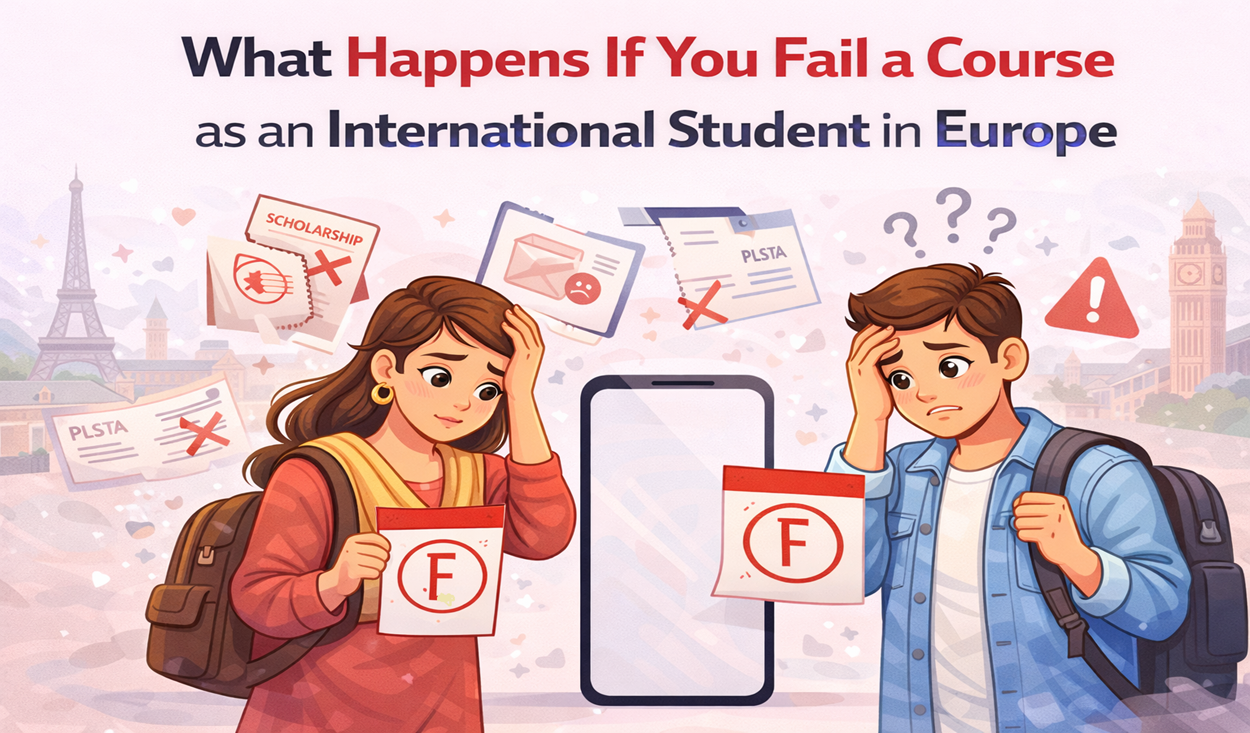
Studying in Europe as an international student is a life-changing opportunity. The continent offers world-class universities, rich cultural diversity, and a unique chance to build a global career. Yet, despite hard work and determination, it is not uncommon for students to face academic setbacks. One of the most anxiety-inducing situations is failing a course.
Failing a course does not automatically mean the end of your academic journey. Still, the consequences vary depending on your country of study, university policies, and student visa conditions. This comprehensive guide explains what happens when you fail a course in Europe and how it affects your immigration status, your academic progression, and your future opportunities.
What does failing a course actually mean across Europe?
It is crucial to comprehend what failing a course truly implies throughout Europe before delving into the repercussions of academic failure. Although the phrase may seem straightforward, European colleges have distinct grading customs and legal systems. Although the Bologna Process, which aimed to standardize higher education throughout Europe, contributes to some uniformity, regional customs continue to differ significantly. The following are the main things you should be aware of-
1. The ECTS Framework and Credit System-
Most European universities operate under the European Credit Transfer and Accumulation System (ECTS).
- Credits represent workload- One academic year usually equals 60 ECTS credits, with each course typically worth 5–10 credits, depending on its length and intensity.
- Requirement for graduation- You must accumulate the full number of credits your program requires to earn your degree. Failing a course means you have not earned the credits attached to it, which can delay graduation or progression to the following year.
2. Grading Scales Differ by Country-
While the Bologna Process introduced ECTS letter grades (A–F), national grading systems remain in use:
- Germany- 1.0 (excellent) to 5.0 (fail)
- France- 0–20, with 10 as the pass mark
- Italy- 0–30, with 18 as the pass mark
- UK- Percentage-based, with 40% (undergraduate) or 50% (postgraduate) usually the minimum pass
- Nordic countries- Often a scale from A–F or 1–5, where the lowest grade indicates failure.
A failure usually means receiving the lowest mark (for example, F or 5.0) or simply not reaching the university's pass threshold.
3. Forms of Failing-
Failure doesn’t always mean you performed poorly in an exam. It can occur if you-
- Miss mandatory coursework or project submissions,
- Fail to meet attendance requirements in courses where participation counts,
- Withdraw late or do not officially drop a course before the deadline.
Each scenario is treated differently: missing an exam might allow a resit, while failing through academic misconduct (like plagiarism) carries more serious penalties.
4. Resit and Retake Policies-
Across Europe, universities typically provide at least one resit opportunity, a chance to retake the exam or submit additional work:
- There are usually two “sessions” in France each year, with a formal retake period known as rattrapage.
- In Germany, students often get two or three attempts before a course is permanently marked as failed.
- In the UK, most institutions allow one or two reassessment attempts, sometimes capped at the minimum pass mark.
It’s vital to check your university’s specific rules, as the number of attempts and whether the resit grade replaces the original can vary.
5. Academic Standing and Progression-
Failing a course typically affects your academic progression-
- If the course is a prerequisite, you may not be able to register for advanced modules until you pass it.
- Some programs require you to earn a minimum of ECTS credits each year. For example, in the Netherlands, many universities expect students to achieve at least 50% of the required credits annually to maintain enrolment and residence permit eligibility.
6. Difference Between a “Fail” and “Incomplete”-
Some universities distinguish between:
- Fail: You attempted the course but did not meet the pass mark.
- Incomplete: You could not complete the course due to illness or other valid reasons; you may be granted an extension rather than a failure.
What are the immediate academic consequences of failing a course as an international student in Europe?
The immediate academic consequences of failing a course as an international student in Europe can be significant and may vary depending on the university and country. However, some common effects include:
- Loss of ECTS Credits- European universities use the European Credit Transfer and Accumulation System (ECTS). Failing a course means you do not earn the credits attached to it, which can-
o Delaying your ability to meet the yearly credit requirements.
o Postpone graduation if the failed course is compulsory.
- Retake Opportunities- Most European universities provide retake or resit opportunities. You may be allowed to
o Resit the final exam during the same academic year.
o Repeat coursework or submit improved assignments.
o Retake the entire course in the following semester or year.
Policies vary-
o In the UK, most institutions allow at least one reassessment attempt.
o In Germany, you typically have two or three chances to pass an exam.
o In France, there are usually two “sessions” per academic year.
· Impact on Academic Progression-
o If the failed course is a prerequisite, you may be barred from registering for higher-level modules until you pass it.
o Some programs require students to earn a minimum number of credits each year; failing to do so may result in repeating a semester or year.
- Effect on Academic Record and GPA-
o The failure will appear on your transcript and may lower your Grade Point Average (GPA) or equivalent.
o Some universities cap the resit grade at the minimum pass mark, even if you pass the course in a resit.
- Possible Extension of Study Duration- Failing a course often means you need additional time to complete your degree, which may-
o Increase tuition and living expenses.
o You must apply for a visa extension if your residence permit is tied to your study duration.
- Requirement for Academic Counseling or Remedial Actions-
o Many universities mandate academic advising sessions or remedial classes to help you address weaknesses and improve performance.
What about the Visa and Immigration Implications?
Your residence permit or student visa is tied to satisfactory academic progress as an international student. Immigration rules vary by country:
- United Kingdom- The UK Home Office expects students to progress academically yearly. Repeating a year or failing to meet progression requirements may affect visa extensions. Universities are required to report students who are no longer enrolled full-time.
- Germany- Student residence permits require “regular studies.” One or two failed exams are not a problem, but repeated failures leading to prolonged study without progress can cause difficulties at renewal.
- Netherlands—For those with an “academic progress requirement,” you must earn a minimum number of ECTS credits each year (typically 50% of the nominal load). Failure to meet this may result in the withdrawal of your residence permit unless special circumstances are proven.
- France, Spain, Italy- Similar rules apply—students must remain enrolled and demonstrate satisfactory academic activity.
Key note- Always inform the international student office at your university. They can advise on remaining compliant with visa regulations if you must repeat courses.
Choose Your Dream Destination in EuropeFrom Germany, Italy, France, and Ireland to other leading European destinations Start your journey today for Study in United Kingdom | Study in Germany | Study in Italy | Study in France |
What is the financial impact of failing a course as an international student in Europe?
Failing a course as an international student in Europe can lead to several financial impacts, both immediate and long-term. These may differ depending on the country, university policies, and the terms of your visa or scholarship, but common consequences include:
- Additional tuition fees for retaking courses- Many universities charge extra fees for repeating a course or retaking exams beyond the regular schedule. These costs can be substantial in some countries (e.g., the UK or Germany’s non-EU fee structure), especially for international students who already pay higher tuition rates.
- Extended duration of study- If failing a course delays graduation, you may need to enroll for an extra semester or academic year, which means-
o Paying additional tuition and administrative fees.
o Covering ongoing living expenses such as rent, utilities, transportation, and food.
- Impact on scholarships and financial aid- Scholarships and grants often require students to maintain a minimum GPA or credit completion rate. Failing a course could result in
- Reduction or loss of scholarship funding, forcing you to pay higher out-of-pocket costs.
- Possible repayment of specific performance-based grants if conditions are not met.
- Visa and residence permit costs- If you need to extend your stay to retake the course or complete your degree, you may incur:
- Visa renewal fees vary by country.
- Additional costs for health insurance are mandatory in most European countries.
- Opportunity costs- A delayed graduation can postpone your entry into the workforce, causing:
- Loss of potential income you would have earned if you graduated on time.
- Possible delay in applying for post-study work visas or permanent residence options.
- Other hidden expenses include the Cost of buying new textbooks or study materials for a repeated course and the cost of paying for extra tutoring or academic support to ensure success in the next attempt.
Emotional and Psychological Considerations-
- Stress and anxiety- The fear of disappointing family, losing scholarships, or facing visa issues can create high levels of stress. Anxiety often increases before retakes or when dealing with academic probation.
- Loss of confidence and self-esteem- Failing a course may lead to self-doubt, making students question their abilities and academic choices. This loss of confidence can affect performance in other subjects and reduce motivation to study.
- Cultural and social isolation- International students might already experience cultural adjustment challenges. Failure can intensify feelings of loneliness or the perception of being an outsider, especially if peers progress while they must retake courses.
- Fear of parental or peer judgment- Many students worry about disappointing parents or sponsors, especially if their families make significant financial sacrifices. Peer pressure or comparison with classmates can increase feelings of embarrassment or guilt.
- Impact on mental health- Prolonged stress and repeated setbacks can lead to depression, burnout, or emotional fatigue. Students may experience sleep problems, loss of appetite, or difficulty concentrating.
- Motivation and academic engagement- Failing a course can decrease motivation, making it harder to stay committed to studies. Some may even consider changing programs or withdrawing entirely.
- Coping strategies and support systems- Seeking help from university counseling services, student support groups, or peer mentors can provide emotional relief. Developing healthy coping mechanisms like time management, mindfulness practices, and regular exercise can reduce stress and improve resilience.
- Building resilience and learning from failure- Although initially disappointing, failure may impart important life lessons like flexibility and tenacity. Viewing the setback as an opportunity for personal growth and academic improvement can help rebuild confidence.
Country-Specific Scenarios-
- Germany- German universities often allow multiple exam attempts, sometimes up to three. Only after repeated failures can a student be barred from the subject. However, if you progress overall, one failed course rarely threatens a residence permit.
- United Kingdom- Undergraduate students typically have one or two resit opportunities. Visa implications become serious if you must repeat a full year or drop below full-time status. Inform your university’s International Office immediately.
- Netherlands- The Dutch Immigration and Naturalisation Service (IND) requires that international students obtain at least 50% of the nominal ECTS each year. Universities can grant exemptions for illness or personal issues, but repeated failure without valid reasons may lead to losing your residence permit.
- France- Universities offer two “sessions” each academic year: an initial exam and a retake. Visa renewals depend on proof of serious study, but a single failure is not critical if progress is demonstrated.
- Nordic Countries (Sweden, Finland, Denmark)- These countries offer flexible retake opportunities. Residence permits require you to study actively; a few failed courses are not an issue unless they cause prolonged inactivity.
Other EU Countries-
In Italy, Spain, and other countries with Bologna-compliant systems, policies are similar: retake options exist, but continued failure can delay graduation and raise visa questions.
What are the most effective strategies for recovery after failing a course as an international student in Europe?
- Understand the university’s retake and resit policies- Carefully review the university’s academic regulations to know the allowed number of resit attempts, deadlines, and grading rules. Find out if the resit grade will replace the original mark or be capped at the minimum pass mark.
- Meet with academic advisors or course tutors- Schedule a meeting with your academic advisor, program coordinator, or course tutor to discuss the reasons for failure. Ask for constructive feedback on weak areas and guidance on preparing for the next attempt.
- Create a targeted study plan- Identify the topics or skills where you struggled and make a focused study schedule. Break down complex material into smaller, manageable tasks and set weekly learning goals.
- Consider peer or professional tutoring. For subjects that require extra attention, join peer study groups or hire a professional tutor. Explaining concepts to peers or learning collaboratively often deepens understanding.
- Improve time management and study habits- Analyze how you used your time during the previous semester and identify distractions. Apply techniques such as the Pomodoro method, task prioritization, and a consistent study routine.
- Explore alternative course options (if allowed)- In some programs, you may replace a failed elective with another course. Discuss with your academic advisor if such flexibility is available.
- Maintain visa and scholarship compliance- Ensure you comply with student visa requirements and scholarship conditions. If failing a course affects your full-time enrollment status, inform the international student office immediately to explore options.
- Reflect and build resilience—View failure as a learning experience, not a permanent setback. Build resilience by acknowledging mistakes, focusing on improvement, and staying motivated for future success.
What are the long-term consequences and career impacts of failing a course as an international student in Europe?
- Extended time to graduate- If the failed course is mandatory or a prerequisite, you may need an additional semester or year to complete your degree. Prolonged studies mean paying extra tuition fees, housing, and living expenses, and possibly extending your visa.
- Effect on academic record and GPA- Most universities record failed attempts on the official transcript, even if you later pass the course.
- Lower GPA or Final Grade Classification- A fail can reduce your cumulative grade point average or, in European systems, lower your final degree classification (e.g., in the UK, dropping from a First to an Upper Second). This could influence eligibility for postgraduate studies or competitive scholarships.
- Impact on postgraduate or exchange opportunities- Universities offering master’s or doctoral programs often require strong academic records. A failure may require explanation in your application or interview. Some European and international exchange programs set minimum academic standards; failing a course might make you ineligible.
- Influence on scholarship renewal- Many merit-based scholarships and financial aid packages require maintaining a certain GPA or earning a specific number of credits each year. Failing a course could result in loss of funding, forcing you to cover higher expenses yourself.
- Career prospects and employability- A high GPA or a history of failures might cause worries during a job interview, even though most companies prioritize experience and general abilities. Industries such as finance, consulting, or academia may place greater weight on academic performance, making consistent grades more critical.
- Professional licenses and certifications—For careers requiring specific professional certifications, such as engineering, medicine, or law, academic failures can delay or complicate eligibility for licensing exams.
- Impact on post-study visa and immigration pathways- Countries like Germany, the UK, or the Netherlands often require timely graduation to qualify for post-study work visas. Extended study time or gaps caused by failing a course might complicate long-term immigration plans.
- Reputation and networking- Though one failure is rarely a career-breaker, repeated academic issues can affect relationships with professors or mentors, potentially impacting letters of recommendation or research opportunities.
- Personal development and resilience—Overcoming failure can, on a positive note, demonstrate adaptability, perseverance, and problem-solving skills, qualities that many employers value highly.
Preventive Measures-
- Attend All Lectures and Tutorials: Stay updated with lessons, key concepts, and essential exam announcements.
- Develop Time-Management Skills: Plan a schedule, set priorities, and break tasks into smaller parts to avoid last-minute stress.
- Seek Academic Support Early: Consult professors, assistants, or advisors before issues escalate.
- Utilize University Resources: Use libraries, writing centers, tutoring, and language support services.
- Join Study Groups: Gain new perspectives, share knowledge, and stay motivated.
- Monitor Grades Regularly: Track progress to identify and fix weak areas promptly.
- Improve Language Skills: Strengthen writing and speaking to boost confidence and clarity.
- Manage Stress: Practice mindfulness, exercise, and maintain balance.
- Know Course Policies: Understand grading, retake options, and regulations.
- Build Faculty Relationships: Seek mentorship, guidance, and recommendations.
Conclusion-
Failing a course as an international student in Europe can feel overwhelming, but it is not the end of your academic journey. While it may lead to immediate challenges such as retaking exams, financial strain, or visa implications, universities often provide support systems to help students recover. By seeking academic guidance, using university resources, and maintaining clear communication with professors and advisors, you can create a realistic plan to regain momentum. Treat the setback as an opportunity to strengthen your study habits, build resilience, and learn from the experience, turning a temporary failure into a foundation for future success.
FAQs on What Happens If You Fail a Course as an International Student in Europe-
Q1. What happens if you fail a course as an international student in Europe?
Ans- You may need to retake the exam or the entire course, which could delay graduation and affect your visa status.
Q2. Will failing one course affect your student visa?
Ans—If it lowers your required credit load or academic progress, it may impact your visa renewal; check with your university’s international office.
Q3. Can you retake the failed exam?
Ans- Most European universities allow one or more resit opportunities, though policies vary by country and institution.
Q4. Will failing a course increase my tuition fees?
Ans- Retaking courses or exams may require extra fees depending on the university’s rules.
Q5. Does failing a course appear on your transcript?
Ans- Yes, but it may be updated if you pass the course after a retake.
Q6. Can you still graduate on time after failing a course?
Ans- Possibly, if you successfully retake the exam or adjust your study plan without delaying credits.
Q7. Will failing a course affect future job prospects?
Ans- Usually not, especially if you eventually pass; employers value overall performance and skills more than a single failure.
Q8. Can you get academic support after failing?
Ans- Universities offer tutoring, counseling, and academic advising to help you improve.
Q9. Is it possible to appeal a failed grade?
Ans- Many universities allow formal appeals if you suspect errors or unfair grading.
Q10. How can you avoid failing in the future?
Ans- Attend all classes, manage time well, seek help early, and use university resources such as study groups and tutoring services.



Leave a Comment
Your email address will not be published.