
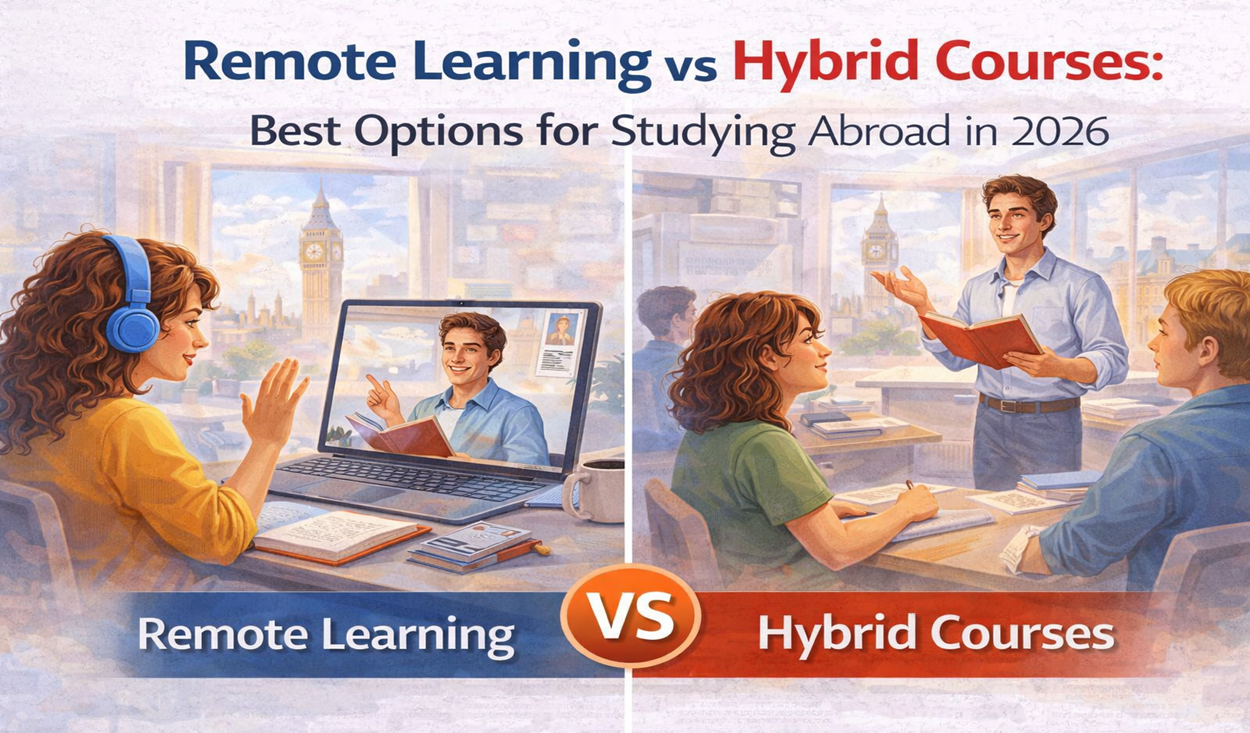
There has been a remarkable change in schooling in recent years. Universities all across the world were obliged to implement hybrid courses and remote learning as essential solutions due to the COVID-19 pandemic. However, what started as a necessity soon evolved into a popular and permanent part of the global education landscape. Today, remote learning and hybrid courses are no longer seen as second-tier alternatives but viable options for students, including those planning to study abroad.
But as the world gradually returns to normal, questions arise: Are remote learning and hybrid courses still worth considering for students aiming for international education? Do these models offer the same benefits, exposure, and career opportunities as traditional study abroad programs? This detailed blog explores these questions in depth.
What is Remote Learning?
Remote learning is a mode of education where students and teachers are not physically present in the same location. Instead, learning takes place through digital platforms, allowing students to attend classes, access study materials, and interact with instructors from any location using the internet. This method became especially popular during the COVID-19 pandemic, but continues to be a flexible and accessible option for many students worldwide.
Key features of remote learning-
- Classes are conducted through virtual platforms such as Zoom, Microsoft Teams, or Google Meet. Lectures can be live (synchronous) or recorded (asynchronous) for flexible access.
- Study materials, assignments, readings, and presentations are shared online through Learning Management Systems (LMS) like Moodle, Blackboard, or Canvas.
- Students can learn from home or any location, saving time and expenses related to travel and accommodation.
- Many remote programs allow students to progress at their own pace, offering greater control over their schedules and learning speed.
- Interaction with instructors and peers happens through emails, discussion forums, video conferencing, and group chats, fostering communication despite physical distance.
- Students can enrol in programs offered by international universities without relocating, making education from prestigious institutions more accessible.
- Exams, quizzes, assignments, and projects are submitted digitally, with feedback provided through online portals.
- A stable internet connection, a computer or mobile device, and basic digital skills are essential to participate effectively.
What is Hybrid Learning / Hybrid Courses?
Blended learning, another name for hybrid learning, is a flexible educational strategy that blends online (remote) and in-person (face-to-face) learning. Students divide their time between taking classes in person and using online resources to finish assignments or lectures. With the flexibility and convenience of online learning combined with the structure and engagement of classroom instruction, this approach seeks to provide the best of both worlds.
Key features of Hybrid Courses-
- Students attend some classes physically on campus (labs, workshops, group activities) while other lectures or materials are accessed online.
- Students enjoy the flexibility of online study alongside the structured environment and benefits of classroom interaction.
- Courses rely on digital platforms for content delivery, assignments, and communication while also utilizing physical campus resources when needed.
- Opportunities to build relationships through campus activities, group discussions, and practical sessions enhance networking and collaboration skills.
- Students benefit from access to university facilities like libraries, laboratories, workshops, and extracurricular activities during their in-person sessions.
- Hybrid learning offers a blend of independent, self-paced study and guided, interactive sessions with instructors and peers.
- Subjects requiring hands-on learning, like engineering or healthcare, often include essential in-person components such as labs or fieldwork.
- Combining different learning methods (videos, readings, discussions, projects, and practical activities) helps maintain student interest and improve comprehension.
Why have Remote and Hybrid courses become popular?
The rise of remote and hybrid courses in recent years is not just a trend but a response to changing educational needs, technological advancements, and global circumstances. Below are the key reasons why these learning models gained popularity-
- COVID-19 Pandemic: A major catalyst- The global pandemic forced educational institutions to adopt remote learning as a necessity. With campuses closed, online learning became the primary mode of education, leading universities to invest heavily in digital infrastructure. This sudden shift proved that education could continue successfully beyond traditional classrooms.
- Advancements in technology- Technological progress has made remote and hybrid learning more practical and effective. High-speed internet, user-friendly Learning Management Systems (LMS), video conferencing tools like Zoom and Microsoft Teams, and collaborative apps like Google Workspace have all enabled seamless learning experiences from anywhere in the world.
- Increased demand for flexibility- Today’s students often juggle multiple responsibilities such as part-time work, internships, and family obligations. Remote and hybrid courses provide the flexibility to balance education with personal and professional commitments, making higher education more accessible.
- Global access to education- Remote learning allows students to enrol in prestigious universities abroad without relocating, saving on travel and living costs. Hybrid learning lets students experience the benefits of studying abroad while minimising time spent away from home.
- Cost-effectiveness- Remote courses often reduce expenses related to housing, travel, and campus facilities. Hybrid models offer partial savings while still allowing for cultural and educational immersion during on-campus sessions.
- Work-study balance- Remote and hybrid formats enable students to work while studying, supporting financial independence and career growth alongside academic progress.
- Evolving educational preferences- Modern learners value personalized, self-paced, and technology-driven education. Remote and hybrid courses align with these preferences, offering diverse learning tools, resources, and formats.
- Employer acceptance increasing- Employers have grown more accepting of degrees earned through remote and hybrid learning, especially when issued by reputable institutions. This growing recognition has enhanced the credibility and appeal of these study models.
- Environmental and sustainability benefits- Remote learning reduces the need for daily commutes and international travel, contributing to lower carbon footprints and aligning with global sustainability goals.
- Preparedness for future crises- Remote and hybrid models provide educational continuity during disruptions like pandemics, natural disasters, or geopolitical issues, making institutions more resilient and students less vulnerable to interruptions.
What is the advantage of Remote and Hybrid learning for international students?
Benefits of Remote learning for international Students-
International students who want to pursue a worldwide education without physically moving might benefit from a number of advantages that remote learning offers. It offers financial savings, flexibility, and admission to world-class colleges. The main advantages are detailed below-
- Affordability- Remote learning eliminates significant expenses such as accommodation, travel, and living costs abroad. Students can earn degrees from prestigious institutions at a fraction of the traditional cost. Students only pay tuition and minimal administrative fees, making education from top global universities more accessible.
- Flexibility and convenience- Remote learning offers greater flexibility in terms of time and location. Students can study from home or any preferred location. To study at their speed, individuals can even select programs that provide asynchronous classes. It allows students to balance their education with other obligations, such as part-time jobs or family duties.
- Access to prestigious institutions- Remote learning removes geographical barriers, allowing students to enroll in courses from prestigious universities in countries like the USA, UK, Canada, and Australia without having to relocate. This opens doors to world-class education from anywhere.
- Balance work and study- International students can continue working in their home country while pursuing their degree remotely. This allows them to gain work experience, maintain financial stability, and apply their learning in real-time without the restrictions of a student visa.
- Diverse learning resources- Remote programs often provide access to recorded lectures, webinars, digital libraries, e-books, virtual labs and simulation tools.
- Improved time management skills- Remote learning fosters self-discipline and time management, valuable skills for both academic success and future career growth. Pupils gain knowledge on how to efficiently manage their calendars, prioritize assignments, and meet commitments.
- Personalized learning experience- A more individualized course of study is made possible via remote learning. Students can revisit recorded lectures, access additional learning materials, and engage with interactive content that suits their learning style.
- Safe learning environment- In uncertain times, pandemics, geopolitical issues, and natural disasters, remote learning offers a safe and stable educational pathway, allowing students to continue their studies without disruption.
Benefits of Hybrid learning for international students-
Hybrid learning offers international students the perfect blend of online flexibility and in-person engagement. It blends the advantages of on-campus learning with the ease of distance learning. Below are the key benefits explained in points with clear subheadings-
- Flexibility with structure- Hybrid learning allows students to enjoy flexibility through online classes while benefiting from the structure of scheduled on-campus sessions. This combination helps students balance studies, work, and personal commitments more efficiently.
- Opportunity for cultural immersion- Unlike fully remote courses, hybrid learning gives international students the chance to experience new cultures, languages, and lifestyles during their in-person components, enriching both personal and academic growth.
- Access to campus facilities and resources- Students can make use of labs, libraries, research centres, workshops, and extracurricular activities during their on-campus visits, enhancing their learning experience with hands-on resources and tools.
- Balanced learning experience- The combination of theoretical online learning and practical, face-to-face activities creates a more well-rounded educational experience. Students can apply what they learn in virtual settings during in-person sessions.
- Improved engagement and motivation- Regular face-to-face interaction during hybrid programs helps maintain motivation and engagement, reducing the isolation that can come with fully remote learning.
- Development of digital and interpersonal skills- Hybrid learning sharpens both digital literacy through online tools and interpersonal skills through in-person collaboration, making students adaptable to modern work environments.
- Better preparation for the global workplace- Exposure to both virtual and physical learning environments mirrors how many global organizations now operate, preparing students for hybrid or remote work models in the future.
- Academic recognition and credibility- Degrees earned through hybrid programs, predominantly from reputed institutions, are widely recognized and respected. They carry the same credibility as traditional degrees, with the added advantage of flexibility.
What are the drawbacks of Remote and Hybrid learning?
While remote and hybrid learning offer many benefits, they also come with specific challenges that students should consider before making a decision. The main shortcomings of both learning approaches are listed below:
Drawbacks of Remote learning-
- Limited networking opportunities- Remote students often miss out on the in-person connections that happen naturally on campus. Networking with classmates, professors, and industry professionals is more challenging online.
- The inability to fully immerse oneself in an unfamiliar society, surroundings, and way of life is one of the main draws of studying abroad. Remote learning does not provide this opportunity.
- Perceived value of degree- Although acceptance is growing, in some regions or industries, remote degrees may be viewed as less prestigious compared to traditional on-campus degrees, especially in fields that value hands-on experience.
- Encouragement and self-control are necessary. Effective time administration and self-control are essential for remote learning. Without regular class attendance and campus life structure, some students may struggle with focus and motivation.
- Technological barriers- Students need reliable internet, updated devices, and digital literacy to participate fully. Any technical issues can disrupt learning.
- Isolation and mental health challenges- Remote learning can feel isolating without daily social interactions. This can lead to loneliness, decreased motivation, and mental health challenges.
- Time zone difficulties- Attending live classes scheduled in different time zones can lead to unusual study hours, fatigue, and reduced participation.
Drawbacks of Hybrid learning-
- Logistical complexity- Hybrid learning requires careful planning of travel, accommodation, and visas for the in-person components, adding logistical challenges for international students.
- Additional costs- Though cheaper than full-time study abroad, hybrid courses still incur costs for travel, temporary housing, and campus fees during on-site periods.
- Unpredictable schedules- Pandemics, natural disasters, or political issues can suddenly affect planned on-campus sessions, causing uncertainty and changes to travel plans.
- Uneven learning experience- Managing both online and in-person requirements can be confusing and may not suit all learning styles. Some students find it harder to adjust between the two formats.
- Not ideal for all programs- Certain courses requiring extensive hands-on practice (e.g., healthcare, engineering labs) may not fit well into hybrid models, leading to gaps in practical skills.
- Adjustment challenges- Switching between remote learning environments and physical classrooms requires adaptability, which can be stressful for some students.
Are Remote and Hybrid courses recognized globally?
Yes, remote and hybrid courses are increasingly recognized globally, but the level of recognition depends on several important factors. Over recent years, especially after the COVID-19 pandemic, attitudes toward online and hybrid education have shifted significantly, and these modes are now widely accepted across industries, universities, and employers, provided certain conditions are met.
For example, a remote MBA from a globally ranked university holds significant value. However, specific sectors like medicine or engineering might still prioritize hands-on experience over remote learning. Globally, employers are increasingly accepting remote degrees, especially if the course is from a recognized institution and includes relevant projects or internships.
Fields where Remote and Hybrid learning work best-
Remote Learning-
- IT and Computer Science
- Business and Management
- Data Science & Analytics
- Finance
- Marketing & Communications
- Creative Writing
- Psychology (Theory-heavy programs)
Hybrid Learning-
- Engineering (requires lab sessions)
- Health Sciences (practical training required)
- Architecture & Design
- Hospitality Management
- Performing Arts
Comparing Traditional, Remote, and Hybrid Courses-
|
Aspect |
Traditional Study Abroad |
Remote Learning |
Hybrid Courses |
|
Cost |
High |
Lower |
Moderate |
|
Flexibility |
Low |
High |
Medium |
|
Networking |
Strong (physical presence) |
Limited |
Balanced |
|
Cultural Exposure |
Full immersion |
Minimal |
Partial |
|
Facilities Access |
Full access |
None or limited |
Periodic access |
|
Recognition |
Widely recognized |
Growing acceptance |
Highly accepted |
Challenges to prepare for Remote Learning and Hybrid Courses-
- Self-Discipline- Remote learners must be highly self-motivated. Without regular in-person interaction, procrastination can become a problem.
- Technology Requirements- Reliable internet, a good laptop, and basic tech skills are essential.
- Time Management- Balancing studies, work, and personal life requires careful planning, especially across time zones.
- Isolation- Remote learning can feel isolating. Actively participating in forums, webinars, and online groups can help.
How are universities evolving these models?
- Virtual Exchange Programs- Students engage with peers from different countries through collaborative projects, enhancing the cultural aspect remotely.
- Global Classrooms- Institutions connect campuses worldwide, blending international cohorts into single classrooms through technology.
- Immersive Technologies- Virtual reality (VR) and simulations are enhancing online lab experiences, especially in fields like healthcare and engineering.
Future Trends in Remote and Hybrid Learning for Study Abroad
- Micro-Credentials and Modular Learning- Short-term, skill-focused certifications are becoming more common alongside traditional degrees.
- AI in Education- Personalized learning paths, automated feedback, and AI-driven tutors enhance the remote experience.
- More Hybrid Flexibility- Institutions may offer “hyflex” models, where students can choose week-by-week whether to attend physically or online.
- Global Networking Platforms- Dedicated networking platforms for remote learners help simulate campus networking environments.
Tips for Students Considering Remote or Hybrid Study Abroad-
1. Research Thoroughly:
Check university rankings, course content, flexibility, and alums feedback.
2. Evaluate Recognition:
Ensure the degree is recognized in your home country and industry.
3. Consider Career Goals:
For fields requiring practical experience, a hybrid might be better than fully remote.
4. Check Support Services:
Look for universities offering robust career counselling, tech support, and mental health resources for remote students.
5. Plan Financially:
While cheaper than full-time abroad, remote and hybrid courses still involve fees. Plan budgets realistically.
Conclusion-
In conclusion, remote learning and hybrid courses remain valuable options for students aspiring to study abroad, offering flexibility, affordability, and access to world-class education without the need for full-time relocation. These models suit students who want to balance work, family, or financial commitments while earning degrees from prestigious global universities. However, they may not fully replace the cultural immersion, networking, and hands-on experiences of traditional on-campus education. Hybrid learning, in particular, offers a balanced solution by combining both virtual and in-person experiences. Ultimately, the right choice depends on individual goals, career aspirations, and learning preferences. As education continues to evolve, remote and hybrid programs will play a crucial role in making international education more accessible and adaptable to modern needs.
FAQs on Remote Learning and Hybrid Courses-
Q.1 How are these degrees presented on certificates?
Ans- In most cases, degrees do not mention the mode of study (remote, hybrid, or on-campus). The certificate simply states the degree earned and the awarding institution, making it equal in appearance and validity to an on-campus qualification.
Q.2 Are Remote and Hybrid degrees valid for further studies?
Ans- Yes, degrees from accredited institutions, whether earned remotely, in hybrid mode, or on-campus, are usually valid for pursuing higher education globally (e.g., master's after a remote bachelor's or PhD after a hybrid master's), provided the awarding body is recognized.
Q.3 Can remote study programs help in getting international jobs?
Ans- Yes, provided the degree is from a reputed institution and relevant to your industry.
Q.4 Is hybrid learning better than fully remote for study abroad?
Ans- It depends on your goals. Hybrid provides some cultural exposure and networking benefits that a fully remote lacks.
Q.5 Do employers value online degrees?
Ans- Increasingly yes, especially from globally recognized institutions.
Q.6 Can you transition from remote to on-campus later?
Ans- Many universities offer pathways to shift from remote to on-campus learning mid-course.
Q.7 How do you manage time zones for live classes?
Ans- Choose programs offering flexible or recorded sessions if time zones are a concern.
Q.8 Is studying remotely truly affordable?
Ans- It reduces costs like accommodation and travel, but tuition fees can still be significant.
Q.9 Will you feel isolated in remote learning?
Ans- Engaging actively with peers and faculty helps combat isolation.
Q.10 Are scholarships available for remote or hybrid programs?
Ans- Some universities do offer scholarships, but they may be less common than for on-campus programs.



Leave a Comment
Your email address will not be published.