Germany Opportunity Card (Chancenkarte) 2026: Student Pathways to Work Explained
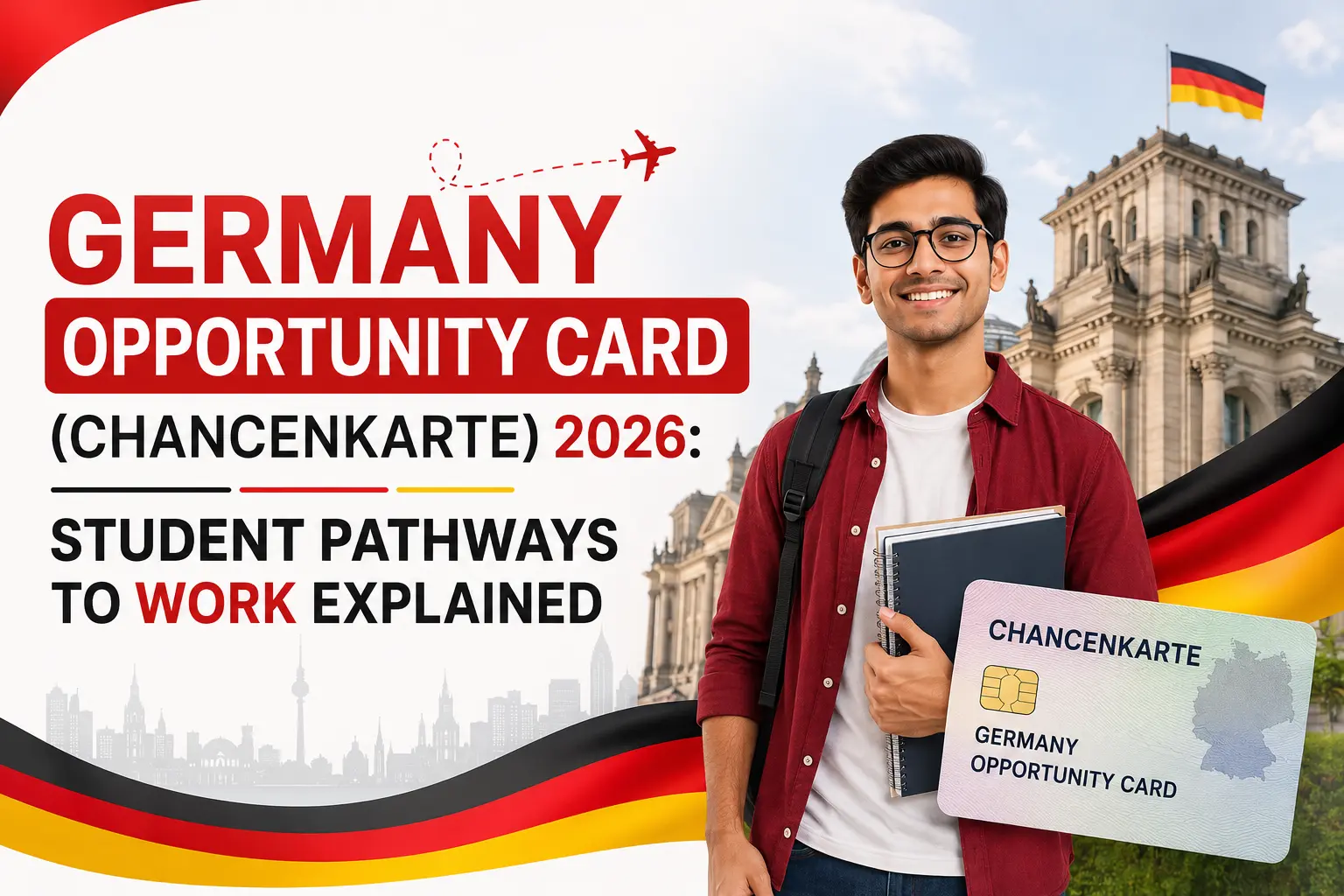
Table of Contents
Germany has become one of the most popular destinations for international students. Every year, thousands of young people choose Germany for higher education because of its low tuition fees, strong economy, and high-quality universities. But studying abroad is not just about getting a degree. Many students also want to build a career and settle in the country after graduation. To make this process easier, Germany introduced the Opportunity Card (Chancenkarte). By 2026, this system will have gained even more attention because it offers a flexible pathway for skilled workers, including international students, to stay and work in Germany. In this article, we will clearly explain what the Chancenkarte is, how it works, and how it can benefit international students planning to study in Germany and build a career after graduation.
What is the German Opportunity Card (Chancenkarte)?
The Germany Opportunity Card (Chancenkarte) is a special residence permit that allows skilled people from non-European Union (non-EU) countries to come to Germany and search for a job without having a job offer in advance. Germany introduced this system to solve its shortage of skilled workers in areas like IT, engineering, healthcare, and skilled trades.
Instead of requiring a confirmed job before entry, Germany now allows eligible candidates to enter the country and find work after arrival. The Chancenkarte works on a points-based system. This means you earn points based on your qualifications, such as your education, work experience, language skills, and age. If you meet the required points, you can apply for the card and stay in Germany for a limited time to look for a job.
Key features of the Germany Opportunity Card (Chancenkarte)-
- No job offer- The Chancenkarte allows applicants to apply without a job offer. This makes the process easier than traditional work visas and gives people the freedom to explore job opportunities after reaching Germany.
- Points system- The system is based on points earned for education, work experience, language skills, age, and connection to Germany. Applicants must meet the minimum points requirement to qualify for the card.
- Stay period- The Opportunity Card lets applicants stay in Germany for up to one year. During this time, they can search for jobs, attend interviews, and understand the job market.
- Part-time work- Cardholders can work part-time for up to 20 hours per week while looking for full-time jobs. They can also take trial jobs, which help them gain experience and improve their hiring chances.
- Qualification rules- Applicants must have a recognized qualification or meet basic criteria. This ensures that only skilled individuals enter the system and contribute to the workforce.
- Money proof- Applicants need to show financial proof, such as savings or a blocked account, to support themselves during their stay and avoid depending on public funds.
- Work switch- After finding a job, applicants can convert the card into a work visa or an EU Blue Card.
- Skilled focus- The Chancenkarte targets skilled workers in high-demand sectors like IT, healthcare, and engineering.
Why did Germany introduce the Chancenkarte?
Germany has one of the strongest economies in Europe, but it also has an aging population. Many workers are retiring, and there are not enough young people to replace them. Because of this, companies are facing serious talent shortages. To solve this issue, Germany wants to attract skilled workers from outside the European Union. So, Germany introduced the Chancenkarte to solve worker shortages and attract skilled talent from around the world.
- Worker shortage- Germany is facing a lack of skilled workers in many sectors, such as IT, healthcare, engineering, and trades. Many companies are unable to find the right employees.
- Aging population- A large number of older workers are retiring, and there are not enough young workers in Germany to replace them.
- Economic growth- Germany needs more workers to keep its economy strong and support industries that are growing fast.
- Easy immigration- Earlier visa rules were strict and required a job offer. The Chancenkarte makes the process easier by allowing people to enter first and search for jobs later.
- Global competition- Countries like Canada and Australia already attract talent through points-based systems. Germany introduced this system to compete and attract global skilled workers.
- Flexible job search- The Chancenkarte gives people time and flexibility to explore job opportunities inside Germany instead of applying from abroad.
How does the points system work?
The Chancenkarte uses a simple points-based system to select skilled people who can work in Germany. Instead of focusing on just one factor, it looks at your overall profile and gives points for different strengths.
- Basic idea: You need to score a minimum number of points, usually around 6, to qualify. The more points you have, the stronger your application becomes.
- Education: You get points if you have a recognized university degree or vocational training. Higher qualifications usually give more points.
- Work experience: You earn points based on how many years of relevant work experience you have. More experience increases your chances.
- Language skills- You can earn points for knowing German or English. German language skills usually give more advantage because most jobs require them.
- Age factor: younger applicants, especially those under 35, usually receive more points because they can work longer and adapt easily.
- Germany connection: You get extra points if you have studied, worked, or stayed in Germany before, or if you have family connections there.
- Simple summary: The system checks your skills, experience, and background together. If you meet the required points, you can apply for the Chancenkarte and go to Germany to search for a job.
Can international students use Chancenkarte?
Yes, international students can use the Chancenkarte, but it is mainly helpful as an alternative or backup option rather than the main pathway. Moreover, it also depends on their situation and where they studied.
- Students in Germany- If you study in Germany, you usually do not need the Chancenkarte. After graduation, you already get an 18-month job search visa. This makes it easier for you to find a job and switch to a work visa.
- Backup option- If you do not find a job within the allowed time, you may have to leave Germany. In that case, you can apply for the Chancenkarte later and return to search for a job again. It works like a second chance.
- Students outside Germany- If you studied in another country, the Chancenkarte is very useful. It allows you to come to Germany and look for a job without needing a job offer.
- Points requirement- Students must still meet the points criteria. This includes having a recognized degree, some work experience, if possible, and language skills.
- Easy or not- For students in Germany, switching to work is already easy, so the Chancenkarte is not always needed. For students outside Germany, it creates a new and flexible pathway to enter the German job market.
What are the main pathways for students in Germany to stay and work after graduation?
Germany offers clear and student-friendly pathways that make it easier to stay and build a career after completing your studies.
- Post-study visa- After graduation, students can apply for an 18-month job search visa. This allows them to stay in Germany, look for jobs, and even work in any field while searching for a role related to their degree.
- Work visa- Once a student finds a job related to their qualification, they can switch to a work visa. This is a direct step toward long-term employment in Germany.
- EU Blue Card- If the job offers a higher salary and meets certain requirements, students can apply for the EU Blue Card. This option provides faster permanent residency and better benefits for skilled professionals.
- Chancenkarte- The Opportunity Card acts as a backup option. If a student cannot find a job within the allowed time or leaves Germany, they can apply for the Chancenkarte later to return and search for work again.
Can Students Switch Easily?
Yes, students in Germany can switch from study to work quite easily, but it depends on their situation and preparation.
- After graduation, Students who complete their degree in Germany get an 18-month job search visa. This gives them enough time to find a job, attend interviews, and start working. Because of this, the transition is usually smooth.
- Job requirement- To switch to a work visa, students must find a job related to their field of study. If they meet this condition, the process becomes simple and direct.
- Language factor- Students who know German have better chances of getting hired quickly. Without language skills, the process may take longer.
- Demand fields- Those studying in high-demand fields like IT, engineering, and healthcare can switch more easily because job opportunities are higher.
- Backup option- If students do not find a job in time, they can use options like the Chancenkarte to return and search again, which reduces risk.
What are the advantages of the German Opportunity Card (Chancenkarte) 2026?
- The Chancenkarte allows you to move to Germany without a job offer, which makes the process easier and gives you the freedom to search for jobs after reaching the country.
- It uses a simple points-based system that considers your education, work experience, language skills, and age, making the selection process more flexible and fairer.
- You can stay in Germany for up to one year, which gives you enough time to explore the job market, attend interviews, and find a suitable job.
- You are allowed to work part-time for up to 20 hours per week while searching for a full-time job, which helps you manage your expenses.
- You can also take part in trial jobs with employers, which helps you gain practical experience and improve your chances of getting hired.
- The Chancenkarte gives you direct access to the German job market, allowing you to meet employers and build professional connections more easily.
- Once you find a job, you can switch to a work visa or EU Blue Card, which can lead to long-term settlement in Germany.
- It focuses on skilled workers in high-demand fields like IT, engineering, and healthcare, which increases job opportunities for qualified applicants.
What challenges should students know before applying for the Chancenkarte?
- Money needed: Students must show proof of funds to support themselves in Germany. Managing living expenses without a full-time job can be difficult.
- Job competition- Many skilled people from different countries apply, so competition for jobs can be high.
- Language gap: Not knowing German can make it harder to find jobs and adjust to daily life.
- Degree approval: Your qualification must be recognized in Germany, which can take time and effort.
- Limited time: The Chancenkarte is valid for a limited period, so students must find a job within that time.
- Job match- Students need to find a job that matches their skills and qualifications, which is not always easy.
Why is the German language important for students and job seekers in Germany?
- Better job chances- Knowing German increases your chances of getting a job because many companies prefer employees who can communicate in the local language.
- More job options- Many roles, especially in small and medium companies, require German. Without it, your job options may become limited.
- Easy communication- German helps you communicate with colleagues, clients, and people in daily life, making your experience smoother.
- Workplace growth- Employees who speak German often grow faster in their careers because they can take part in meetings, training, and leadership roles.
- Daily life comfort- From shopping to handling paperwork, German makes everyday tasks easier and less stressful.
- Strong integration- Language helps you connect with people, understand the culture, and feel more comfortable living in Germany.
What are the financial requirements for Chancenkarte?
To apply for the Chancenkarte, you must prove that you can support yourself financially while living in Germany. The government has set a fixed minimum amount for this.
- Required amount- You need to show about €1,091 per month, which means around €13,092 for one year. This amount is based on the estimated cost of living in Germany.
- Blocked account- The most common way to show proof is through a blocked account (Sperrkonto). You deposit the full amount in a German bank, and then you can withdraw a fixed amount every month for your expenses.
- Alternative options- Instead of a blocked account, you can also show financial proof in other ways. For example, a formal sponsorship (Verpflichtungserklärung) from someone in Germany or a part-time job contract can be accepted if it covers your living costs.
- Monthly access- Even if you deposit the full amount, you can only withdraw around €1,091 per month. This ensures that your money lasts for your entire stay.
Let’s compare both- Chancenkarte vs Traditional Work Visa-
For students, the traditional route (post-study work visa) is still easier. But Chancenkarte adds flexibility.
Feature | Chancenkarte | Work Visa |
Job Offer Required | No | Yes |
Flexibility | High | Low |
Entry Purpose | Job Search | Employment |
Risk | Higher (no job guarantee) | Lower |
Will Chancenkarte Replace Student Pathways?
No, the Chancenkarte will not replace student pathways in Germany. It serves a different purpose and acts as an additional option rather than a substitute. The Chancenkarte is mainly designed for skilled workers who want to enter Germany and search for a job without having a job offer in advance.
Student pathways are already well-established and provide a smooth transition from education to employment. International students in Germany can stay for up to 18 months after graduation to look for a job and then switch to a work visa or EU Blue Card. These benefits make the student route one of the easiest ways to settle in Germany. The Chancenkarte simply adds more flexibility. It helps those who studied outside Germany or need a second chance to find work, while student pathways remain the primary route.
Future of Chancenkarte in 2026 and beyond-
Germany’s Chancenkarte is expected to become a key part of its immigration system in the coming years. The country is facing a continuous shortage of skilled workers, and this demand will grow further as more people retire and fewer young workers enter the workforce. Because of this, Germany will depend more on global talent, making the Chancenkarte even more important.
The government is also working to make the process faster and simpler. By 2026 and beyond, visa procedures are likely to become more streamlined, helping applicants enter Germany more easily and start their job search without long delays. At the same time, opportunities will expand across different sectors like healthcare, construction, logistics, and engineering, not just IT. The Chancenkarte is part of long-term immigration reforms, which show strong policy support. In the future, it will act as a major pathway for skilled workers to enter Germany, find jobs, and move toward long-term careers and settlement.
Conclusion-
Germany’s Opportunity Card (Chancenkarte) 2026 has made it easier for skilled people to enter the country and search for jobs without a job offer. For international students, the pathway from study to work is already smooth, especially with the 18-month post-study job search visa. Because of this, most students in Germany can switch to work quite easily if they prepare well, gain skills, and start job hunting early.
The Chancenkarte does not replace student pathways but supports them. It acts as a backup option for those who could not find a job in time or for students who studied outside Germany and want to explore opportunities there. With the right planning, language skills, and field of study, students can successfully move from education to employment. Overall, Germany continues to offer strong career opportunities, and the Chancenkarte adds more flexibility and security for future job seekers.
FAQs on Germany Opportunity Card
Q.1 What is the Chancenkarte?
Ans- It is a residence permit that allows skilled people to enter Germany and search for a job without a job offer.
Q.2 Can students in Germany switch to work easily?
Ans- Yes, students can switch easily after graduation using the 18-month job search visa.
Q.3 Is a Chancenkarte needed for students in Germany?
Ans- Not always, because students already have a direct pathway to work after studies.
Q.4 Can students apply for Chancenkarte later?
Ans- Yes, if they do not find a job, they can apply later as a second option.
Q.5 How long can you stay with Chancenkarte?
Ans- You can stay for up to one year to search for a job.
Q.6 Can you work while holding Chancenkarte?
Ans- Yes, you can work part-time and do trial jobs.
Q.7 What is the minimum points requirement?
Ans- Usually, you need around 6 points based on skills and qualifications.
Q.8 Do you need German language skills?
Ans- It is not always mandatory, but it greatly improves job chances.
Q.9 Can Chancenkarte lead to permanent residence?
Ans- Yes, after getting a job, you can switch to a work visa and later apply for PR.
Q.10 Who benefits most from Chancenkarte?
Ans- Skilled workers and students who studied outside Germany benefit the most.
Author
Sakshi Taneja
Content Writer & International Education Specialist
Sakshi Taneja is a content writer specializing in international education, study abroad opportunities, university admissions, student visas, scholarships, and career guidance. She creates accurate, research-driven, and student-focused content to help aspiring international students make informed decisions about their global education journey.
Comments (0)
No comments yet
Comments are temporarily closed.
Contact Details
Please provide your contact information
Free Counselling
Latest Articles
Germany Blue Card Benefits for International Graduates in 2026
Oct 24, 2026
STEM vs. Non-STEM Degrees in 2026: Jobs, Salaries & Visa Opportunities Abroad
Oct 23, 2026
PAL vs TAL: The New Canadian Visa Step Every Student Must Know
Oct 22, 2026
Collateral vs. Non-Collateral Loans: How to Fund Your Studies in 2026
Oct 21, 2026
Germany vs UK Study Costs 2026: Tuition Fees, Living Costs & Scholarships
Oct 16, 2026
Categories
Have a question about Articles?
Want some help figuring out what kind of information you need?
Help and Support