
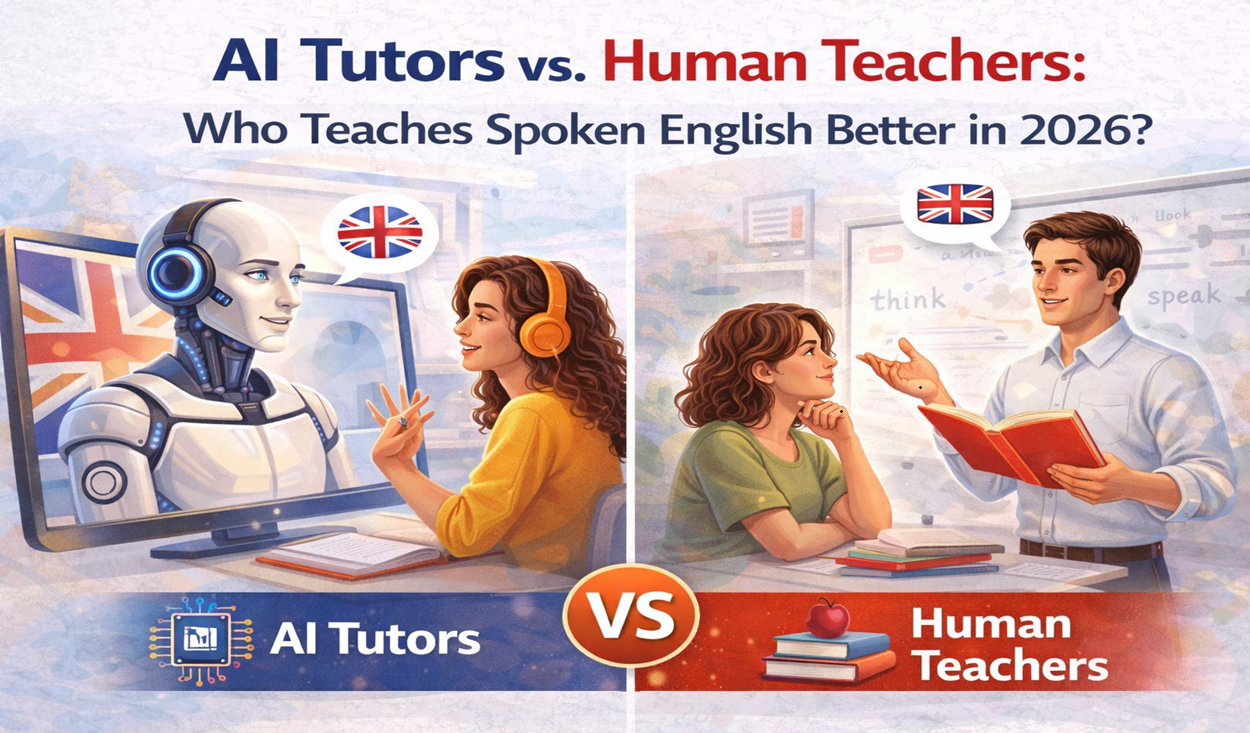
Spoken English sits at the intersection of accuracy, fluency, confidence, and cultural nuance. In 2026, learners face more choices than ever: polished AI tutors with instantaneous feedback, large language model (LLM) conversation partners, specialized pronunciation apps, and human teachers who bring empathy, mentorship, and classroom experience. This post examines both sides of the aisle. I’ll compare strengths and weaknesses, summarize key research, and offer practical guidance so learners, schools, and managers can choose what actually teaches spoken English better for their goals.
I write this with an eye on recent evidence, real products, and classroom practice. I use transitional signposts throughout so that you can follow the argument easily: first background, then evidence for AI, then evidence for human teachers, followed by hybrid models, ethical and logistical considerations, and final recommendations.
What do you mean by “AI tutors”, and what do they actually do?
AI tutors are digital teaching systems powered by artificial intelligence, designed to help learners practice and improve specific language skills—especially speaking, pronunciation, vocabulary, and fluency. These tutors use technologies like speech recognition, language models, machine learning, and text-to-speech to interact with learners in a natural, conversation-like manner.
They don’t replace human teachers but serve as virtual assistants or practice partners that guide learners individually at any time. Moreover, an AI tutor includes several distinct technologies, such as
- LLM-based conversation partners- chatbots or voice agents that simulate dialogue, ask questions, and respond conversationally.
- Pronunciation & fluency coaches- apps that analyze acoustic features and give targeted correction (for example, ELSA-type systems).
- Adaptive practice systems- platforms that personalize exercises and re-teach weaknesses using automated diagnostics.
- Automated assessment tools- scoring systems that evaluate pronunciation, fluency, and even content coherence.
These systems operate at scale. They give instant feedback, log progress, and adapt to performance patterns. They also integrate speech recognition, TTS (text-to-speech), and increasingly capable LLMs to hold sustained spoken exchanges. Companies and platforms scaled this model aggressively in 2024–2026, and significant language apps now embed generative-AI features to create personalized speaking tasks at speed.
How does AI Tutor work?
- Speech recognition: Understanding what you say- An AI tutor begins by listening to your voice through your device’s microphone. It uses advanced speech recognition technology to convert your spoken words into text. This system analyzes pronunciation, accent, speed, and clarity to understand precisely what you are saying. Once the speech is converted into text, the AI can interpret your message and prepare an appropriate response.
- Natural language processing: Interpreting meaning- After converting speech to text, the AI uses natural language processing to understand the meaning behind your words. It identifies grammar structures, vocabulary choices, intentions, and emotional tone. It helps the AI figure out whether you are asking a question, giving an answer, making a mistake, or needing assistance. This step ensures that the conversation feels natural and relevant.
- Machine learning: Learning from your performance- AI tutors continuously learn from your behaviour and progress. When you interact with the system, it automatically records your strengths, weaknesses, and patterns of mistakes. Over time, the AI identifies which skills you need to improve, such as pronunciation, fluency, grammar, or vocabulary. It then adjusts your future lessons to suit your needs, creating a personalized learning path.
- Real-Time feedback: Correcting mistakes immediately- One of the core functions of an AI tutor is its ability to give instant feedback. When you mispronounce a word or make a grammatical error, the AI highlights the mistake and explains how to fix it. This immediate correction helps learners improve quickly because they can practice again right away. The AI also provides suggestions, examples, and improved sentences to guide you toward better accuracy.
- Generative response system: Creating human-like conversation- Using large language models, the AI tutor generates natural and meaningful responses. It can ask follow-up questions, offer explanations, create conversation topics, and simulate real-life dialogues. This ability makes practice engaging, as the AI can act like an interviewer, a friend, a travel guide, or even a colleague in a business meeting. The goal is to give you a realistic environment for improving spoken English.
- Text-to-speech: Speaking back to you- Once the AI prepares a response, it uses text-to-speech technology to speak in a natural voice. Modern AI tutors offer multiple voice options and accents, such as American, British, or Australian English. It allows learners to listen closely to pronunciation, intonation, and rhythm, helping them develop a more natural speaking style.
- Performance tracking: Measuring your improvement- AI tutors continuously track your progress. They measure pronunciation accuracy, fluency rate, hesitation, error patterns, vocabulary usage, and sentence structure. This data is organized into reports and dashboards that show how your skills improve over time. These insights help learners understand their progress and set clearer goals.
- Personalization engine: Creating customized lessons- Based on your performance data, the AI adjusts lessons, difficulty levels, conversation topics, and practice sessions. A beginner may receive simple sentence-building tasks, while an advanced learner may get debates or interview simulations. This personalized approach ensures that each learner receives exactly the support they need.
What do human teachers bring to spoken-English learning?
Human teachers offer a mix of professional judgment, emotional intelligence, and social mediation that machines cannot replicate fully. Specifically, teachers:
- Emotional understanding: They sense a learner’s confidence level, anxiety, or hesitation and adjust their approach accordingly.
- Personalised feedback: Human teachers provide detailed corrections on pronunciation, tone, grammar, and clarity based on individual needs.
- Natural conversation practice: They create authentic, spontaneous dialogues that build fluency and help learners think in English.
- Cultural context: Teachers explain idioms, expressions, and cultural nuances that improve authentic communication.
- Real-time adaptation: They modify lessons instantly depending on the learner’s progress, mood, and learning pace.
- Confidence-building: Through encouragement and positive interaction, they help students overcome the fear of speaking.
- Interactive learning environment: Teachers engage learners through discussions, role-plays, storytelling, and debates.
- Human warmth & motivation: Their presence makes the learning experience supportive, inspiring, and enjoyable.
- Holistic evaluation: They notice body language, tone shifts, and speaking patterns that AI may miss.
In short, teachers shape not only linguistic competence but also learner identity and confidence. Consequently, human teachers remain irreplaceable for nuanced, high-stakes, or interpersonal skill development.
What do current research and available studies reveal about the effectiveness of AI tutors in teaching spoken English?
Multiple controlled studies and reviews in the 2023–2026 window show that AI systems produce measurable improvements in specific speaking subskills. Researchers found that when AI tutors provide immediate corrective feedback, learners improve pronunciation accuracy, increase speaking time, and reduce anxiety in practice sessions. For example, randomised and quasi-experimental studies reported learning gains when students practised with AI partners compared with unguided practice.
Moreover, studies evaluating AI conversation bots found that these systems act as “virtual MKOs” (more knowledgeable others) within learners’ zones of proximal development by scaffolding just enough to push speaking ability forward. Learners reported feeling less judged and more willing to take risks in conversation with AI agents, a factor that translates into more practice and, therefore, faster improvement in fluency.
Finally, specialized pronunciation systems now use acoustic models and targeted drill sequences to reduce error rates for specific phonemes and intonation patterns. In practice, these tools consistently improve segmental accuracy (individual sounds) and give clear visual and auditory cues that speed learning for many users.
In which areas does AI clearly excel, and what are its concrete strengths in spoken-English learning?
- Scale and availability. AI tutors run 24/7 and accept unlimited practice requests. Students can practice anytime, which increases cumulative speaking time — the single strongest predictor of improvement. Consequently, learners who use AI daily often log more practice hours than peers who rely only on scheduled classes.
- Instant, consistent corrective feedback. AI gives immediate pronunciation scores and error flags. For repeatable motor skills like articulation, that quick loop accelerates improvement.
- Personalization. Adaptive systems tailor prompts and difficulty based on user performance. So, beginners and advanced learners receive tasks at appropriate challenge points.
- Reduced speaking anxiety. Many learners talk more freely to a nonjudgmental agent. Reduced anxiety yields longer practice sessions and more risk-taking — both essential for fluency development.
- Data-driven progress tracking. AI logs measurable metrics (words per minute, pause length, pronunciation scores) and turns them into dashboards that both learners and institutions can use.
- Cost efficiency for drill-based learning. Where budgets are tight, AI scaling can make regular speaking practice affordable for large cohorts.
Where does AI fall short in spoken-English learning?
- Pragmatic and cultural nuance. AI still struggles to coach on subtleties like politeness strategies in different cultures or context-dependent register shifts. Human teachers interpret context and social meaning far better.
- Deep error diagnosis. Machines often flag an error, but they cannot always explain why a learner made that error in a way that helps the learner self-correct strategically. Teachers supply multi-layered explanations and analogies.
- Emotional scaffolding. Motivation and confidence-building rest heavily on relationships; teachers provide care, encouragement, and personalized encouragement that significantly affect persistence.
- Assessment validity in unconstrained speech. Automated scoring shows reliability in controlled tasks, but it still struggles with open-ended, content-rich speaking where coherence, nuance, and persuasion matter. Researchers call for improved assessment in uncontrolled tasks.
- Ethical and fairness concerns. Speech recognition often works better for accents and demographic groups represented in training data. Therefore, AI can unintentionally disadvantage specific learners unless developers intentionally address bias.
What does research show about the effectiveness of human teachers in spoken English learning?
- Better pronunciation improvement- Studies show learners achieve more natural intonation, rhythm, and stress patterns when guided by trained human instructors.
- Higher speaking confidence- Research highlights that supportive teacher–student interactions reduce anxiety and boost willingness to communicate.
- Stronger conversational skills- Human teachers create authentic, meaningful dialogues that mirror actual social communication, improving fluency and spontaneity.
- Effective error correction- Teachers use context-sensitive feedback—explaining why an error occurred, not just correcting it.
- Enhanced cultural understanding- Research shows learners gain cultural competence (idioms, social cues, tone) more effectively through human teaching.
- Better learner engagement- Classroom studies indicate students stay more motivated and focused with human guidance.
- Personalized scaffolding- Teachers adjust explanations, activities, and examples based on each student’s emotional state and learning style.
- Holistic evaluation- Human teachers observe body language, hesitation, confidence levels, and non-verbal cues, factors crucial for spoken communication.
What do you mean by Hybrid models, which is the best of both worlds?
“Hybrid models” in spoken-English learning refer to an approach that combines the strengths of both AI tutors and human teachers. Instead of depending on only one, learners get a balanced system where each fills the gaps of the other. They pair-
- AI for volume and drill (daily pronunciation, timed speaking tasks, automated feedback)
- Human teachers for calibration and nuance (strategy, cultural norms, complex feedback, motivation)
Students learn more quickly and efficiently when these two are together. While human teachers concentrate on real-world communication, soft skills, and more profound comprehension, AI takes care of repeated drills and pronunciation practice.
Several studies and large-scale rollouts in 2024–2026 documented this approach. For instance, institutions that used AI for formative practice and teachers for summative coaching reported higher overall gains and better student satisfaction than those relying on either AI or teacher-only models. The AI reduced routine burdens on instructors, freeing teachers to do what humans do best: mentor, adapt, and humanize the learning experience.
Practical advice for learners in 2026-
You should choose tools and schedules that match your real goals. Here’s a practical decision rubric:
- Pronunciation & intelligibility for everyday conversation- Use AI pronunciation coaches daily and pair them with occasional human feedback to correct persistent errors.
- Fluency and reducing speaking anxiety- Practice with AI conversation bots to build speaking time and confidence; then rehearse high-stakes scenarios with teachers or peers.
- Professional presentations, interviews, or cross-cultural negotiation- Prioritize human coaching. Use AI for preparatory drills but rely on trained teachers for strategic and cultural coaching.
- Exam preparation (IELTS/TOEFL speaking tasks that are structured)- Combine automated scoring for timed practice with teacher feedback on content organization and communicative strategies.
- Continuous learning on a budget- Lean on AI for daily practice and use community-based language exchanges for social practice. Purchase occasional teacher-led sessions for benchmarks and troubleshooting.
Across all goals, track speaking time, monitor progress metrics, and ask human teachers for error explanations that AI cannot deliver.
Implementation tips for institutions and trainers
If you run a language centre or design curricula, follow these principles:
- Integrate AI as formative support, not final authority. Use AI for practice and repeat drills; make teachers responsible for summative assessment and nuanced feedback.
- Train teachers to interpret AI analytics. Dashboards show metrics, but teachers must translate those metrics into targeted lesson plans.
- Address fairness and bias. Validate AI with your learner population and supplement with human review for underrepresented accents.
- Design tasks that mix open-ended and controlled practice. Alternate AI drills with teacher-led debates, storytelling, and group problem-solving.
- Protect privacy and explain data use. Learners should know how recorded speech data is stored and processed.
Assessment, validity, and high-stakes testing-
Automated scoring performs well in controlled speaking tasks (short prompts, read-aloud, or structured responses), but it still struggles with free speech where coherence, persuasion, and content depth matter. Researchers have urged caution when using AI for high-stakes decisions; they recommend human-in-the-loop assessment for any consequential judgments (e.g., admissions or licensure). Meanwhile, hybrid assessment models — automated pre-screening followed by human moderation — show promise as practical compromises.
Equity, access, and ethical considerations-
AI offers remarkable access: learners in remote regions can now practice with native-like models whenever they want. Yet the technology poses risks:
- Bias in speech recognition. Models may misrecognize accents underrepresented in their training data, which can frustrate and demotivate learners unless developers address inclusivity.
- Data privacy. Spoken data can reveal identity. Institutions must obtain informed consent and secure speech records.
- Commercialization pressures. Companies may push AI as a cost-saving substitute for teachers — a move that risks eroding quality if institutions prioritize short-term savings over learning outcomes. Analysts and educators have already flagged concerns about an “AI-first” rush in which developer incentives outpace pedagogical safeguards.
The human-AI partnership: designing for synergy
The future of technology is not about replacing humans but creating systems where humans and AI work together. A well-designed partnership enhances productivity, creativity, and decision-making.
· Why do humans and AI need each other?
Humans bring empathy, context, ethics, and emotional intelligence. AI contributes speed, automation, pattern recognition, and data-driven insights. Combining these strengths leads to better results than either could achieve alone.
· Principles of Effective Synergy-
A successful human–AI partnership requires human-centred design, where technology adapts to people. Transparency, explainability, and user control build trust. Shared autonomy ensures humans supervise high-stakes decisions while AI manages repetitive or complex tasks. Continuous feedback loops help AI improve while empowering humans to learn from AI-generated insights. If you want spoken-English programs to perform at scale, design them for human-AI synergy:
§ Automate routine drills (pronunciation, word stress, repetition).
§ Reserve teachers for strategy and social skills. Let humans model persuasion, humour, and cultural nuance.
§ Use AI analytics to inform teacher action. Teachers should get summarized suggestions: “these students struggle with final consonants,” rather than raw logs.
§ Create cycles of practice and reflection. After AI practice, have learners reflect and discuss mistakes with teachers or peers.
§ Iterate and validate. Continuously measure learning outcomes and adjust the blend of AI and human instruction based on data.
This design logic helps everyone: learners get frequent practice; teachers work at the highest-value tasks; institutions scale responsibly.
Cost and scalability: cold math and warm learning-
AI reduces the marginal costs of additional practice hours, which translates into wider access and lower per-learner cost for drill-based components. However, human-led coaching still carries fixed personnel costs. Therefore, an institution can achieve both reach and depth by automating routine practice while preserving human-led formative checkpoints. In many deployments, this hybrid method produced superior cost-effectiveness compared to enlarging class sizes or relying on human-only extra sessions. Economic analyses in 2024–2026 support this blended investment approach for institutions that care about both reach and quality.
What are the common mythologies and evidence that busts them?
- AI will replace all human jobs- Research shows that AI replaces specific tasks rather than entire professions, allowing humans to focus on roles requiring judgment and creativity. Reports from the World Economic Forum highlight that while some routine jobs may shift, new opportunities emerge in areas such as AI monitoring, data analysis, creative work, and human-centred services. Skills like empathy, ethics, negotiation, leadership, and emotional understanding remain uniquely human and cannot be replicated fully by machines.
- AI is always accurate- AI accuracy depends entirely on the quality of the data it is trained on, and it can produce errors when exposed to biased or incomplete information. Studies in fields like medical diagnosis and facial recognition show that AI performance varies across contexts and demographic groups. Human oversight continues to be essential to interpret results, correct mistakes, and ensure decisions are reliable.
- AI understands emotions as humans do- AI can analyze vocal tones or facial expressions, but it does not genuinely feel or comprehend emotions. Human emotional intelligence, shaped by lived experiences, forms the basis of empathy, compassion, and cultural sensitivity. Because of this, human presence remains crucial in areas such as counselling, teaching, and leadership.
- AI learns on its own without risk- AI systems learn from human-created data, which means biased or flawed inputs can lead to biased outcomes. Research shows that without human corrections, AI may reinforce harmful patterns in recruitment, policing, or financial modelling. Continuous human supervision ensures fairness and ethical results.
- AI creativity is the same as human creativity- AI generates content by rearranging patterns found in existing data, while human creativity is driven by imagination, emotion, and personal experience. Truly innovative results appear when humans guide AI-generated ideas, refine them, and add originality.
- AI is neutral and objective- AI systems reflect the biases of the data and developers behind them, which has been proven through studies revealing racial, gender, and socioeconomic disparities in algorithmic decisions. Ethical design and diverse human teams are essential for fairness.
- Humans become less critical as AI gets smarter- Research on human–machine collaboration shows that the best outcomes occur when humans contribute context, judgment, and ethics. At the same time, AI provides speed and analytical power. Industries such as medicine, aviation, finance, and education perform best when humans and AI work together.
- AI can make perfect decisions because it uses data. Data-driven decisions still require human interpretation, especially when information may be outdated or incomplete. Human judgment ensures decisions align with ethical values, cultural realities, and long-term goals.
- Using AI means giving up control- Modern AI design promotes shared autonomy, allowing users to decide how and when AI should assist. Explainable AI tools help people understand and override AI suggestions, ensuring that humans remain in charge.
- AI will eventually think exactly like humans- AI processes information mathematically rather than emotionally or experientially. Human thinking is shaped by memory, emotion, culture, and consciousness—qualities AI does not possess. Human and machine intelligence are fundamentally different, and AI cannot replicate the depth of human cognition.
Recommendations for teachers, learners, and edtech builders-
- For teachers- Embrace AI as a co-teacher. Learn to interpret AI analytics, design tasks that build on AI practice, and advocate for ethical AI use in your institution.
- For learners- Use AI for daily practice and reserve human sessions for benchmarking and tackling persistent errors. Track your speaking time; minutes add up to mastery.
- For edtech builders- Prioritize fairness in speech recognition, improve model transparency, and design human-in-the-loop workflows for high-stakes assessment. Also, include culturally diverse speech data and give teachers easy-to-read analytics that inform instruction.
Where do we stand in 2026?
In 2026, spoken English learning has reached a balanced point where AI tutors and human teachers work side by side rather than competing against each other. AI has become highly advanced, offering real-time pronunciation analysis, personalized feedback, and unlimited practice sessions. It supports learners with convenience and consistency that traditional classrooms cannot always match. At the same time, human teachers remain irreplaceable for building confidence, teaching emotional expression, correcting subtle mistakes, and offering cultural and conversational depth. Students benefit most from a blended approach, using AI for intensive practice and human teachers for mentorship and real-life communication skills. Instead of choosing one over the other, the world in 2026 recognizes that both AI and human teachers play essential roles in developing strong spoken English abilities. Together, they create a more flexible, engaging, and effective learning ecosystem than ever before.
Conclusion-
In 2026, the debate between AI tutors and human teachers is no longer about who is better, but about how each contributes uniquely to spoken English learning. AI tutors offer personalized practice, instant feedback, and unlimited access—making them powerful tools for mastering pronunciation, fluency, and daily speaking drills. However, human teachers bring emotional understanding, cultural nuance, motivation, and real conversational depth that AI still cannot replicate. Effective spoken English learning requires confidence, empathy, and context, all of which are strengthened through human interaction. The most successful learners are those who combine both: using AI for intensive practice and human teachers for guidance, correction, and authentic communication. Therefore, the future of spoken English education lies in a hybrid model where AI enhances learning efficiency while human teachers enrich learning quality. Together, they create a balanced, dynamic, and highly effective learning experience.
FAQs on AI Tutors vs. Human Teachers: Who Teaches Spoken English Better in 2026
Q1. Which is better for spoken English in 2026—AI tutors or human teachers?
Ans- Both excel in different areas. AI is excellent for practice and feedback; humans are better for real interaction and cultural context.
Q2. Can AI tutors improve pronunciation effectively?
Ans- Yes. AI offers instant, accurate pronunciation analysis and helps learners practice anytime.
Q3. Do human teachers still matter if AI is advanced?
Ans- Absolutely. Humans provide empathy, motivation, and natural conversation skills that AI cannot fully replicate.
Q4. Are AI tutors good for beginners?
Ans- Yes, they help build confidence and practice basic structures, but beginners still benefit from human guidance.
Q5. Can AI teach grammar and fluency?
Ans- AI can teach grammar rules and offer fluency exercises, but humans help refine natural speaking patterns.
Q6. Which is more affordable—AI or human teachers?
Ans- AI tutors are generally cheaper and available 24/7.
Q7. Can AI understand emotions in conversations?
Ans- AI can recognize tone patterns but cannot truly understand or respond with genuine empathy.
Q8. Do human teachers help with accent and confidence?
Ans- Yes. They offer personalized correction, encouragement, and real-world communication practice.
Q9. Is a combination of AI and human teaching effective?
Ans- Very. Hybrid learning provides the precision of AI and the depth of human interaction.
Q10. Will AI replace human English teachers in the future?
Ans- No. AI will assist, not replace. Human teachers remain essential for meaningful, interactive learning.






Leave a Comment
Your email address will not be published.